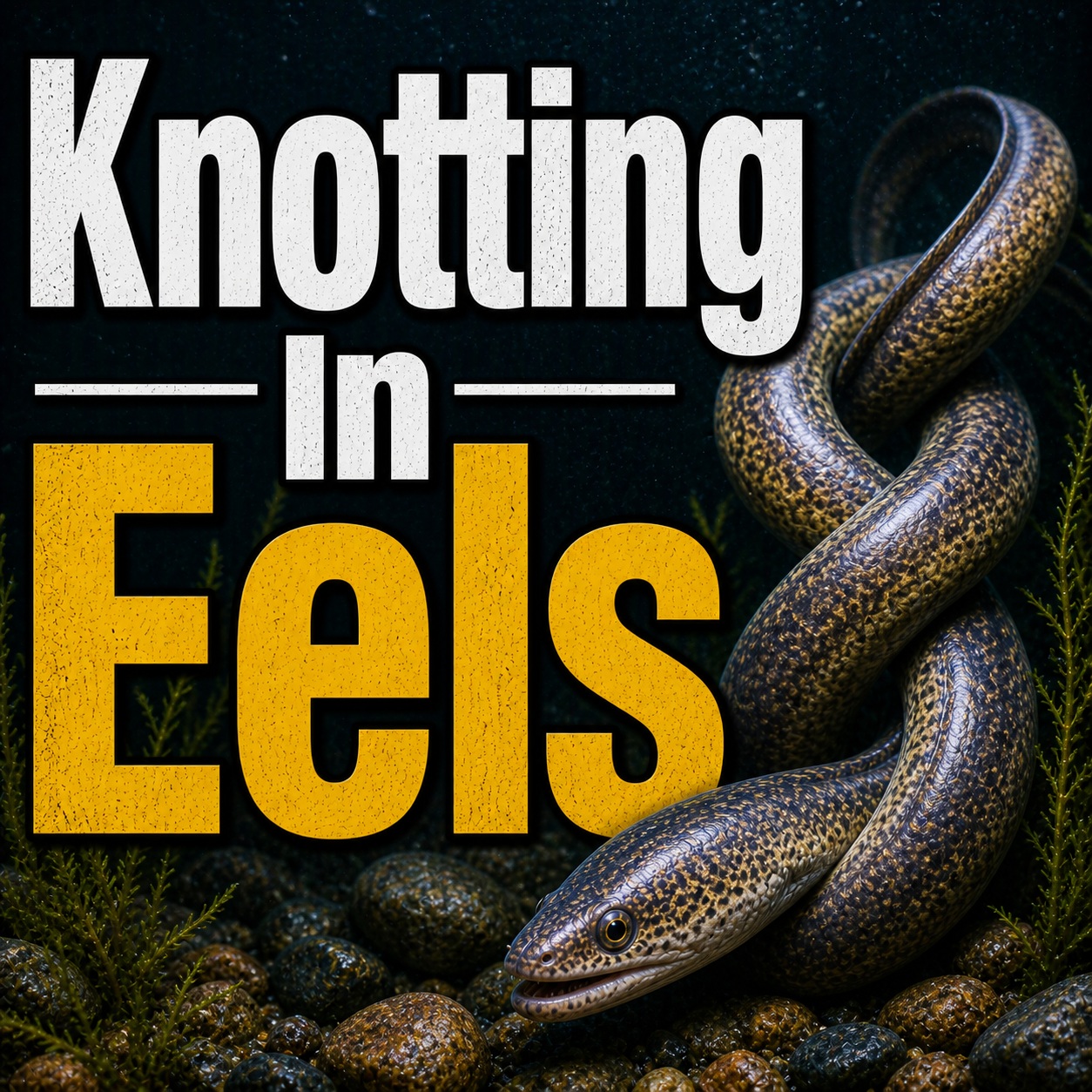
In the predatory world of the ocean, having no limbs is a significant disadvantage. Without arms to hold down prey or hands to scrape off parasites, most fish are limited by what they can do with their mouths alone. However, eels have evolved a “physics-defying” workaround known as knotting.
By twisting their elongated, flexible bodies into a literal overhand knot, eels create mechanical leverage that allows them to perform tasks that would otherwise be impossible for a limbless animal.
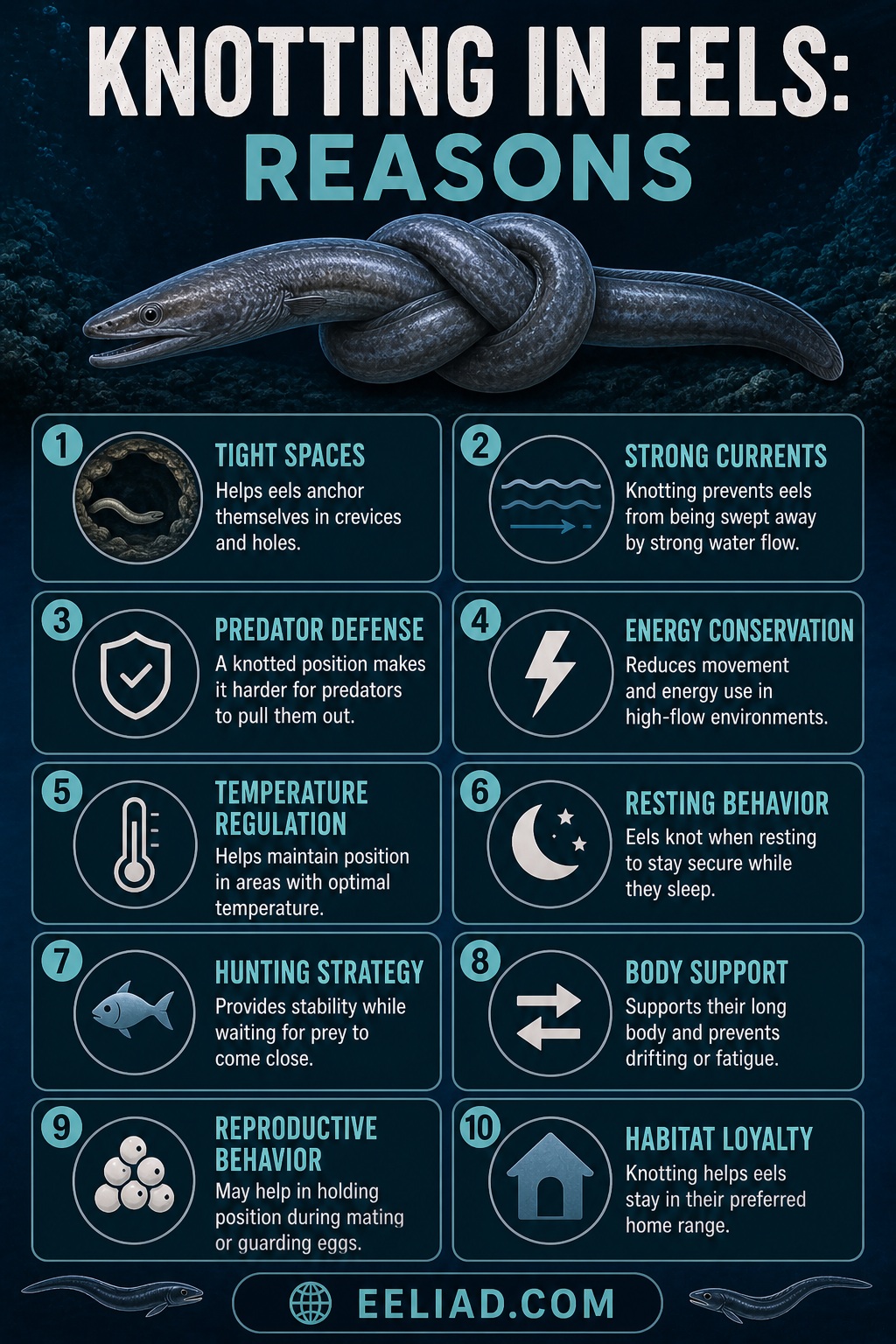
10 Reasons for Knotting in Eels
Eels, particularly moray eels and the unrelated hagfish (often called “slime eels“), tie themselves in knots for several specialized behavioral and physiological reasons.
Here are the main reasons why eels form knots:
- Leverage for Feeding: Morays use knots to gain leverage against large prey that is too big to swallow whole.
- Tearing Prey: By passing their tail forward and tightening a loop, they can rip chunks of flesh off prey.
- Moving Food Down the Throat: A knot can be moved forward along the body to push food down toward the stomach.
- Extracting Hidden Prey: Knots provide leverage to pull prey out of holes and crevices in reefs.
- Removing Excess Mucus (Hagfish): Hagfish produce massive amounts of slime when threatened and use a sliding knot to “squeegee” the slime off their bodies so they do not choke.
- Removing Parasites (Hagfish): Similar to clearing slime, a traveling knot helps scrape off external parasites and debris.
- Providing a Makeshift Jaw: Hagfish lack proper jaws, so they tie their tail into a knot to create a hard, flat surface to act as a brace, allowing them to pull food items.
- Stabilizing Body Position: The knot acts as an anchor to assist in maneuvering in tight, complex, or low-complexity habitats.
- Escape Mechanisms: The ability to pull their head through a knot can help them escape tight spaces or potentially from a predator’s grip.
- Reproductive Rituals: Some species of eels have been observed twisting and intertwining with each other during breeding.
1. The Mechanics of the Maneuver
Knotting is a display of incredible spinal flexibility. The eel initiates the process by looping its tail over its midsection and through the gap, forming a classic knot. Once the knot is formed, the eel can “slide” the knot along its body by rippling its muscles.
This isn’t just a random squiggle; it is a controlled, high-torque movement that serves three primary purposes: feeding, defense, and grooming.
2. Feeding: The “Biological Nutcracker”
Because eels (especially morays) live in tight crevices, they cannot use the high-speed “shake and tear” method that sharks use to break apart large prey. Instead, they use the knot for leverage.
- Tearing Flesh: When an eel bites into a large carcass, it ties a knot in its tail and slides the knot forward until it reaches its own head. By pressing the knot against the prey while pulling its head back, the eel creates enough force to rip off chunks of meat.
- Crushing Shells: Some species use the knot to exert immense pressure on hard-shelled prey like crabs, acting like a biological nutcracker to reach the meat inside.
3. Defense: The Great Escape
If a predator—such as a shark or a larger eel—manages to grab an eel’s tail, the eel doesn’t just pull away.
The “Push-Off” Strategy: The eel ties a knot near its head and slides it down toward the predator’s mouth. When the knot hits the predator’s jaws, it provides a solid surface for the eel to push against. This allows the eel to literally “launch” itself out of the attacker’s grip with far more force than simple swimming could provide.
4. Grooming: Slime Management
Eels are covered in a thick, protective layer of mucus. While this slime is essential for protection and navigation, it can become clogged with silt, parasites, or excess bacteria.
By tying a tight knot and sliding it from head to tail, the eel effectively “squeegees” itself. This scraping action peels off the old layer of slime and any hitchhiking parasites, keeping the eel’s skin healthy and its “slippery” defense at peak performance.
5. The Hagfish: The Ultimate Knot-Tyer
While true eels use knotting effectively, their distant relatives, the Hagfish, are the undisputed masters of the craft.
| Feature | Moray Eel Knotting | Hagfish Knotting |
| Frequency | Occasional (Feeding/Escape) | Constant (Feeding/Defense/Cleaning) |
| Complexity | Simple Overhand | Multiple Loops / “Figure-Eights” |
| Primary Use | Leverage for tearing meat | Clearing suffocating slime from their own face |
| Anatomy | Supported by a bony spine | Supported by a cartilaginous “notochord” |
Hagfish produce so much slime that they can actually suffocate themselves. They must knot their bodies multiple times a day just to wipe the mucus off their own nostrils so they can breathe.
Why Knotting Works?
The success of this strategy comes down to friction and surface area. By creating a knot, the eel creates a temporary “solid” point of contact on its own body. This allows it to turn its entire length into a lever, magnifying its muscle power by a factor of three or four.
It is essentially “origami with vertebrae,” allowing a simple, tube-shaped animal to function with the mechanical complexity of a creature with multiple limbs.
🌍 Ecological Role
- Predation Efficiency: Knotting allows eels to exploit prey that other fish cannot handle.
- Reef Balance: By feeding on crustaceans and fish hidden in crevices, eels regulate reef populations.
- Scavenging: Hagfish knotting aids in breaking down carrion, recycling nutrients in deep‑sea ecosystems.
🧠 Scientific Observations
- Moray Eels: Documented knotting while feeding on large fish in aquariums.
- Hagfish: Observed knotting inside carcasses to tear flesh and escape slime.
- Deep‑Sea Eels: Knotting may also assist in maneuvering through tight spaces, though direct observation is rare.
Why Eels Knot FAQs
Q1: Do all eels knot themselves? Not all species, but many morays and hagfish are known for this behavior.
Q2: Is knotting dangerous for the eel? No—it is a controlled, natural behavior that enhances survival.
Q3: Can knotting help eels escape predators? Yes, especially hagfish, which knot themselves to push free from a predator’s grip.
Conclusion
Knotting in eels is a remarkable evolutionary adaptation. It transforms their flexible bodies into tools for feeding, anchoring, cleaning, and defense. Far from being a curiosity, knotting is central to their survival strategy, making eels one of the most versatile predators in aquatic ecosystems.