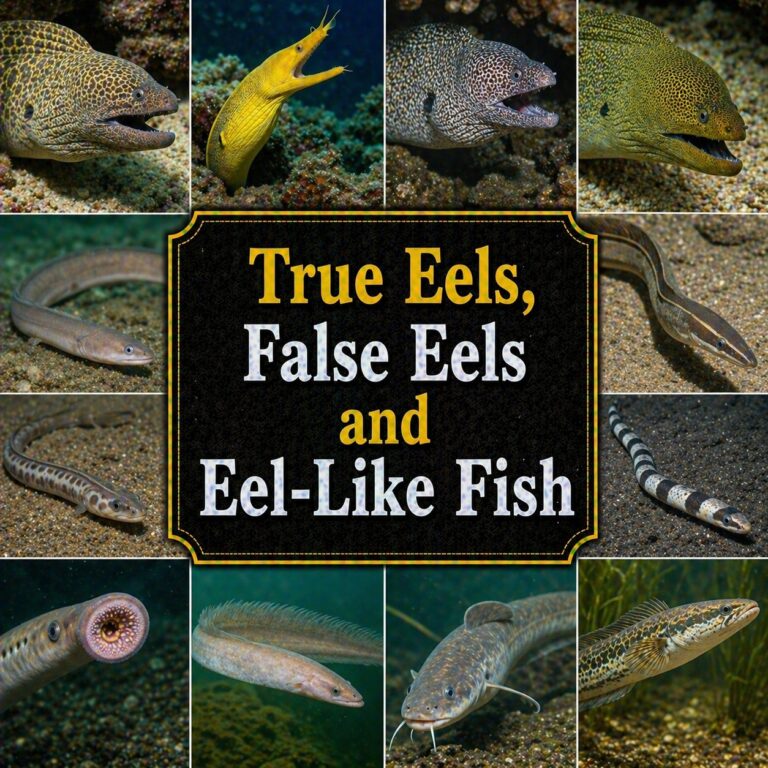
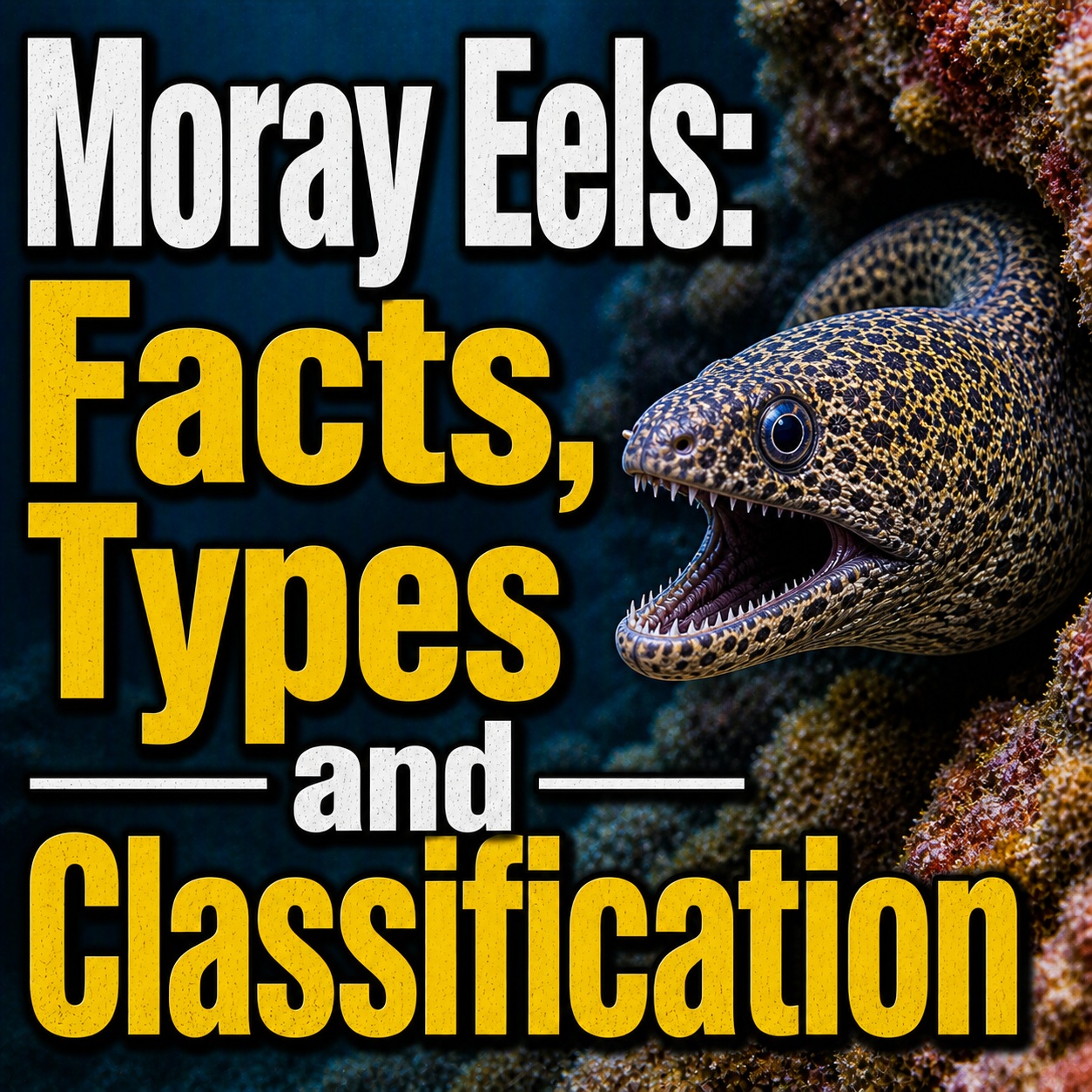
If the ocean had a “grumpy neighbor” archetype, the moray eel would play the part perfectly. Peering out from dark reef crevices with a permanent snarl and a rhythmic, gaping mouth, morays have earned a reputation as the villains of the coral reef. However, behind that menacing exterior lies one of the most sophisticated, ancient, and biologically fascinating predators in the animal kingdom.
Belonging to the family Muraenidae, moray eels comprise approximately 200 species found in nearly all tropical and temperate seas. From the massive, muscular Green Moray to the delicate, color-shifting Ribbon Eel, these creatures are the silent sentinels of the underwater world.
In this comprehensive guide, we will break down the anatomy, behaviors, and diverse types of moray eels that haunt the world’s oceans.
Moray Eel Classification
- Kingdom: Animalia
- Phylum: Chordata
- Class: Actinopterygii (ray‑finned fishes)
- Order: Anguilliformes (true eels)
- Suborder: Muraenoidei
- Family: Muraenidae (moray eels)
Subfamilies
- Muraeninae (≈190 species): Typical morays with continuous dorsal, anal, and caudal fins.
- Uropterygiinae (≈30–40 species): Reduced fins restricted to the tail tip, smaller group with specialized burrowing habits.
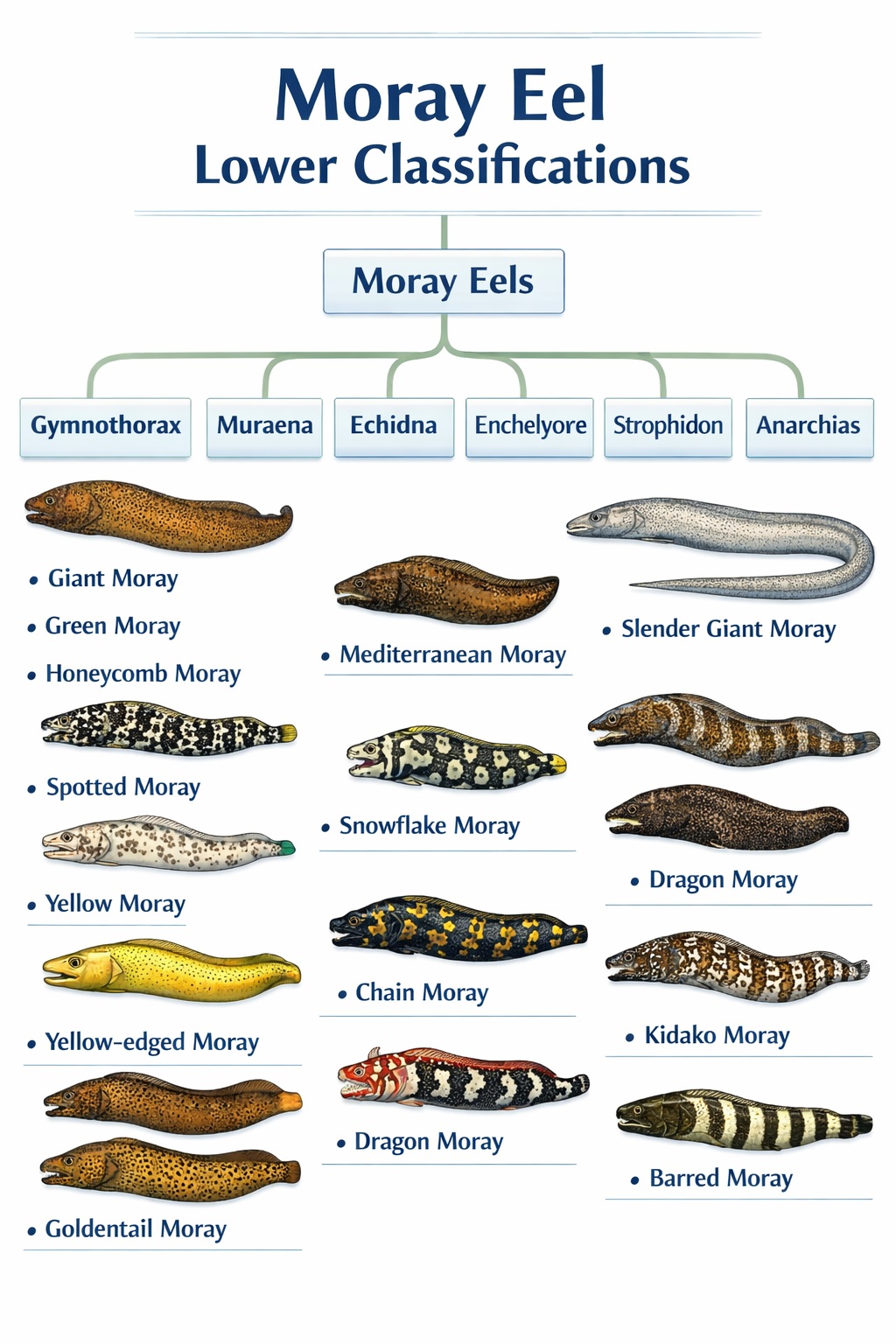
Moray Eel Lower Classifications
Here’s a clear breakdown of Moray Eel Lower Classifications, organized by genus with representative species for quick reference:
Gymnothorax
- Giant Moray – Largest moray, Indo‑Pacific reefs, up to 3 m.
- Green Moray – Western Atlantic, olive‑green body, common in Caribbean.
- Honeycomb Moray – Striking black‑and‑white spotted pattern, Indian Ocean.
- Spotted Moray – Smaller Atlantic species with dark spots.
- Yellow Moray – Bright yellow coloration, Indo‑Pacific shallow reefs.
- Yellow‑edged Moray – Brown body with yellow fin edges, Indo‑Pacific.
- Indian Mud Moray – Brackish estuaries and muddy coastal waters of India.
- Goldentail Moray – Caribbean species with golden tail tip.
Muraena
- Mediterranean Moray – Classic European moray, mottled brown, Mediterranean Sea.
Genus Echidna
- Snowflake Moray – White body with black and yellow markings, crustacean feeder.
- Chain Moray – Yellow chain‑like pattern, Caribbean, crustacean specialist.
Enchelycore
- Dragon Moray Eel – Vibrant orange and white, horn‑like nostrils, rare.
- Fangtooth Moray – Long needle‑like teeth, aggressive predator.
- Kidako Moray – Japanese species, bold spotted pattern, sharp teeth.
Strophidon
- Slender Giant Moray – Longest moray, up to 4 m, slender Indo‑Pacific species.
Anarchias
- Barred Moray
Why Moray Look (and Act) That Way
To understand a moray, you have to look past the “serpent” silhouette. Every inch of their body is optimized for life in the tight, jagged confines of a reef.
1. The Mystery of the Gaping Mouth
One of the most common misconceptions is that a moray eel opening and closing its mouth is a sign of aggression. In reality, it is respiration. Morays lack the gill covers (opercula) found on most fish. To breathe, they must constantly pump water through their mouths and over their gills. This “panting” is simply the eel taking a breath.
2. The “Alien” Jaws (Pharyngeal Jaws)
The most incredible biological trait of the moray is its pharyngeal jaws. While most fish use suction to swallow prey, the moray eel uses a mechanical “second set” of jaws located in its throat.
- The Strike: The primary jaws (the ones you see) grab the prey.
- The Launch: A second set of jaws launches forward from the throat, hooks into the prey, and drags it down into the esophagus.
- Evolutionary Advantage: This allow morays to feed in tight crevices where they cannot expand their mouths to create suction.
3. Scale-less Skin and Toxic Slime
Morays do not have scales. Instead, their skin is smooth and covered in a thick layer of mucus.
- Protection: This slime contains crinotoxins that are toxic to many predators and parasites.
- Navigation: The mucus acts as a lubricant, allowing the eel to slide into abrasive coral holes without injuring its skin.
- Coloration: In species like the Green Moray, the mucus is actually yellow; when it covers the eel’s naturally blue skin, the animal appears bright green.
Major Types of Moray Eels
The diversity within the Muraenidae family is staggering. While they share the same basic body plan, their aesthetics and diets vary wildly.
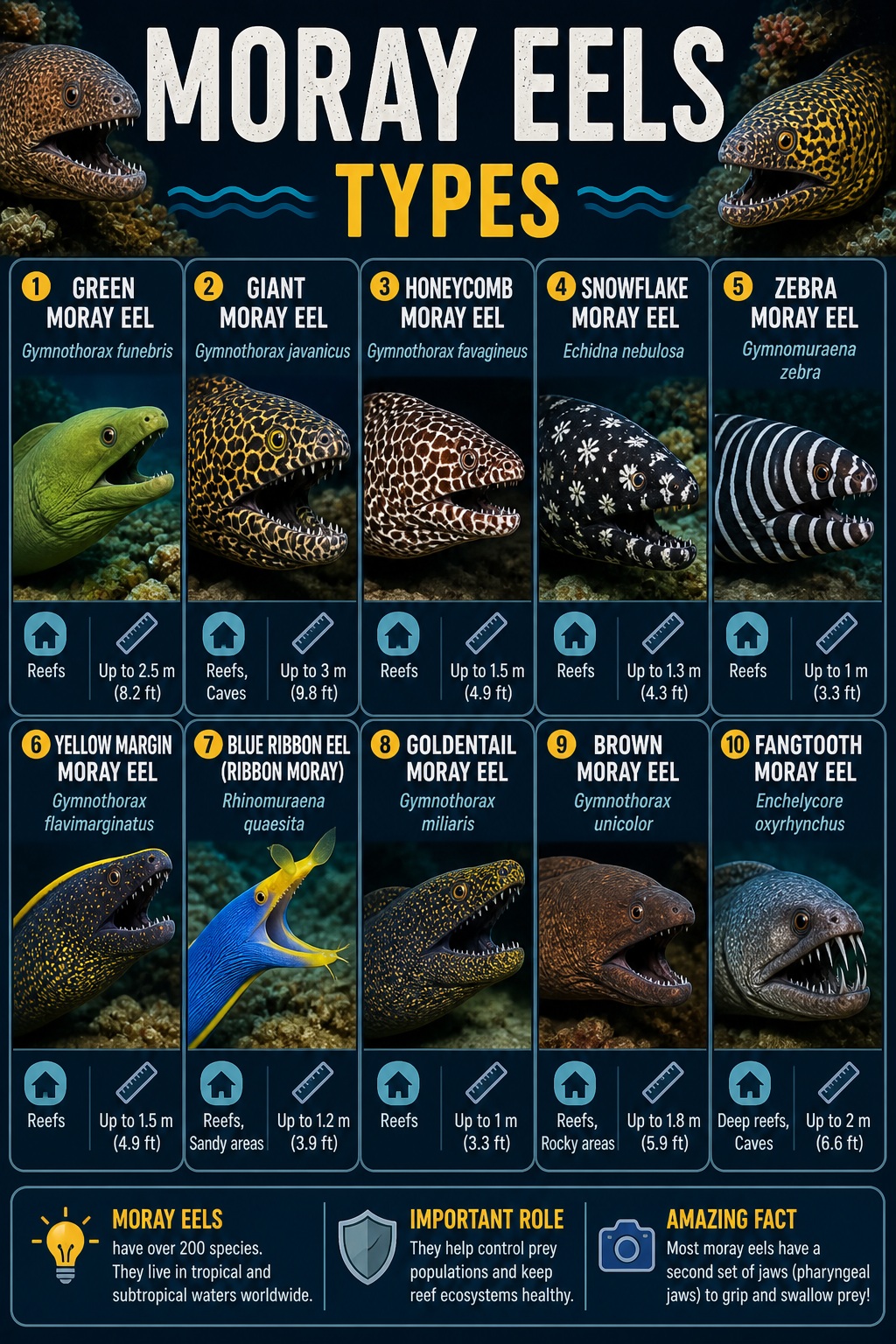
1. The Giant Moray (Gymnothorax javanicus)
The “King of the Reef” in the Indo-Pacific. This is the eel that most divers encounter and remember.
- Size: Can reach 3 meters (10 feet) and weigh up to 30 kilograms (66 lbs).
- Appearance: Brownish with black specks, turning into solid black patches behind the head.
- Diet: A top-tier predator that eats everything from octopuses to small sharks.
2. The Green Moray (Gymnothorax funebris)
The most famous resident of the Western Atlantic and Caribbean.
- Identity: While they look neon green, they are actually blue. The yellow mucus layer creates the green hue.
- Temperament: Generally docile but highly territorial if its “home” hole is approached.
3. The Ribbon Eel (Rhinomuraena quaesita)
Arguably the most beautiful and biologically unique moray. Ribbon eels are protandric hermaphrodites, meaning they change sex and color as they age.
- Juvenile: Black with a yellow dorsal fin.
- Male: Bright electric blue with yellow accents.
- Female: Entirely yellow.
- Anatomy: They have expanded, leaf-like nostrils that help them sense chemical changes in the water with extreme precision.
4. The Snowflake Moray (Echidna nebula)
A favorite in the aquarium trade, the Snowflake is a “pebble-tooth” eel.
- The Teeth: Unlike the needle-teeth of the Giant Moray, the Snowflake has blunt, rounded teeth designed for crushing the shells of crabs and shrimp.
- Pattern: White body with black and yellow “snowflake” or star-like patterns.
5. The Dragon Moray (Enchelycore pardalis)
The “demon” of the eel world.
- Horns: It possesses flared, tube-like nostrils that look like horns.
- The Snarl: Its jaws are permanently curved, meaning its mouth can never fully close, exposing a forest of needle-sharp teeth.
- Visuals: Striking orange, white, and brown leopard-like spots.
Behavioral Secrets: How They Survive
Morays are not just mindless eating machines; they exhibit complex social and hunting behaviors that are rare among fish.
1. Cooperative Hunting (The Grouper Connection)
In one of the few recorded instances of cross-species cooperation, morays have been seen hunting alongside Roving Coral Groupers.
- The Signal: The grouper will find a prey fish hiding in a crevice and “head-shake” to signal a moray.
- The Teamwork: The eel enters the crevice to flush the fish out. If the eel catches it, the eel eats; if the fish escapes the crevice, the grouper catches it in the open water.
- The Result: Both species have a higher success rate when working together than when hunting alone.
2. The “Knotting” Maneuver
Because eels lack fins to hold down their food, they use their own bodies as tools. To rip a piece of meat off a large carcass, a moray will tie itself into a knot and slide the knot toward its head. The pressure of the knot against the carcass provides the leverage needed to tear off a bite.
3. Nocturnal Predators
The majority of morays are nocturnal. During the day, they remain in their holes, occasionally cleaning their teeth with the help of Cleaner Shrimp or Wrasses. At night, they emerge, using their sophisticated sense of smell to track sleeping fish.
Moray Eel Facts: A Quick Reference
| Feature | Detail |
| Eyesight | Very poor; they rely almost entirely on their sense of smell. |
| Teeth | Most have backward-pointing teeth to prevent prey from escaping. |
| Blood | Toxic. Moray eel blood contains a protein that can be fatal to humans if ingested. |
| Lifespan | Can live 10 to 30 years depending on the species and environment. |
| Scales | None. They are completely scale-less. |
| Heart | Located far back in the body, near the gills. |
Human Interaction: Danger and Conservation
The “Bite” Factor
Morays are generally shy and will retreat rather than attack. Most “attacks” on divers are cases of mistaken identity. Because they have poor eyesight, a diver’s wiggling fingers can look like a small octopus or fish. Furthermore, if an eel is being hand-fed (a practice highly discouraged by marine biologists), it can become aggressive or lose its natural fear of humans.
The Risk of Infection
A moray eel bite is particularly nasty not just because of the mechanical damage, but because of the bacteria. Their mouths are home to a cocktail of pathogens that can lead to severe infections if the wound isn’t treated immediately with antibiotics.
Conservation Status
While most moray eels are not currently listed as endangered, they are highly sensitive to habitat destruction. Since they rely on healthy coral reefs for shelter, the bleaching and death of reefs directly lead to the decline of eel populations. As top predators, their absence can cause an explosion in prey fish populations, which then overgraze the reef, leading to an ecological collapse.
The Wildcards: Strange Moray Species
To truly appreciate the diversity of this family, one must look at the outliers.
- The Zebra Moray (Gymnomuraena zebra): Unlike the aggressive-looking morays, the Zebra is a specialized scavenger. It is almost exclusively a “crustacean crusher,” and its striped pattern is designed to mimic the shadows of sea urchin spines.
- The Tiger Moray: Known for its bright orange mouth, this species is found in the deeper waters of the Atlantic and is rarely seen by casual snorkelers.
- The Slender Giant Moray: The “pencil” of the ocean, this eel can reach 4 meters in length but remains incredibly thin, allowing it to navigate through the mud and silt of estuaries.
Conclusion: The Misunderstood Sentinel
The moray eel is a triumph of evolution. For millions of years, it has occupied the same role: the hidden guardian of the reef’s cracks and shadows. They are not the mindless monsters of myth, but intelligent, cooperative, and chemically complex animals that maintain the balance of the ocean’s most diverse ecosystems.
Whether it’s the neon-blue transformation of the Ribbon Eel or the “Alien” jaws of the Giant Moray, these creatures remind us that the ocean still holds secrets that defy conventional biology. The next time you see a moray “gaping” at you from a reef, remember: it’s just taking a breath, watching the world go by, and waiting for the sun to set so its true work can begin.
Unique Moray Eel Facts
Here are 10 unique facts about moray eels:
- Alien-like Pharyngeal Jaws: They are the only fish known to use a second set of jaws, called pharyngeal jaws, located in their throat to capture and pull prey down into their stomach, similar to the monster in the movie Alien.
- No Scales, Just Slime: Instead of protective scales, they have thick, smooth skin covered in mucus. This allows them to glide through tight, jagged coral crevices without injury.
- They Can Breathe With Their Mouths Open: Moray eels lack bony gill covers (opercula). They frequently keep their mouths open to pump water over their gills for respiration, not necessarily as a threat display.
- Cooperative Hunting with Groupers: They sometimes work together with coral trout (groupers). The grouper initiates the hunt and the moray pursues fish into tight holes, sharing the catch.
- Poor Eyesight, Incredible Smell: While their eyesight is poor, they have a keen sense of smell, allowing them to hunt effectively at night.
- Toxic Mucus and Bite: Many species have skin that releases toxic mucus. Some are also capable of causing illness if eaten due to toxins in their flesh.
- They Can Be Hermaphrodites: Many moray species are protandrous hermaphrodites, meaning they are born male and switch to female as they mature.
- Cleaning Symbiosis: Certain shrimp, such as cleaner shrimp, will enter the mouth and gill areas of a moray eel to eat parasites and dead skin, with the eel providing protection to the shrimp.
- Tiny Larval Stage: Moray eels start life as transparent, leaf-shaped larvae called leptocephalus that float in the open ocean for several months before settling on a reef.
- Some Can Travel on Land: The snowflake moray eel has been observed leaving the water for short periods to hunt crabs on land.
Frequently Asked Questions (FAQ)
1. Are moray eels venomous?
Technically, no. They do not have venom glands in their teeth like snakes. However, their skin mucus can be toxic, and their blood is poisonous if consumed.
2. Why do they live in holes?
Their bodies are soft and lack scales, making them vulnerable to large predators like sharks. A hole provides 360-degree protection, leaving only their tooth-filled head exposed.
3. Do moray eels have ears?
They do not have external ears, but they have internal ear structures that can detect vibrations in the water, helping them sense approaching predators or prey.
4. Can you keep a moray eel as a pet?
Yes, but only certain species. The Snowflake Moray is common, but they require large tanks (50-100+ gallons), extremely high-quality filtration, and a lid that is weighted down—eels are legendary escape artists.
5. Do they ever leave their holes?
Yes, primarily at night to hunt. During the day, they may move between holes, but they prefer to stay under cover to avoid being spotted by sharks or large groupers.