
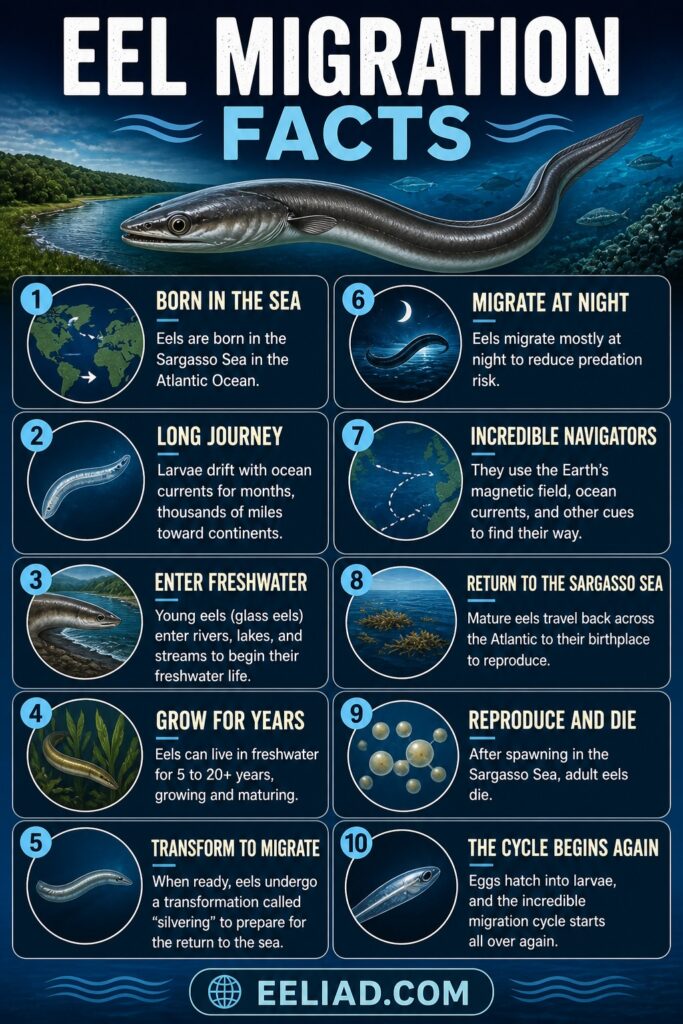
Eel migration is one of the most mysterious and extraordinary phenomena in the natural world. For centuries, humans puzzled over where eels came from, how they reproduced, and why they disappeared from rivers only to return as tiny glass eels. Today, thanks to decades of research, satellite tagging, and oceanographic expeditions, we finally know the answers: eels undertake epic journeys across thousands of kilometers, converging on specific spawning grounds such as the Sargasso Sea.
This article explores the history of eel migration studies, the biology of silver eels, the ecology and evolution of their migratory strategies, myths about the Bermuda Triangle, continental differences, overland migration, and modern mapping of their routes.
📜 History: We Finally Know Where Eels Come From
- Ancient Theories: Aristotle believed eels arose spontaneously from mud. Medieval scholars thought they came from horsehair or dew.
- Scientific Breakthrough: In the early 1900s, Danish biologist Johannes Schmidt discovered eel larvae (leptocephali) in the Sargasso Sea, proving it was their spawning ground.
- Modern Confirmation: Satellite tagging in the 21st century confirmed that European and American eels travel thousands of kilometers to spawn in the Sargasso Sea, solving a mystery debated for over 2,000 years.
🐟 Silver Eels: 7,000 km Migration After 40+ Years
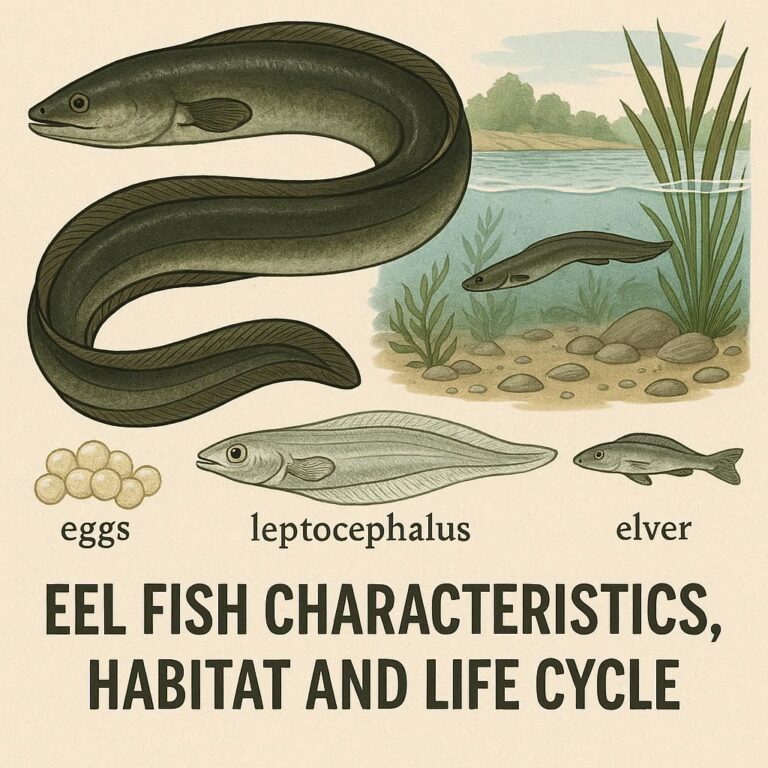
- Life Cycle: Eels hatch as leptocephali, drift with currents, transform into glass eels, then yellow eels, living in rivers for decades.
- Silver Stage: After 20–40 years, they metamorphose into silver eels—eyes enlarge, skin turns silvery, digestive systems shut down.
- Journey: European eels (Anguilla anguilla) migrate up to 7,000 km from rivers in Europe to the Sargasso Sea.
- One‑Way Trip: They spawn once and die, completing a cycle that links freshwater rivers to the deep ocean.
Ecology and Evolution of Migration in Freshwater Eels
- Catadromous Strategy: Unlike salmon (anadromous), eels are catadromous—living in freshwater but spawning in the ocean.
- Evolutionary Advantage: This strategy allows eels to colonize vast inland habitats while ensuring larvae drift with currents to new regions.
- Ecological Role: Eels regulate prey populations, recycle nutrients, and serve as prey for larger predators.
- Carbon Cycling: Their migrations contribute to vertical carbon transport, linking surface productivity to deep‑sea storage.
The Bermuda Triangle Connection
The myth of the Bermuda Triangle often intersects with eel biology. While the Triangle is famous for missing ships, for eels, it is a biological sanctuary. The unique magnetic anomalies in this region may actually help the eels.
How do eels reproduce in the Bermuda Triangle?
Current research suggests eels use Magnetoreception. They possess tiny crystals of magnetite in their heads that act like a GPS, sensing the Earth’s magnetic field. The specific magnetic signature of the Bermuda/Sargasso region likely acts as a “finish line” signal, telling the eels they have finally arrived at their ancestral spawning grounds.
- Spawning Grounds: The Sargasso Sea, overlapping with the Bermuda Triangle, is the only confirmed spawning site for European and American eels.
- Unobserved Behavior: No scientist has ever witnessed eels mating in the wild; evidence comes from larvae distribution.
- Myths: The overlap with the Bermuda Triangle fueled legends of “mystical eel origins,” but the truth is biological, not supernatural.
- Depth: Spawning likely occurs at 400–700 m depth, in warm, calm waters.
Continental Differences in Eel Migration
While the Atlantic eels are the most famous, migration occurs across various continents.
- The European Eel (Anguilla anguilla): Their 6,000–7,000 km journey is the longest, taking them from the fjords of Norway and the rivers of England all the way to the Bermuda Triangle.
- The American Eel (Anguilla rostrata): They follow a shorter route from North American estuaries to the same Sargasso spawning grounds.
- The Japanese Eel (Anguilla japonica): These eels migrate from the rivers of East Asia to spawn near the West Mariana Ridge in the Pacific, following similar deep-sea patterns.
Other Species: Tropical eels spawn in localized oceanic regions, showing diversity in migratory strategies.
❓Why Do Eels Go to the Sargasso Sea?
- Ocean Currents: The Sargasso’s gyre currents distribute larvae across the Atlantic.
- Stable Environment: Warm, calm waters provide ideal spawning conditions.
- Evolutionary Fixation: Over millions of years, eels evolved to rely on this unique region, making it central to their survival.
🌱 Overland Migration
- Elvers (juvenile eels): Can crawl across wet grass, mud, or even roads during rainy nights.
- Purpose: Allows colonization of inland lakes and rivers cut off from direct ocean access.
- Adaptation: Their slimy skin and ability to absorb oxygen through skin enable short terrestrial journeys.
Eel Migration Map: The Great Loop
The migration forms a giant, circular loop across the Atlantic:
- Start: Spawning in the Sargasso Sea.
- Drift: Larvae spend 1–3 years drifting east via the Gulf Stream.
- Arrival: They enter European/American rivers as “Glass Eels.”
- Growth: They spend 10–40 years as “Yellow Eels” in fresh water.
- Return: They transform into “Silver Eels” and swim 7,000 km back to the start.
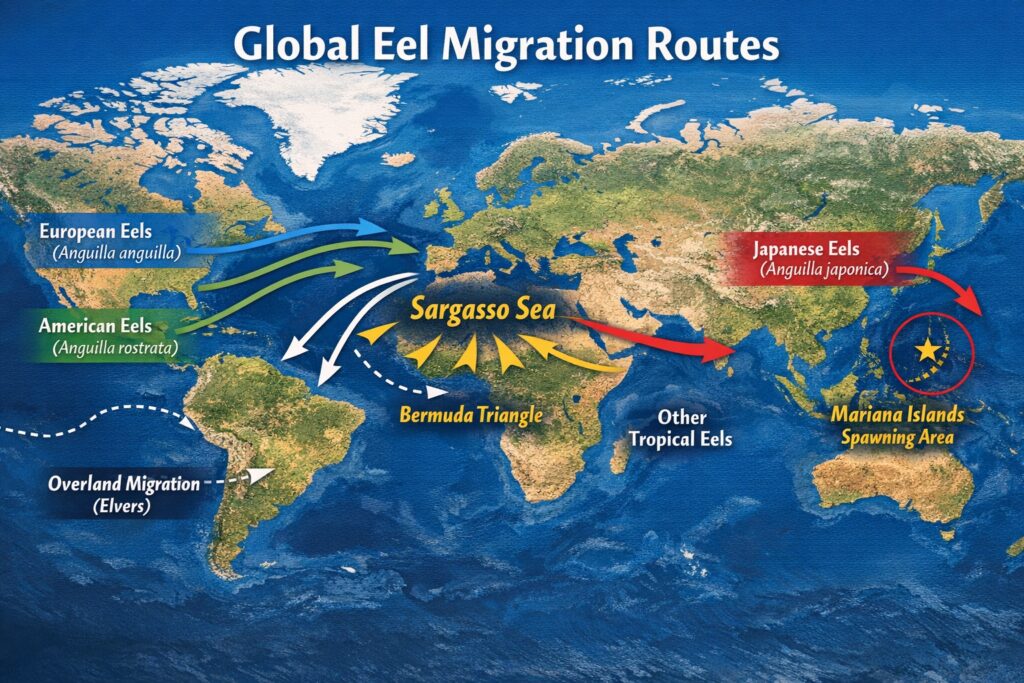
🗺️ Eel Migration Map
Routes:
- European Eels: Rivers → North Atlantic → Sargasso Sea.
- American Eels: East Coast rivers → Sargasso Sea.
- Japanese Eels: East Asia rivers → Mariana spawning grounds.
- Overland Paths: Elvers crossing damp terrain to inland waters.
Global Significance:
- These maps reveal intercontinental connections, showing how eels link rivers, oceans, and ecosystems across thousands of kilometers.
🌙 Modern Research and Expeditions
- Satellite Tagging: Confirms eel routes and depths.
- #OBVI #LivingBioreactors Expedition: Studies gut microbiomes of migrating animals like snipe eels, linking them to carbon storage.
- Conservation: European eels are critically endangered, with populations down 90% since the 1980s. Protecting migration corridors is vital.
❓Eel Migration FAQs
Q1: How far do eels migrate?
European eels travel up to 7,000 km.
Q2: Do all eels spawn in the Sargasso Sea?
No—Japanese eels spawn in the Pacific.
Q3: Why is eel migration important?
It sustains populations, ecosystems, and carbon cycling.
Q4: Can eels migrate over land?
Yes, juveniles can cross damp terrain.
Q5: Do eels die after spawning?
Yes, most species are semelparous.
Conclusion
Eel migration is a biological epic—a journey spanning continents, rivers, and oceans. From ancient myths to modern science, we now understand that eels spawn in the Sargasso Sea and other oceanic regions, completing a cycle that links freshwater rivers to the deep ocean. Their migrations not only sustain populations but also contribute to global carbon cycling and climate regulation.