
The world of eels is one of extreme proportions. Within the order Anguilliformes, which comprises over 800 species, you will find creatures that can fit inside a thimble and others that rival the length of a professional basketball goal. Because eels lack pelvic fins and typically have elongated, snake-like bodies, their “size” is often measured by a combination of length and girth, as a four-meter eel might still be thinner than a one-meter grouper.
This guide explores the staggering diversity of eel sizes, from the massive titans of the Indo-Pacific to the gossamer threads of the deep sea.
The Heavyweights: The Largest Eels by Mass and Length
When people think of “giant” eels, they are usually envisioning one of two species. While they inhabit different environments, both represent the peak of eel evolution in terms of sheer physical presence.
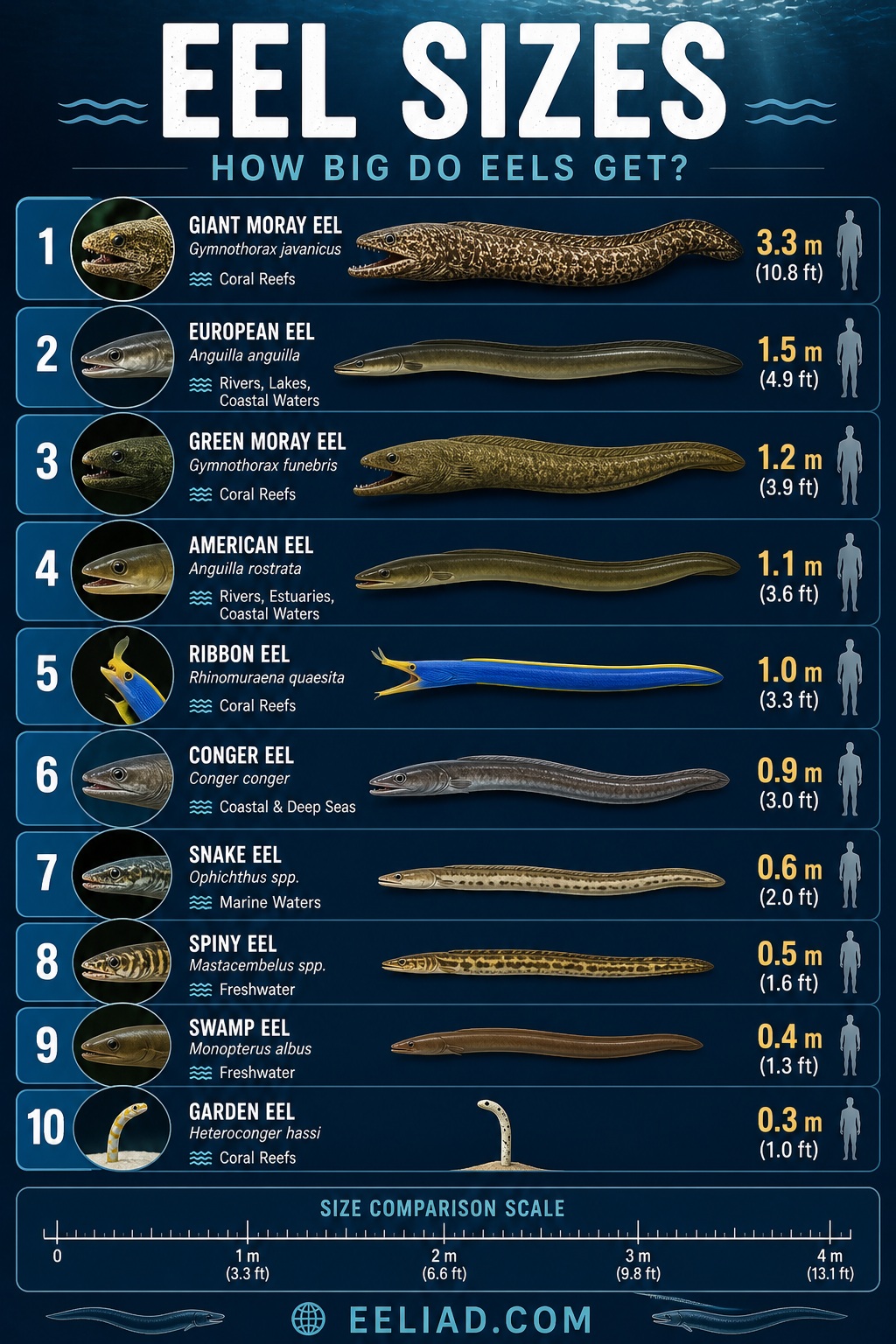
1. The Giant Moray (Gymnothorax javanicus)
The Giant Moray is the undisputed heavyweight champion of the reef. While it may not be the longest eel, it is the most massive.
- Maximum Length: Up to 3 meters (nearly 10 feet).
- Maximum Weight: Records indicate they can reach 30 kilograms (66 lbs) or more.
- Physical Profile: These eels are exceptionally thick-bodied. A fully grown adult can have a girth similar to a human thigh. Their massive heads house powerful muscles required to operate their dual-jaw system.
2. The Slender Giant Moray (Strophidon sathete)
If the Giant Moray is the heavyweight boxer, the Slender Giant Moray is the high-jump champion. This species holds the record for the longest eel in the world.
- Maximum Length: Specimens have been recorded at 4 meters (13 feet).
- Physical Profile: Despite its incredible length, it is much thinner than its “Giant” cousin. It lives primarily in muddy environments and estuaries, where its long body allows it to navigate through silt and shallow water with ease.
The Freshwater Titans: Anguillid Eels
Freshwater eels (Anguillids) have a different growth trajectory because they spend decades in rivers and lakes before their final ocean migration.
3. The New Zealand Longfin Eel (Anguilla dieffenbachii)
Endemic to New Zealand, this is arguably the largest freshwater eel species.
- Maximum Length: Females (which grow much larger than males) can reach 2 meters (6.6 feet).
- Maximum Weight: They can exceed 40 kilograms (88 lbs), though such giants are becoming rare due to overfishing and habitat loss.
- Age and Size: Size in these eels is a function of time. A two-meter eel may be over 80 to 100 years old. They grow slowly, adding only a few centimeters of length per year.
4. European and American Eels
- European Eel (Anguilla anguilla): Typically reaches 60–80 cm, but rare “monster” specimens in landlocked lakes have been found reaching 1.5 meters.
- American Eel (Anguilla rostrata): Generally smaller, with females reaching about 1 to 1.2 meters.
The Deep-Sea Wonders: Length Without Mass
In the deep ocean, size is often a trade-off. Large bodies require more calories, which are scarce in the abyss. Therefore, deep-sea eels tend to be “ribbon-like”—all length and no girth.
5. The Snipe Eel (Nemichthys scolopaceus)
- Length: Can reach up to 1.5 meters (5 feet).
- Weight: Incredibly light. Despite their length, they may weigh only a few ounces.
- Anatomy: Their body tapers into a thread-like tail. If you held one, it would feel more like a wet string than a fish.
6. The Gulper Eel (Eurypharynx pelecanoides)
- Length: Up to 1 meter (3.3 feet).
- Proportions: Most of this “size” is actually head. The Gulper eel has a massive, pouch-like mouth that accounts for nearly a quarter of its total length, while the rest of the body is a thin, whip-like appendage.
The “Miniatures”: Smallest Eel Species
On the opposite end of the spectrum are the eels that have evolved to live in the tiniest cracks of the reef or the open ocean.
7. The One-Jaw Eel (Monognathus)
These deep-sea oddities are among the smallest eels.
- Size: Many species in this family never exceed 5 to 10 centimeters (2 to 4 inches).
- Niche: They occupy a highly specialized niche in the bathypelagic zone, where being small is an advantage for energy conservation.
8. Dwarf Morays
- Size: The Snyder’s Moray (Anarchias leucurus), the smallest known moray, reaches a maximum length of only 11 centimeters (4.5 inches). It spends its entire life hidden deep within the pores of coral heads.
Why Do Eels Grow to These Sizes? (The Biology of Scale)
The size of an eel is rarely accidental; it is a direct response to its hunting style and environment.
The Benefit of Being Large (Reef Morays)
Large morays need mass to tackle large prey like octopuses and groupers. Their thickness provides the muscular leverage needed for “knotting“—the process where an eel ties its body in a knot to rip pieces of flesh off a carcass or pull itself out of a tight grip.
The Benefit of Being Long (Sand/Mud Eels)
For eels that burrow, like the Sharptail Eel or the Slender Giant, length is an advantage. A long body provides more surface area for the muscles to push against the sand, allowing for the rapid backward-burrowing that is their primary defense.
The Benefit of Being Small (Deep-Sea/Pore Dwellers)
In the deep sea, “downsizing” reduces the metabolic cost of living. In the reef, being a “Dwarf Moray” allows access to food sources (like tiny shrimp) that larger eels cannot reach.
Size Comparison Table
| Eel Type | Common Name | Max Length | Max Weight | Habitat |
| Moray (Heavy) | Giant Moray | 3.0 m | 30 kg | Coral Reefs |
| Moray (Long) | Slender Giant Moray | 4.0 m | 10 kg | Mud/Estuaries |
| Freshwater | NZ Longfin Eel | 2.0 m | 40 kg | Rivers/Lakes |
| Deep Sea | Snipe Eel | 1.5 m | < 1 kg | Midnight Zone |
| Conger | European Conger | 3.0 m | 60+ kg | Rocky Shores |
| Dwarf | Snyder’s Moray | 0.11 m | < 0.01 kg | Coral Pores |
The “Conger” Exception
While morays get the most attention, the European Conger (Conger conger) is arguably the true titan of the order.
- The Weight Record: Congers have been caught weighing over 60 to 100 kilograms (130-220 lbs).
- The Length: They can reach nearly 3 meters.
- Comparison: Unlike the Slender Giant Moray, the Conger is thick and muscular throughout its body. It is often considered the most powerful eel species in the world, capable of living in shipwrecks and deep rocky reefs.
Factors Influencing Eel Growth
- Food Availability: Eels are opportunistic. In areas with high biodiversity, such as protected marine reserves, eels reach their maximum theoretical size much more frequently than in overfished areas.
- Temperature: Freshwater eels grow significantly faster in warmer climates. A New Zealand eel in the warm North Island will reach maturity years earlier than one in the cold South Island.
- Gender (Sexual Dimorphism): In almost all migratory eel species (Anguilla), the females grow significantly larger than the males. Males often stay small to conserve energy for the final migration, while females must grow large to carry millions of eggs.
Eel Size Guide by Species
| Species | Maximum Recorded Size | Weight Range | Habitat | Notes |
|---|---|---|---|---|
| Slender Giant Moray | 4 m (13 ft) | 30–50 kg | Indo‑Pacific reefs | Longest eel species; slender body. |
| European Conger | 3 m (10 ft) | Up to 110 kg | Atlantic & Mediterranean | Heaviest eel; massive girth. |
| Giant Moray | Nearly 3 m (9.8 ft) | 30 kg+ | Coral reefs | Aggressive reef predator. |
| Giant Mottled Eel | 2 m (6.6 ft) | Up to 28 kg | Indo‑Pacific rivers | Largest freshwater eel. |
| New Zealand Longfin Eel | 2 m+ (6.7 ft) | Up to 24 kg | New Zealand rivers | Females grow larger than males. |
| Japanese Eel | 1.5 m (5 ft) | 3–4 kg | East Asia rivers | Common aquaculture species. |
| American Eel | 1.2 m (4 ft) | 7.5 kg | North America rivers | Long‑lived; migrates to Sargasso Sea. |
| European Eel | 1.5 m (4.9 ft) | 5 kg | Europe rivers | Critically endangered. |
| Snipe Eel | 1.3 m (4.3 ft) | < 0.5 kg | Deep ocean | Thread‑thin body, 750 vertebrae. |
| One‑Jaw Eel | 0.6 m (2 ft) | < 0.2 kg | Abyssal depths | Skeletal, fang‑like teeth. |
| Smallest Eels (e.g. Snyder’s Moray) | 11 cm (4 in) | Few grams | Shallow reefs | Miniature species. |
Factors Influencing Eel Growth
- Species genetics: Each eel has a fixed growth potential; morays and congers dominate in size.
- Habitat & food: Nutrient‑rich environments yield larger individuals.
- Age: Eels grow continuously—older specimens are bigger.
- Sex: Females often outgrow males, especially in freshwater species.
- Temperature: Warmer waters accelerate metabolism and growth.
Conclusion
From the four-meter Slender Giant to the four-inch Dwarf Moray, eels have mastered every possible size niche in the aquatic world. Their size is their destiny: determining what they eat, where they hide, and how they survive the grueling migrations that define their lives. Whether they are the thick-bodied “kings of the reef” or the “ghostly threads of the abyss,” eels remain a testament to the incredible diversity of vertebrate life.
Frequently Asked Questions
1. What is the biggest eel ever recorded?
The European Conger holds the record for weight (up to 110kg), while the Slender Giant Moray holds the record for length (up to 4 meters).
2. Are big eels dangerous to humans?
Only if provoked. Large eels have poor eyesight and may bite a hand if they smell food, but they do not hunt humans. Their size makes their bite powerful enough to cause serious injury.
3. Do eels stop growing at a certain age?
Most eels exhibit indeterminate growth, meaning they continue to grow throughout their lives, although the rate of growth slows significantly as they get older.
4. Why are the females bigger?
In the world of eels, size equals eggs. A larger female can carry significantly more eggs (up to several million), increasing the chances that her offspring will survive the long journey back from the Sargasso Sea.