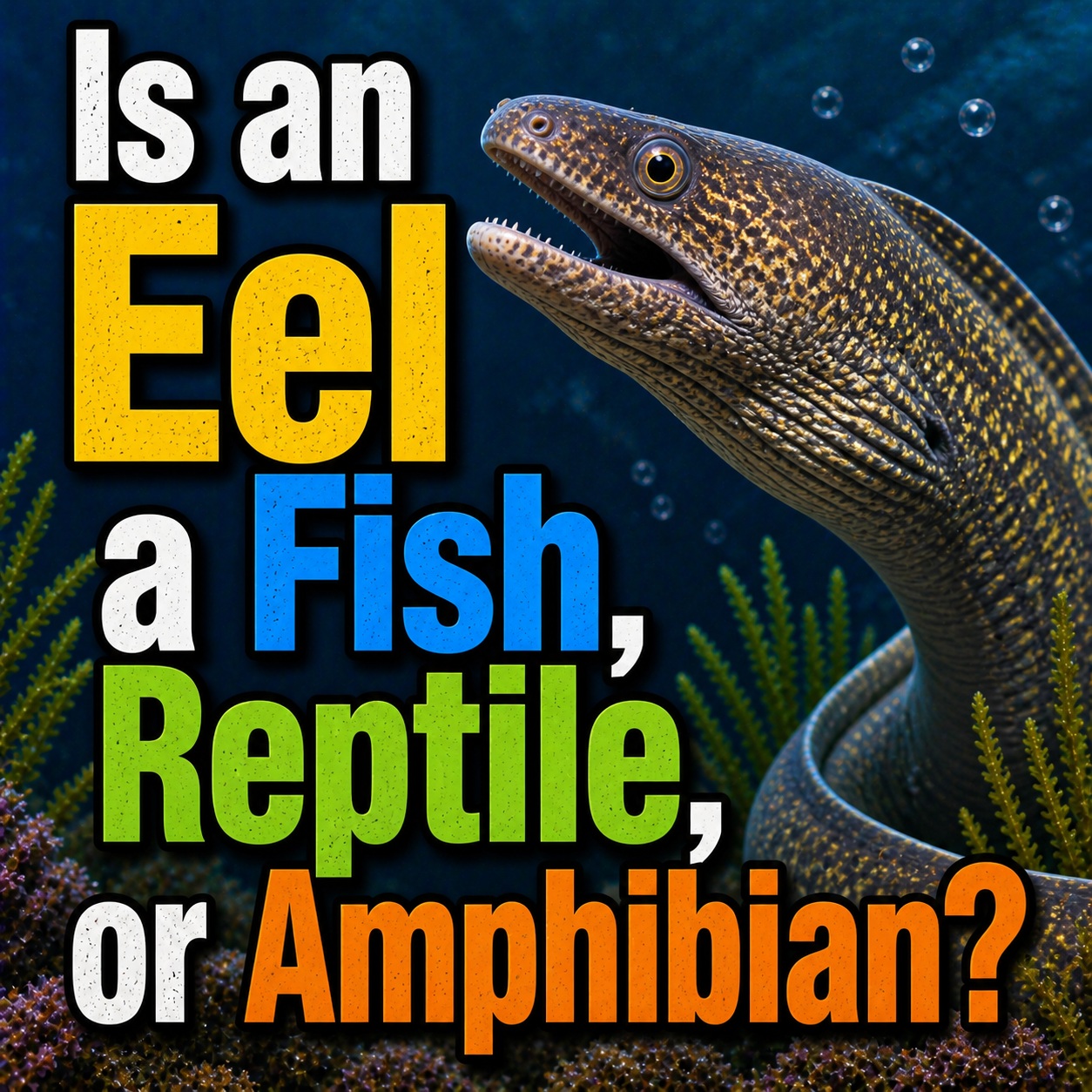
Why eels keep their mouths open and whether they are fish, reptiles, or amphibians are two of the most common questions asked by marine enthusiasts. Eels look like snakes, move like serpents, and sometimes even breathe air—but biologically, they are true fish. Belonging to the order Anguilliformes, eels are aquatic vertebrates that have evolved unique adaptations for life underwater.
This article explores every aspect of eel biology—classification, anatomy, evolution, and differences from reptiles and amphibians—while explaining why eels are fish and how they fit into the broader aquatic ecosystem.
🧬 What Exactly Is an Eel?
Eels are elongated, ray‑finned fish (Actinopterygii) found in both freshwater and marine environments. Their bodies are flexible, allowing them to swim through tight spaces and burrow into sand or mud.
Taxonomic Classification
- Kingdom: Animalia
- Phylum: Chordata
- Class: Actinopterygii (ray‑finned fishes)
- Order: Anguilliformes
- Families: Over 19 families, including Muraenidae (morays) and Anguillidae (freshwater eels).
This classification places eels firmly within the fish category, not reptiles or amphibians.
6 Key Characteristics of Eels
Eels share all the defining traits of fish:
1. Gills for Breathing
Eels extract oxygen from water through gills. Some species can absorb oxygen through their skin when out of water briefly, but they remain aquatic.
2. Fins for Movement
Their dorsal, anal, and caudal fins merge into a continuous ribbon‑like structure, helping them glide efficiently.
3. Aquatic Habitat
Eels spend their entire lives in water, from spawning to adulthood.
4. Slimy Skin
Their skin secretes mucus, reducing friction and protecting against parasites.
5. Reproduction in Water
Eels lay eggs in aquatic environments; larvae drift with ocean currents before metamorphosing into juveniles.
6. Carnivorous Diet
They feed on fish, crustaceans, and worms, using sharp teeth and powerful jaws.
Eel vs. Snake: Key Differences and Identification
Eels are often mistaken for snakes because of their shape, but they differ fundamentally.
| Feature | Eel | Snake |
|---|---|---|
| Classification | Fish (Anguilliformes) | Reptile (Serpentes) |
| Breathing | Gills | Lungs |
| Habitat | Aquatic | Terrestrial or semi‑aquatic |
| Skin | Slimy, mucus‑covered | Dry, scaly |
| Movement | Undulating swimming | Muscular crawling |
| Reproduction | Eggs in water | Eggs or live young on land |
| Fins | Present (reduced) | None |
| Temperature Regulation | Cold‑blooded aquatic | Cold‑blooded terrestrial |
Eels are fish that evolved to resemble snakes for efficient swimming, not for land movement.
Why Eels Are Fish, Not Reptiles or Amphibians
Eels are true fish. They breathe through gills, have fins, and live their entire lives in water. Reptiles and amphibians, by contrast, rely on lungs and can survive on land.
Key Biological Classification
| Feature | Eels | Reptiles | Amphibians |
|---|---|---|---|
| Respiration | Gills | Lungs | Gills (larvae), lungs (adults) |
| Habitat | Aquatic | Terrestrial or semi‑aquatic | Dual (water + land) |
| Skin | Slimy, mucus‑covered | Dry, scaly | Moist, permeable |
| Reproduction | Eggs in water | Shelled eggs on land | Eggs in water |
| Body Covering | Embedded scales | Overlapping scales | Smooth skin |
🧠 Evolutionary Background
Eels evolved from early bony fish over 100 million years ago. Their elongated bodies and reduced fins are adaptations for burrowing and navigating narrow spaces.
Evolutionary Milestones
- Early Ancestors: Primitive ray‑finned fish.
- Adaptation: Elongated body for crevice dwelling.
- Diversification: Over 800 species across marine and freshwater environments.
Unlike amphibians, eels never transitioned to land—they remained fully aquatic.
🌍 Habitat and Distribution
Eels inhabit nearly every aquatic environment:
- Freshwater Rivers: European and American eels migrate between rivers and oceans.
- Coral Reefs: Moray eels dominate tropical reefs.
- Deep Sea: Conger eels thrive in depths exceeding 500 meters.
- Estuaries: Juvenile eels adapt to brackish waters during migration.
Their global distribution underscores their adaptability as fish.
🧬 Differences from Reptiles and Amphibians
Eels vs. Reptiles
- Reptiles breathe air through lungs; eels use gills.
- Reptiles have dry, scaly skin; eels have smooth, mucus‑covered skin.
- Reptiles lay shelled eggs on land; eels spawn in water.
Eels vs. Amphibians
- Amphibians live both in water and on land; eels are fully aquatic.
- Amphibians undergo metamorphosis from tadpoles; eels have leptocephalus larvae.
- Amphibians breathe through lungs and skin; eels rely mainly on gills.
🌊 Ecological Importance
Eels play vital roles in aquatic ecosystems:
- Predator Control: Regulate populations of smaller fish and crustaceans.
- Nutrient Cycling: Burrowing aerates sediment and redistributes organic matter.
- Food Source: Support fisheries and marine food webs.
⚠️ Conservation and Threats
Many eel species face population decline due to:
- Overfishing for food and aquariums.
- Habitat Loss from coastal development.
- Pollution affecting spawning grounds.
- Climate Change altering migration patterns.
Conservation efforts by organizations like IUCN and NOAA Fisheries aim to protect eel habitats and migration routes.
📜 Cultural and Historical Significance
Eels appear in myths and folklore worldwide:
- Japan: Symbol of vitality and endurance; grilled eel (unagi) is a delicacy.
- Polynesia: Represented as reef guardians.
- Europe: Once believed to emerge spontaneously from mud.
Their mysterious life cycle has inspired legends for centuries.
Related FAQs
Q1: Are eels amphibians or fish?
Eels are fish; they breathe through gills and live underwater.
Q2: Is an eel a reptile or a fish?
It’s a fish, not a reptile—reptiles have lungs and dry scales.
Q3: What category of fish is eel?
Eels belong to the order Anguilliformes, a group of ray‑finned fish.
Q4: What is an amphibian eel?
No true amphibian eel exists; some species briefly survive on land using skin respiration.
Q5: Did fish become amphibians?
Yes, amphibians evolved from ancient fish that developed lungs and limbs.
Q6: Is eel a fish or worm?
A fish—worms lack gills, fins, and vertebrae.
Q7: Are eels reptiles?
No, they are aquatic fish, not air‑breathing reptiles.
Q8: Are eels lizards?
No, lizards are reptiles with limbs; eels are limbless fish.
Q9: Can eels breathe air? Some can absorb oxygen through skin briefly, but they rely on gills.
Q10: Why do eels look like snakes? Their elongated bodies evolved for swimming efficiency, not for terrestrial movement.