The eel is perhaps the only creature on Earth that has successfully hidden its private life from humanity for over two thousand years. Neither fully fish in appearance nor serpent in biology, the eel occupies a liminal space in our collective imagination. It is a creature of the “in-between”—thriving in both salt and fresh water, breathing through its skin on land, and appearing out of thin air in landlocked ponds.
Eels have long been seen as mysterious, transformative creatures in myth, history, and folklore—symbolizing rebirth, wisdom, fertility, and resilience across cultures from Celtic Europe to Japan and Africa. Their elusive nature and ability to thrive in both freshwater and saltwater made them powerful metaphors for adaptability and hidden knowledge.
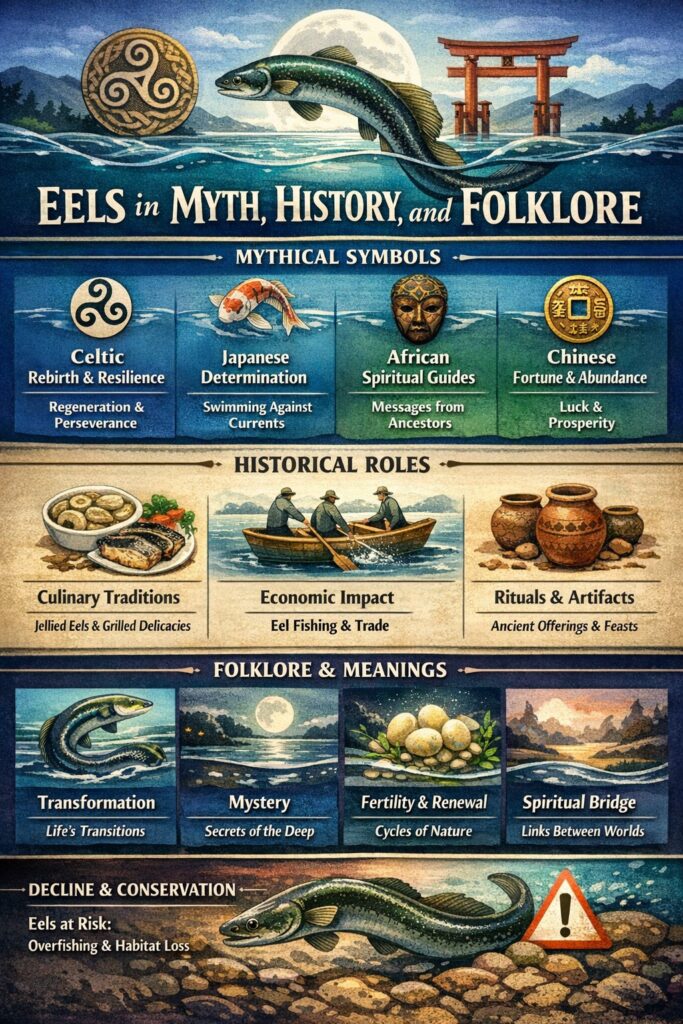
🌊 Eels in Mythology
- Celtic Beliefs: Eels symbolized rebirth and resilience, thought to regenerate even after being cut, embodying perseverance.
- Japanese Mythology: Revered for swimming upstream against currents, eels represented determination and overcoming obstacles.
- African Traditions: Seen as spiritual guides, often appearing in dreams as messages from ancestors urging transformation.
- Native American Folklore: Associated with wisdom and intuition, often depicted as advisors guiding heroes through challenges.
- Chinese Symbolism: Linked to good fortune and abundance, appearing in art and festive motifs.
📜 Historical Roles
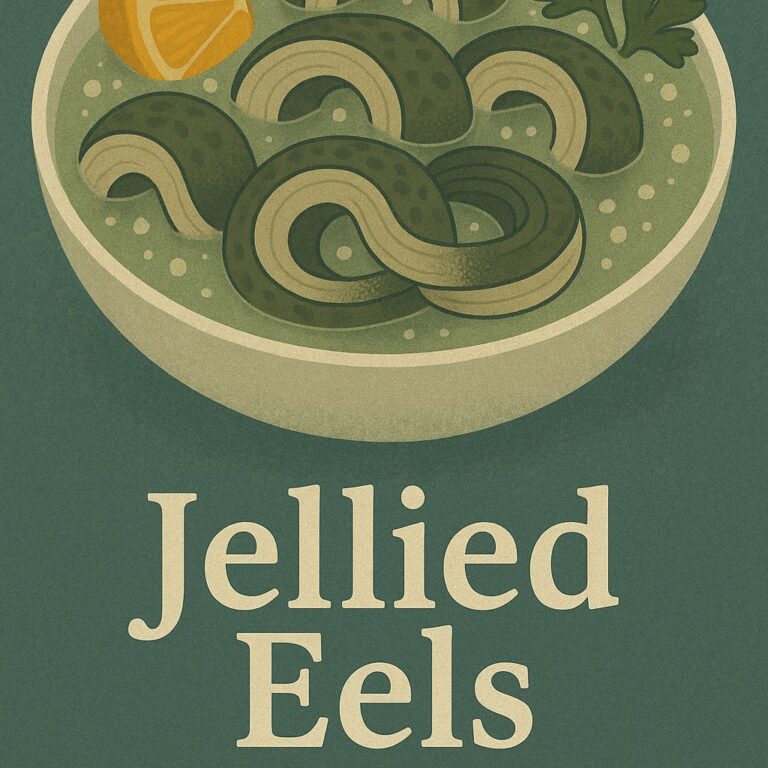
- Food & Rituals: Eels were prized in cuisines across Europe and Asia (e.g., jellied eels in London, grilled eel in Japan).
- Economic Importance: Eel fishing and trade shaped local economies, especially in Ireland, Japan, and China.
- Archaeological Evidence: Ancient eel remains show their role in ritual offerings and feasts.
- Idioms & Arts: Their snake-like form inspired metaphors for slipperiness and unpredictability in language and literature. Springer
🌌 Folklore & Symbolism
- Transformation: Their migration between rivers and oceans made them symbols of life’s transitions and adaptability.
- Mystery: Nocturnal habits and hidden spawning grounds gave them an aura of secrecy and the unknown.
- Fertility & Renewal: In some traditions, eels embodied nature’s cycles and fertility, tied to water’s nurturing role.
- Spiritual Journeys: Folklore often cast eels as guides between the physical and spiritual worlds, reflecting balance and hidden wisdom. brainwisemind
⚖️ Comparative Overview
| Culture/Region | Symbolism/Role | Key Traits Highlighted |
|---|---|---|
| Celtic Europe | Rebirth, resilience | Regeneration, perseverance |
| Japan | Perseverance, overcoming odds | Swimming upstream |
| Africa | Spiritual guidance | Ancestors, transformation |
| Native America | Wisdom, intuition | Advisory role |
| China | Fortune, abundance | Fertility, prosperity |
| Europe (History) | Cuisine, rituals | Jellied eels, feasts |
🚨 Risks & Decline
- Modern Conservation Issue: Global eel populations, especially the European eel (Anguilla anguilla), have sharply declined due to overfishing, habitat loss, and climate change.
- Cultural Loss: As eels vanish, traditions tied to them—rituals, cuisines, folklore—risk fading away.
Ancient Foundations: Spontaneous Generation to Sacred Status
In the ancient world, the eel was a source of profound confusion. Because no one could find eel eggs or see them mating, the greatest minds of antiquity were forced to invent supernatural origins for them.
Aristotle’s Spontaneous Generation Theory
In the 4th century BCE, the Greek philosopher Aristotle—the father of modern biology—was stumped. He dissected hundreds of eels and found no eggs, no milt, and no reproductive organs. In his work History of Animals, he concluded that eels did not reproduce like other fish.
Instead, he proposed the theory of Spontaneous Generation. Aristotle argued that eels emerged from the “guts of the earth” (gas enteron), essentially growing out of the mud and slime in marshes after a heavy rain. This “scientific” fact remained the standard belief for nearly 2,000 years.
Egypt and the God Atum
While the Greeks were theorizing, the Ancient Egyptians were worshipping. Eels were associated with Atum, the creator god who rose from the primordial waters. Because eels could survive in the mud—a symbol of the fertile Nile—they were seen as manifestations of life-force.
In some regions, eels were so sacred that they were mummified in bronze sarcophagi and buried with honors, a testament to their divine status in eel history.
The Eel in European Folklore: Magic and Medicine
As the mystery of the eel moved into the Middle Ages, the lack of scientific explanation led to a flourishing of “folk science” and bizarre superstitions across Europe.
The Horsehair Myth
A pervasive piece of European folklore suggested a magical origin for eels. It was widely believed that if a hair from a horse’s tail fell into a stream, it would come to life and transform into an eel.
This myth likely arose from observations of Gordian worms (horsehair worms), which are thin parasites that look remarkably like miniature eels and appear in puddles and troughs.
The Dew Myths
In the Middle Ages, the mystery deepened. Since people still couldn’t find eel larvae, folklore took over:
The May Dew Myth: Others thought eels formed from the morning dew that fell upon the riverbanks in the spring.
Medical Marvels and Superstitions
In Medieval England and France, eels were not just food; they were a pharmacy.
- The Cure for Drunkenness: It was believed that placing a live eel in a glass of wine until it died would create a potion that made the drinker forever disgusted by alcohol.
- Vision Quests: Some folk traditions claimed that eating the heart of an eel while it was still warm would grant a person the gift of prophecy.
- Skin Care: Eel skin was often wrapped around limbs to treat cramp, rheumatism, and even broken bones, as the “supple” nature of the eel was thought to transfer to the human body.
Eels as Currency: The Medieval Economy
One of the most fascinating chapters in eel history is their role as a global economic powerhouse. In Medieval England, eels were more than a meal; they were money.
Rent Paid in “Sticks”
Between the 10th and 14th centuries, thousands of rent agreements in England were settled in eels. The standard unit of measurement was a “stick” of eels, which consisted of 25 eels threaded onto a willow branch.
- The Scale of Trade: Records from the Domesday Book show that over 500,000 eels were paid in rent annually to various landlords and monasteries.
- The Fenlands: The swampy regions of East Anglia became the “Wall Street” of the eel trade, where the abundance of these fish dictated the wealth of entire towns.
Polynesian Mythology: The Origin of the Coconut
Perhaps the most beautiful eel folklore comes from the Pacific Islands, particularly Samoa and Tahiti. This is the legend of Sina and the Eel.
In the myth, a beautiful woman named Sina had a small pet eel. As the eel grew larger, it fell in love with her. Distressed by its size and affection, Sina fled, but the eel followed her through every pool and stream.
Eventually, the eel grew old and realized it was dying. It asked Sina to bury its head in the sand. From that spot grew the first coconut tree.
- The Visual Link: Polynesians point to the three holes on a husked coconut as the “eyes” and “mouth” of the eel, a permanent reminder of the creature’s devotion. This myth transformed the eel from a predator into a provider of life.
The 2,000-Year Detective Story: Solving the Mystery
The transition from eel myths to science is a saga involving some of the most famous names in history.
The Freud Dissections
In 1876, a young medical student named Sigmund Freud—who would later invent psychoanalysis—spent weeks in a laboratory in Trieste, Italy. His task? To find the testes of the eel. He dissected 400 eels and found… nothing.
He was so frustrated by the “missing” organs that he eventually quit biology for psychology. Freud didn’t know that eels only develop reproductive organs at the very end of their lives, once they leave the rivers.
The Discovery of the Sargasso Sea
The mystery was finally unraveled by Johannes Schmidt, a Danish biologist who spent 20 years (1904–1924) sailing the Atlantic. He used a fine-mesh net to scoop up larvae. He noticed that the further west he sailed, the smaller the larvae became.
Finally, he traced them to the Sargasso Sea, a seaweed-choked region near Bermuda. He realized that every single eel from every river in Europe and North America travels thousands of miles to this one spot to mate, spawn, and die.
Cultural Significance: Japan and the “Ushi no Hi”
In Japan, the eel (Unagi) is a symbol of endurance. During the Doyo no Ushi no Hi (Midsummer Day of the Ox), millions of Japanese citizens eat grilled eel.
- The Legend of Stamina: This tradition dates back to the Edo period. Folklore suggested that eating eels provided the “stamina” needed to withstand the oppressive summer heat.
- Kabayaki: The method of grilling eel over charcoal remains a culinary art form, with shops claiming to use “secret sauces” that have been replenished for over 200 years.
The “Invisible” Eel: Modern Superstitions
Even today, eels inhabit the darker corners of our folklore. In the popular imagination, the Loch Ness Monster is often theorized to be nothing more than a “giant eel.” This theory gained traction in 2019 when DNA samples from the lake showed a massive abundance of eel DNA and zero evidence of “dinosaur” DNA.
The Discovery: Giovanni Grassi and Johannes Schmidt
The breakthrough happened in two major steps:
The Identity Correction (1896): Italian scientist Giovanni Grassi watched a transparent Leptocephalus in an aquarium transform into a glass eel. This proved that the “mystery leaf fish” was actually the baby stage of the eel.
The Map to the Sargasso (1904–1922): Danish biologist Johannes Schmidt spent nearly 20 years sailing the Atlantic, scooping up larvae. He noticed that the further east he went, the larger the larvae were.
By following the “trail” of smaller and smaller larvae, he traced them back to a single spot: the Sargasso Sea, a seaweed-filled area in the North Atlantic.
Summary of Eel Symbolism
| Culture | Symbolism |
| Ancient Greek | Spontaneous Life / Earth Spirits |
| Polynesian | Sacrifice and Creation (The Coconut) |
| British | Economic Stability / Working Class Food |
| Japanese | Vitality and Summer Endurance |
Why It Is Still a Mystery Today
Even though we know where they go, the mystery isn’t fully solved. To this day, no human has ever seen eels mating in the wild in the Sargasso Sea. We have never found eel eggs in the open ocean.
Scientists have tried to track eels using satellite tags, but the eels often disappear into the deep or get eaten by sharks before they reach the finish line. We know the destination, but the “act” itself remains one of nature’s best-kept secrets.
Conclusion
The history and folklore of eels remind us that nature still holds secrets. For millennia, the eel was a “shapeshifter” that defied the laws of biology. It was a currency, a god, a medicine, and a monster. Today, as eel populations decline globally, the mystery has shifted from “Where do they come from?” to “Can we save them?” To lose the eel would be to lose one of the most enduring mysteries of the natural world—a creature that proves reality is often stranger than myth.
Frequently Asked Questions
1. Why did people think eels came from horsehairs?
Small, thin worms that look like eels often appeared in water troughs where horses drank, leading to the belief that the hair had come to life.
2. Did Romans really feed humans to eels?
While some Roman writers told stories of the cruel Vedius Pollio feeding slaves to his morays, most historians believe this was an exaggerated tale used to illustrate the decadence of the era.
3. What is the “Eel Mystery”?
It refers to the 2,000-year period where humans were unable to find eel eggs or determine how they reproduced.
4. Why are eels associated with the Loch Ness Monster?
Because eels can grow very large and move with a serpentine motion, many scientists believe “sightings” of Nessie are actually sightings of large eels.
5. Why was the Sargasso Sea discovery so important?
It proved that eels are “catadromous,” meaning they live in fresh water but migrate to the deep ocean to spawn, a discovery that solved a mystery dating back to Aristotle.