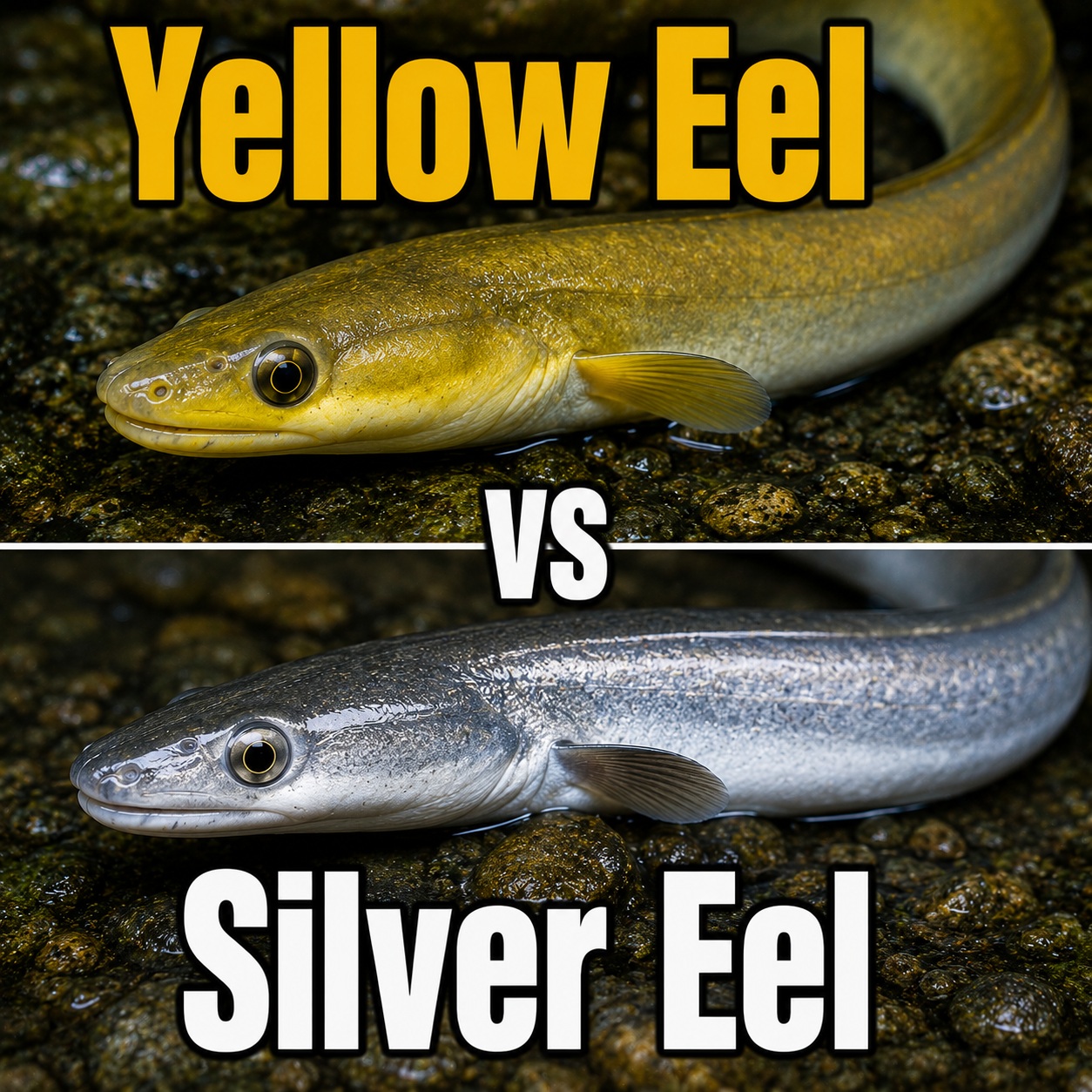
The life of a freshwater eel is one of the most dramatic transformations in the animal kingdom. While they are the same animal, the Yellow Eel and the Silver Eel represent two completely different life stages with vastly different goals, bodies, and behaviors.
Think of the Yellow Eel as the “Stay-at-Home” stage and the Silver Eel as the “World Traveler” stage. Here is a comprehensive look at how they differ.
1. The Biological Mission
The primary difference between these two stages is their purpose in life.
- Yellow Eel (Feeding Stage): The goal is growth and accumulation. They spend this stage (which can last 5 to 20+ years) living in rivers, lakes, or estuaries, eating as much as possible to build up fat reserves.
- Silver Eel (Migratory Stage): The goal is reproduction. Once they reach a certain size and fat percentage, their bodies trigger a “metamorphic” change. They stop eating entirely and begin a one-way trip thousands of miles into the ocean to spawn and die.
2. Physical Appearance and Coloration
The shift from “Yellow” to “Silver” is a masterpiece of natural camouflage, adapting the eel from a murky river environment to the deep, open ocean.
| Feature | Yellow Eel | Silver Eel |
| Back Color | Brownish, olive-green, or dark grey. | Metallic black or dark blue. |
| Belly Color | Yellowish, cream, or pale white. | Brilliant, shimmering silver. |
| Lateral Line | Standard; used for sensing nearby movement. | Highly prominent; used for long-range navigation. |
| Skin Texture | Thinner skin. | Thick, leathery skin to prevent water loss. |
The “Counter-Shading” Logic: In the deep ocean, a dark back hides the eel from predators looking down (matching the dark depths), while a silver belly hides them from predators looking up (matching the sunlight hitting the water’s surface).
3. Sensory Adaptations: The Eyes
One of the most “shocking” changes occurs in the eel’s head.
- Yellow Eel Eyes: They have small, standard eyes suited for shallow, murky river water where they rely more on smell than sight.
- Silver Eel Eyes: Their eyes double or triple in size. They also develop a specialized pigment (rhodopsin) that allows them to see in the blue-spectrum light found in the deep, dark ocean. Essentially, they grow “night-vision goggles” for their journey.
4. Internal Changes: The Point of No Return
As the eel turns silver, its internal organs undergo a radical restructuring to prepare for the marathon swim.
- Digestive System: In the Yellow stage, the eel is a voracious predator. In the Silver stage, the stomach and intestines wither away. The eel will never eat again, fueling its entire 4,000-mile journey solely on the fat it stored as a Yellow eel.
- Reproductive Organs: Yellow eels are sexually immature (you cannot even tell if they are male or female). Silver eels finally begin to develop gonads, though these won’t fully mature until they reach the spawning grounds in the Sargasso Sea.
- Swim Bladder: The Silver eel’s swim bladder becomes more efficient at handling the intense pressure of the deep ocean.
5. Behavior and Habitat
- Yellow Eel: These are mostly nocturnal and sedentary. they find a “home” stretch of a river and stay there for years, hiding in the mud or under rocks during the day and hunting at night.
- Silver Eel: These become determined migrators. They lose their “home-body” instinct and follow the current downstream toward the sea. During this time, they become much more active during the day to ensure they reach the ocean on schedule.
6. Summary Comparison Table
| Characteristic | Yellow Eel | Silver Eel |
| Life Purpose | Growth and Fat Storage | Migration and Spawning |
| Habitat | Freshwater Rivers/Lakes | Open Atlantic Ocean |
| Feeding | Active Predator | Fasting (Does not eat) |
| Eyes | Small | Large (Ocean-optimized) |
| Skin | Slimy and thin | Thick and leathery |
| Duration | 5–20+ Years | ~6–12 Months (The journey) |
Conclusion
The transition from a Yellow eel to a Silver eel is a biological “all-in” bet. By dissolving its digestive system and changing its very chemistry, the eel commits itself to a final, heroic journey. It leaves behind the safety of the river mud to become a shimmering, deep-sea voyager, fulfilling a cycle that has remained unchanged for millions of years.
Did you know? Humans mostly encounter Yellow eels when fishing in rivers, but the eels used in high-end sushi are typically caught during the transition phase to ensure they have the maximum fat content required for that signature buttery flavor.
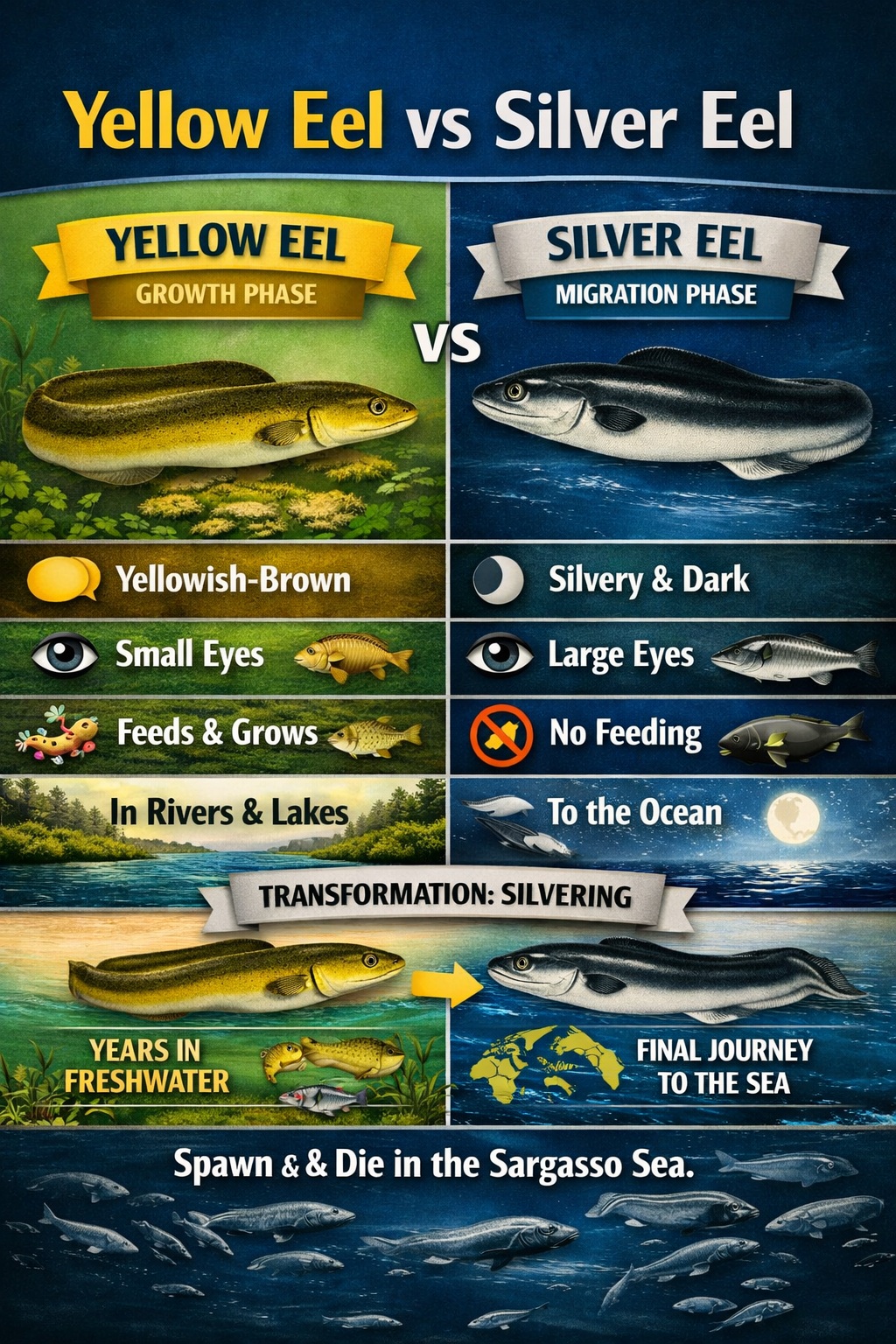
Key Differences Between Yellow Eels and Silver Eels
| Feature | Yellow Eel | Silver Eel |
|---|---|---|
| Stage | Growth stage (juvenile to adult, 5–20 years in rivers/lakes). | Final migratory stage before spawning. |
| Coloration | Greenish‑brown or yellowish sides, white belly. | Metallic sheen, darker back, silvery belly. |
| Habitat | Freshwater rivers, lakes, estuaries. | Oceanic migration to the Sargasso Sea. |
| Eyes | Small, suited for shallow waters. | Enlarged eyes, adapted for deep ocean and low light. |
| Fins & Muscles | Normal size, adapted for feeding and hiding. | Enlarged fins and stronger muscles for long‑distance swimming. |
| Reproductive Organs | Not yet developed. | Gonads mature just before migration. |
| Feeding | Active feeders on worms, crustaceans, fish. | Stop feeding entirely during migration. |
| Behavior | Sedentary, nocturnal hunters. | Highly migratory, swimming nonstop for thousands of kilometers. |
| Duration | Can remain in this stage for decades. | Short stage — migration and spawning, then death. |
Yellow Eel and Silver Eel FAQ’S
Here are five of the most common questions people ask about the mysterious transition between the yellow and silver life stages of the eel.
1. Can a Silver Eel ever turn back into a Yellow Eel?
No. The transformation into a Silver Eel is a biological “point of no return.” Because their digestive tract withers away and their internal organs restructure for the deep ocean, they cannot revert to their river-dwelling feeding stage. Once they turn silver, they must either successfully migrate and spawn or they will eventually die without reproducing.
2. How does an eel “know” when it is time to turn silver?
It is a combination of age, size, and fat percentage. An eel won’t begin the transformation until it has stored enough “fuel” (fat) to survive a journey of several thousand miles without eating. Environmental triggers, such as changes in water temperature or the lunar cycle during autumn, usually signal the start of the downstream migration.
3. Which stage is better for eating?
Culinary preference usually leans toward the late Yellow stage or the very beginning of the Silver stage. This is when the eel has reached its maximum fat content but before it has started to “burn” those fat reserves for its long swim. At this point, the meat is at its richest, most buttery, and most flavorful.
4. Why do Silver Eels have such large eyes?
In the murky rivers where Yellow Eels live, sight is less important than smell. however, the Silver Eel must navigate the open ocean at depths of up to 2,000 feet (600 meters). Their eyes enlarge and develop specialized pigments to detect the faint, blueish “twilight” light of the deep sea and to spot bioluminescent predators or prey.
5. Do they change their scales during the transformation?
Eels actually have very tiny, “cycloid” scales embedded deep within their skin. During the transition to the Silver stage, their skin becomes much thicker and tougher. This serves two purposes: it protects them from the higher salt concentration (osmotic pressure) of the ocean and makes them more resistant to the physical abrasions of a 4,000-mile journey.