

If you have ever tried to hold a live eel, you know it is an exercise in futility. They are widely considered the most “un-grabbable” creatures in the animal kingdom. This legendary slipperiness isn’t just a byproduct of living in water; it is a sophisticated biological defense mechanism and a marvel of evolutionary engineering.
The “slip” of an eel comes from a specialized layer of mucus—a complex, multi-functional coating that allows the eel to thrive in environments that would be lethal to other fish.
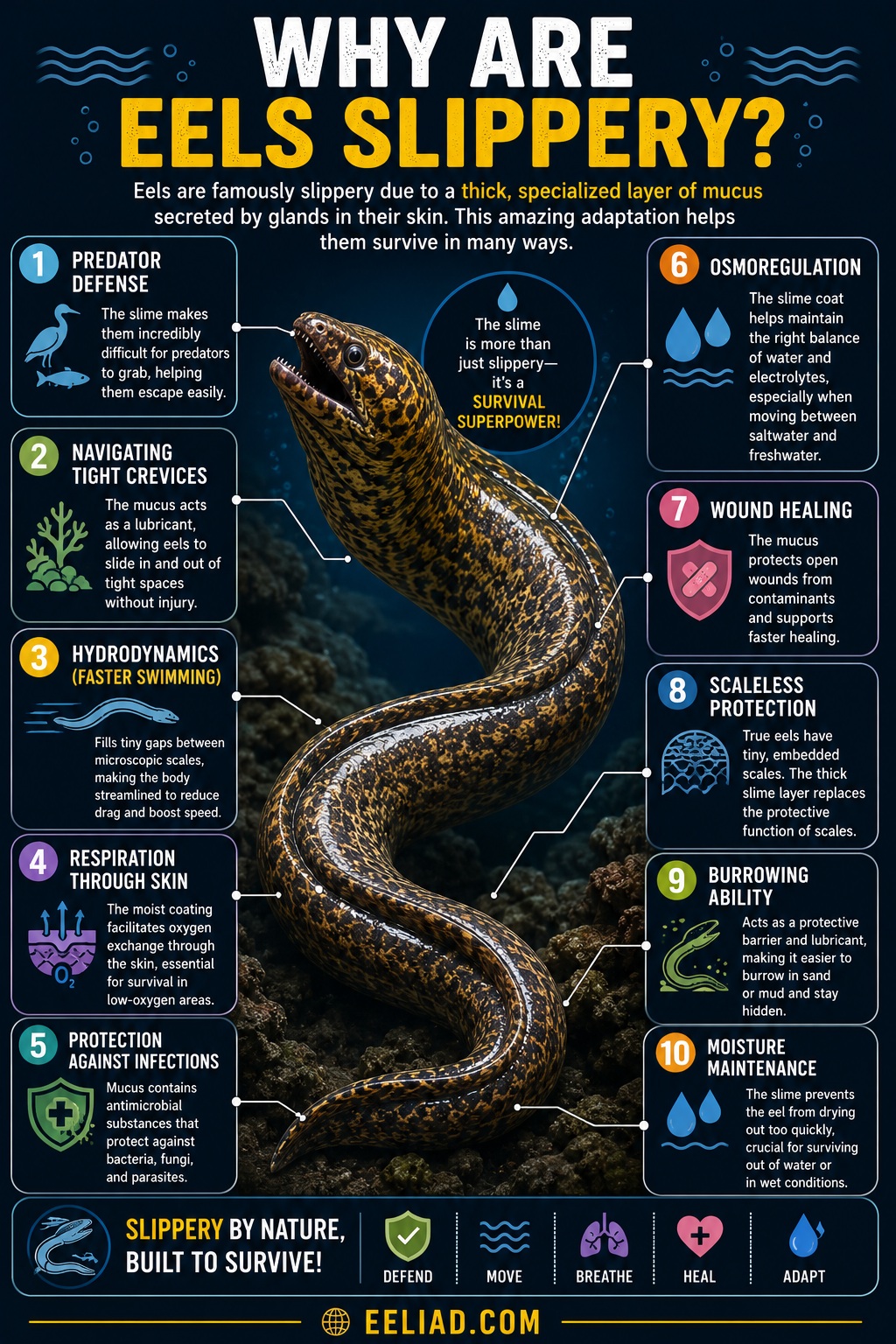
10 reasons why eels are slippery
Eels are famously slippery due to a thick, specialized layer of mucus (slime) secreted by glands in their skin. This adaptation serves several survival purposes, ranging from escape to breathing.
- Predator Defense: The slime makes them incredibly difficult for predators—such as birds, fish, and mammals—to grab, allowing them to escape easily.
- Navigating Tight Crevices: The mucus acts as a lubricant, allowing moray eels and others to slide in and out of tight, rocky crevices and coral reefs without injuring their skin.
- Hydrodynamics (Faster Swimming): The mucus fills the tiny gaps between their microscopic scales, making their bodies highly streamlined to reduce drag and increase speed through the water.
- Respiration Through Skin: Eels can breathe through their skin, and the moist, slimy coating facilitates the exchange of oxygen, which is essential for their ability to move over wet land or survive in shallow, oxygen-poor water.
- Protection Against Infections: The mucus is packed with antimicrobial substances that protect the eel from bacteria, fungi, and parasites in their environment.
- Osmoregulation: The slime coat helps maintain the necessary balance of water and electrolytes in their bodies, particularly when transitioning between saltwater and freshwater environments.
- Wound Healing: The mucus helps protect open wounds from environmental contaminants, aiding in quick healing.
- Scaleless Protection: Unlike most fish, true eels have extremely small, embedded scales. The thick mucus layer replaces the protective function that traditional scales provide in other fish.
- Burrowing Ability: For species that live in sand or mud, the slime acts as a protective barrier and lubricant, making it easier to burrow and stay hidden.
- Moisture Maintenance: The slime prevents the eel from drying out too quickly, which is crucial for their ability to travel over land or survive temporarily out of water.
1. The Anatomy of the Slime Layer
The slipperiness of an eel begins in the epidermis (the outer layer of skin). Unlike many fish that rely on thick, overlapping scales for protection, eels have either very small, deeply embedded scales or no scales at all.
To compensate for this lack of “armor,” their skin is packed with specialized goblet cells and club cells. These cells continuously produce and secrete a protein called mucin. When mucin contact water, it expands rapidly, transforming into the slippery, viscous gel we recognize as eel slime.
2. A Living Shield: Protection Against Predators
The most obvious benefit of being slippery is predator avoidance.
- The “Soap Bar” Effect: When a predator, such as a heron or a larger fish, tries to clamp its jaws onto an eel, the mucus acts as a high-performance lubricant. The harder the predator squeezes, the faster the eel squirts out of its grip.
- Clogging the Gills: If a predator does manage to get an eel into its mouth, the eel can release a massive “stress burst” of mucus. This slime can coat the predator’s mouth and even clog its gills, forcing the attacker to spit the eel out to avoid suffocation.
3. The “Liquid Bandage”: Health and Immunity
Eel slime is far more than just a lubricant; it is a potent chemical cocktail. Because eels often live in muddy, bacteria-rich environments or sharp coral crevices, their skin is at constant risk of infection.
- Antimicrobial Properties: The mucus contains enzymes (like lysozymes) and antibacterial peptides that kill pathogens on contact.
- Physical Barrier: It acts as a “second skin,” sealing small cuts and abrasions instantly to prevent fungus and parasites from taking hold.
4. Breathing Through the Skin
One of the most remarkable reasons for the eel’s slipperiness is its ability to travel over land. Some species, like the European or American eel, frequently migrate across damp grass to move between bodies of water.
- Cutaneous Respiration: Eels can absorb up to 50% of their oxygen through their skin. However, for this to work, the skin must remain moist.
- Moisture Retention: The thick mucus layer traps a thin film of water against the skin, acting like a SCUBA tank in reverse. It prevents the eel from drying out (desiccation) while it “breathes” atmospheric oxygen during its overland journeys.
5. Hydrodynamics: Reducing Friction
Water is 800 times denser than air, making friction a major obstacle for swimming animals.
- Laminar Flow: The mucus layer smoothes out tiny irregularities on the eel’s body surface. This creates a more “laminar” flow of water around the eel, reducing turbulent drag.
- Energy Efficiency: By being slippery, the eel requires less muscular effort to glide through the water, allowing it to travel thousands of miles during its legendary spawning migrations with minimal caloric burn.
6. Slipperiness in the Kitchen: The Culinary Challenge
For chefs, the eel’s slime is the first hurdle to a successful meal.
- The Salt Cure: To remove the slipperiness, traditional Japanese and Italian chefs rub the eel with coarse salt or vinegar. This “denatures” the proteins in the mucus, causing it to coagulate so it can be scraped away.
- Safety Tip: As discussed in previous guides, while the slime itself isn’t toxic, the blood underneath is. Handling a slippery eel requires a firm grip (often using a dry cloth) to ensure the knife doesn’t slip during preparation.
Summary: The Multi-Tool of the Sea
The slipperiness of an eel is a perfect example of biological efficiency. What we perceive as a “gross” or “slimy” texture is actually:
- A suit of armor against predators.
- An immune system against bacteria.
- A respirator for land travel.
- A turbocharger for swimming efficiency.
In the wild, being slippery isn’t just a trait—it’s a superpower that has kept eels at the top of the food chain for millions of years.
Related FAQ’S
1. Which fish is most oily?
While “oiliness” can vary based on the season and the fish’s diet, Eels are consistently ranked among the oiliest fish in the world. Their fat content can reach up to 20% to 30% of their body weight.
Other highly oily fish include:
- Mackerel: High in Omega-3s and very heart-healthy.
- Sablefish (Black Cod): Often called “Butterfish” due to its intense, silky oil content.
- Salmon: Particularly the King (Chinook) variety.
- Sardines: Packed with healthy fats and nutrients.
2. Are eels actually slippery?
Yes, and it is a marvel of biological engineering. Eels do not just “feel” slippery because they are wet; they are covered in a thick layer of mucus.
This slime is produced by specialized “goblet cells” in their skin. When the eel is stressed or handled, these cells release proteins that expand in water to create a high-performance lubricant. This makes them nearly impossible for predators (or humans) to grip, and it also allows them to breathe through their skin when traveling over damp land.
3. What is the most slippery animal?
While eels are the masters of the “escape grip,” the title for the most slippery animal on Earth generally goes to the Hagfish.
Known as the “Slime Eel” (though it is not a true eel), the Hagfish can produce liters of thick, fibrous slime in seconds when threatened. This slime is so strong and viscous that it can clog the gills of an attacking shark, forcing the predator to retreat to avoid suffocation.
4. Why can’t eel be eaten raw?
This is the most important safety rule in eel consumption: Eel blood is toxic to humans.
Freshwater and saltwater eels contain a toxic protein called ichthyotoxin. If ingested raw, this toxin can cause:
- Severe muscle cramping (including the heart).
- Respiratory distress.
- Nausea and vomiting.
The Good News: This toxin is extremely heat-sensitive. Cooking eel to an internal temperature of 140°F (60°C) completely neutralizes the protein, rendering the fish safe and delicious. This is why even in the finest sushi restaurants, you will always see the eel grilled (Unagi) or simmered (Anago) rather than served as raw sashimi.