While most people are familiar with the eels found in rivers or shallow coral reefs, the deep sea (the bathypelagic and abyssopelagic zones) is home to some of the most specialized and bizarre-looking vertebrates on the planet.
Down here, where the pressure is crushing and the light is non-existent, “true” eels and eel-like fish have evolved radical body shapes to survive.
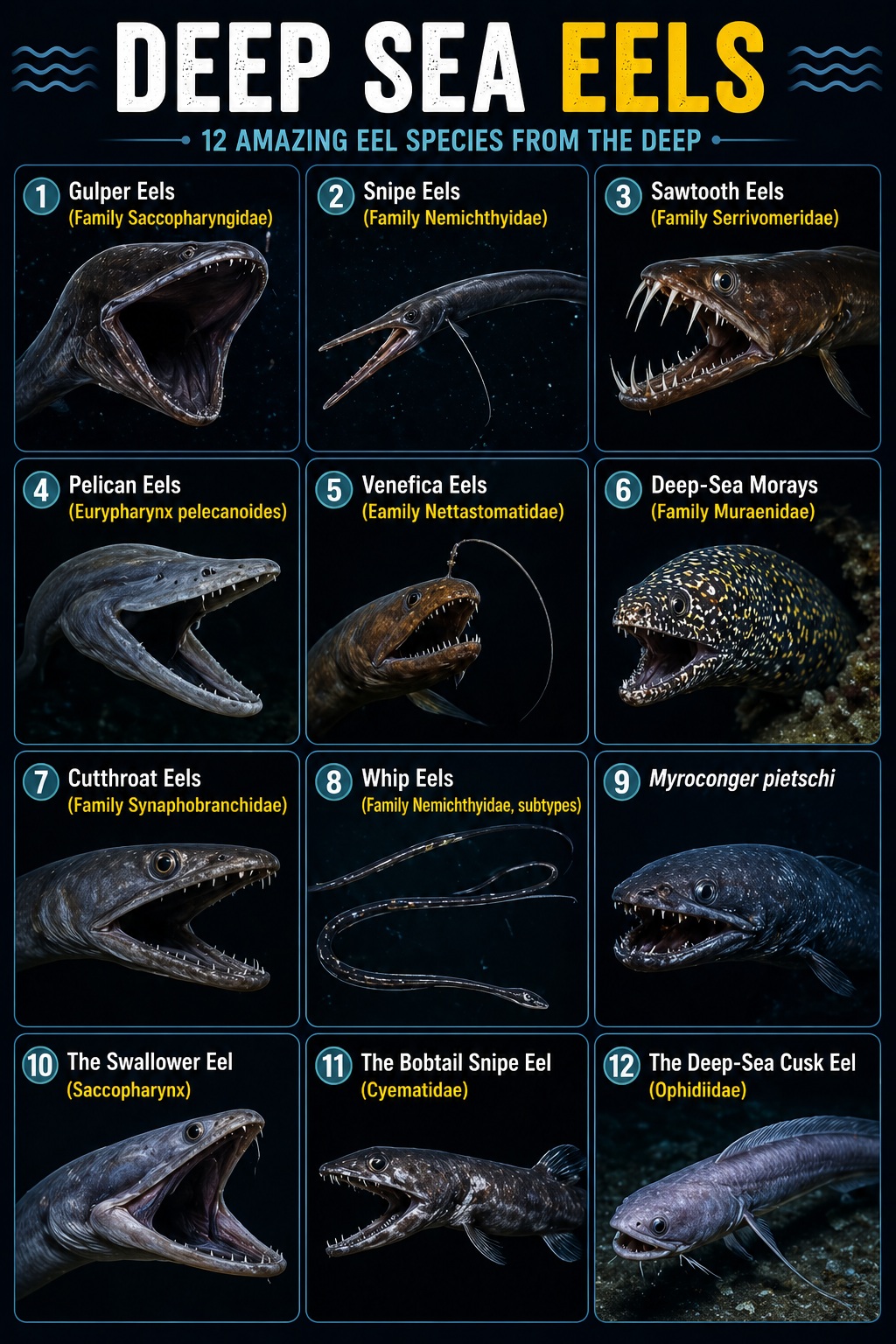
1. The Gulper Eel (Eurypharynx pelecanoides)
Often called the Pelican Eel, this is perhaps the most famous deep-sea eel. It lives at depths of 500 to 3,000 meters.
- The Body: Because its mouth is so large, its body is disproportionately small and thin.
- Appearance: Gigantic, pouch‑like jaws resembling a pelican’s beak.
- Depth Range: 500–3,000 m.
- Adaptations: The lower jaw expands to engulf prey; the tail tip glows to lure victims.
- The Tail: It has a long, whip-like tail ending in a complex organ (photophore) that glows with pink light. Scientists believe it uses this as a fishing lure to attract prey in the dark.
- Fun Fact: Despite their size, they weigh less than a loaf of bread — their bones are paper‑thin.
2. The Snipe Eel (Nemichthys scolopaceus)
Snipe eels are incredibly slender, looking more like a piece of ribbon than a fish. They live in the “Twilight Zone” and deeper (up to 2,000 meters).
- The Beak: They have extremely long, thin jaws that curve away from each other at the tips, resembling the beak of a bird called a Snipe.
- The Teeth: The jaws are covered in tiny, hooked teeth. They swim with their mouths open, and when the “beak” touches the antennae of a deep-sea shrimp, the shrimp becomes hopelessly entangled in the teeth.
- The Eyes: They have large, well-developed eyes to catch the faint bioluminescence of their prey.
3. Sawtooth Eels (Family Serrivomeridae)
- Appearance: Razor‑like teeth protrude even when the mouth is closed.
- Depth Range: 1,000–3,000 m.
- Adaptations: Hunt small fish and squid in pitch‑black waters using sensitive lateral lines to detect movement.
- Fun Fact: Their teeth glow faintly under certain light conditions due to reflective enamel.
5. Venefica Eels (Family Nettastomatidae)
- Appearance: Slender, fang‑toothed hunters with snake‑like heads.
- Depth Range: 400–2,000 m.
- Adaptations: Ambush predators that bury in sediment, waiting for passing prey.
- Fun Fact: Their name means “poison‑bearing,” though they are not venomous — just intimidating.
6. Deep‑Sea Morays (Family Muraenidae)
- Appearance: Muscular, scaleless bodies with sharp teeth and patterned skin.
- Depth Range: 200–1,000 m.
- Adaptations: Use pharyngeal jaws to pull prey into their throats — a true “alien‑style” mechanism.
- Fun Fact: Some species can change sex from male to female depending on population density.
7. Cutthroat Eels (Family Synaphobranchidae)
- Appearance: Pale, translucent skin with visible veins and gill slits that look “cut.”
- Depth Range: 1,000–4,000 m.
- Adaptations: Survive extreme pressure and cold; feed on carrion and small crustaceans.
- Fun Fact: Their blood contains antifreeze proteins that prevent ice crystal formation.
8. Whip Eels (Family Nemichthyidae, subtypes)
- Appearance: Ultra‑slender, whip‑like bodies with tiny heads.
- Depth Range: 500–2,000 m.
- Adaptations: Swim in slow, wave‑like motions to conserve energy; feed on plankton and larvae.
- Fun Fact: Their bodies are so thin that internal organs form a single ribbon‑like strand.
9. Myroconger pietschi
- A rare species of the red eel family (Myrocongridae).
- Found in deep, dark ocean environments, often below 400–1,000 m.
- Distinctive bright red coloration acts as camouflage in the abyss (red light doesn’t penetrate deep water).
- Soft, gelatinous body adapted to crushing pressure and low‑energy habitats.
10. The Swallower Eel (Saccopharynx)
Closely related to the Gulper Eel, the Swallower is the heavy-weight champion of deep-sea consumption.
- The Stomach: It has an incredibly distensible (stretchy) stomach. It can consume meals so large that they visibly bulge the eel’s entire midsection, allowing it to go weeks or months between meals.
- The Teeth: Unlike the Gulper, which has tiny teeth, the Swallower has multiple rows of sharp, curved teeth to ensure prey cannot escape its massive maw.
11. The Bobtail Snipe Eel (Cyematidae)
A cousin of the Snipe Eel, but with a very different “short-order” design.
- The Shape: Instead of a long, tapering tail, it has a blunt, “bobbed” tail.
- The Mystery: They are rarely seen alive. Most of what we know comes from specimens caught in deep-sea trawling nets. They are thought to be “sit-and-wait” predators, hovering vertically in the water column.
12. The Deep-Sea Cusk Eel (Ophidiidae)
While not “true” eels (they are members of the Ophidiiformes order), they are the deepest-living eel-like fish in the world.
- The Record Holder: A species of Cusk Eel (Abyssobrotula galatheae) was discovered in the Puerto Rico Trench at a depth of 8,370 meters (27,460 feet). This makes it one of the deepest-living vertebrates ever recorded.
- The Appearance: They have soft, flabby bodies and reduced eyes, as vision is useless in the absolute darkness of the trenches.
13. European Eels (Adults)
- During their final migration to the Sargasso Sea, adults can descend to depths of over 1,400 m.
- At this stage, they transform into silver eels: enlarged eyes, stronger muscles, and no feeding.
- Their ability to survive such depths highlights extreme physiological adaptations.
14. Deep‑Water Predators
Green Moray Eel (Gymnothorax funebris)
- Found on deep reefs and rocky areas in the western Atlantic.
- Can reach lengths of up to 8 feet (2.4 m).
- Known for their alien‑style pharyngeal jaws, pulling prey into the throat.
- Despite their fearsome look, they are generally shy unless provoked.
Conger Eels (Family Congridae)
- Large, muscular eels inhabiting deep coastal waters and continental slopes.
- Some species exceed 10 feet (3 m) in length.
- Powerful predators feeding on fish, squid, and crustaceans.
- Unlike morays, they have scales and smoother bodies, adapted for open‑water hunting.
🧭 Conclusion
Deep‑sea eels are masters of adaptation, thriving in crushing pressure, freezing temperatures, and total darkness. From the jaw‑snapping morays to the ghostly snipe eels, each species reveals evolution’s creativity in the ocean’s abyss. Their bizarre forms — glowing tails, expandable jaws, and transparent bodies — remind us that life can flourish even in the most alien environments on Earth.
Deep‑Sea Eel Types FAQ’s
1. What makes deep‑sea eels different from shallow‑water eels?
Deep‑sea eels live at extreme depths (hundreds to thousands of meters), adapted to darkness, crushing pressure, and scarce food. They often have bizarre jaws, glowing tails, or transparent bodies.
2. Are gulper eels and pelican eels the same?
No. Both have huge mouths, but gulper eels (Saccopharyngidae) have balloon‑like jaws, while pelican eels (Eurypharynx) have pouch‑like beaks resembling pelicans.
3. Do deep‑sea eels produce light?
Some species, like gulper and pelican eels, use bioluminescent tails to lure prey in the dark. Others rely on reflective tissues.
4. Are deep‑sea eels dangerous to humans?
Not really. Most live far below human reach. Their teeth look terrifying, but they pose no threat unless handled.
5. Why are snipe eels so thin?
Snipe eels have thread‑like bodies with over 700 vertebrae. Their thin shape reduces energy use and helps them drift in mid‑ocean currents.
6. What is the rarest deep‑sea eel?
Myroconger pietschi and other red eels are among the rarest, known from only a few specimens collected in deep trawls.
7. Do European eels go deep?
Yes. During migration, adult European eels can dive to over 1,400 m en route to the Sargasso Sea.
8. How big can deep‑sea eels get?
Conger eels can exceed 10 feet (3 m), while green morays reach 8 feet (2.4 m). Gulper and pelican eels look huge due to their mouths but are lightweight.
9. Do deep‑sea eels have bones?
Many have reduced skeletons or gelatinous bodies to withstand pressure and conserve energy.
10. Why are some deep‑sea eels red?
Red coloration acts as camouflage — red light doesn’t penetrate deep water, making them invisible in the abyss.