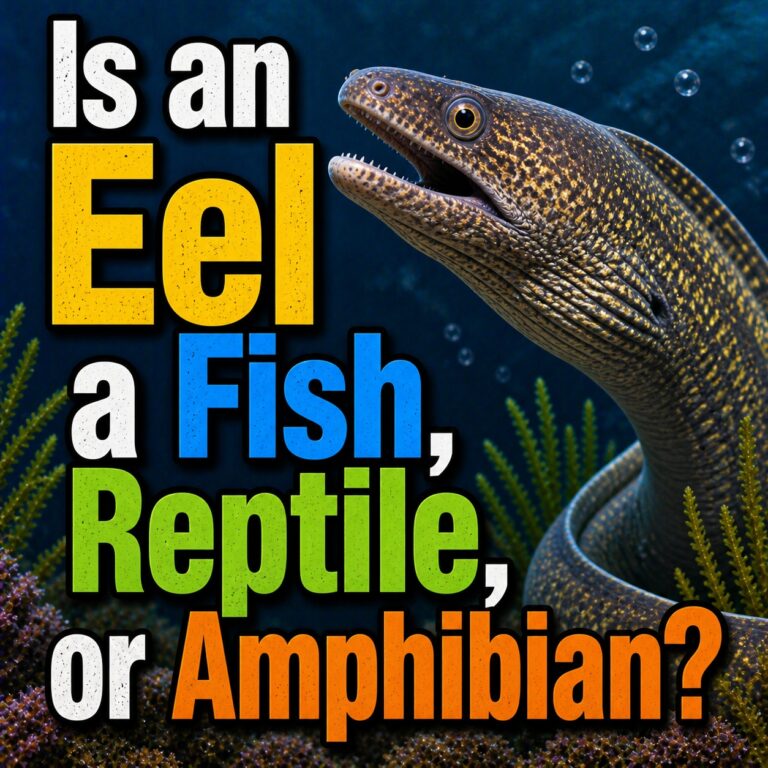

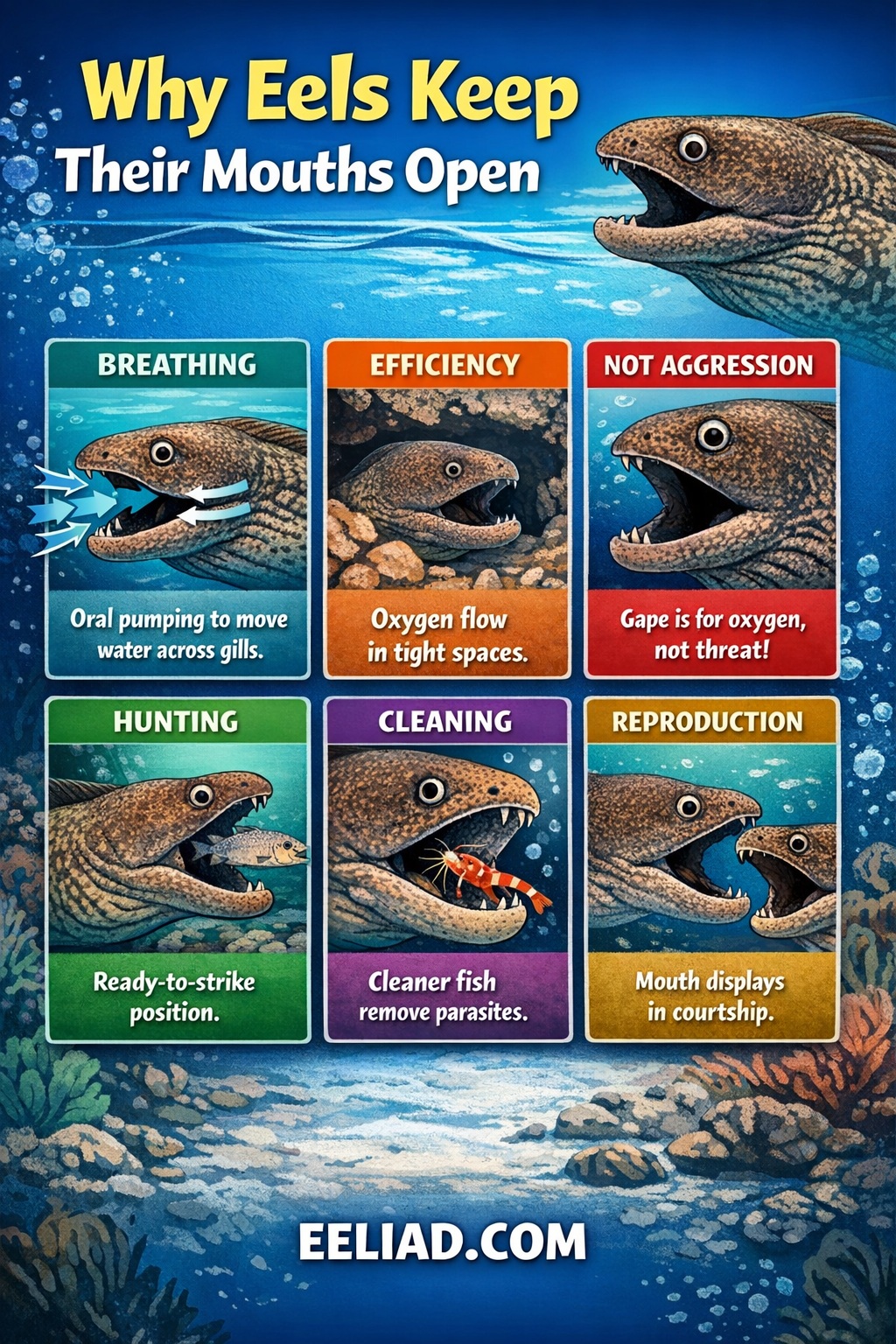
Why eels keep their mouths open has fascinated divers, marine biologists, and casual observers alike. The behavior looks intimidating, but it is not aggression. Instead, it is a multifunctional adaptation tied to breathing, hunting, efficiency, cleaning symbiosis, and even reproduction. This article explores the reasons behind this behavior, supported by science, ecology, and cultural insights.
🫁 Breathing Mechanism: Oral Pumping
Eels lack the operculum, the bony gill cover found in most fish. Without it, they cannot passively pump water over their gills. Instead, they use an oral pump system:
- Opening the mouth draws water in.
- Closing the mouth pushes water across the gills.
- This rhythmic gaping ensures oxygen intake even when stationary.
This breathing mechanism is the primary reason eels keep their mouths open.
⚠️ Not a Threat Display
Divers often misinterpret the open mouth as aggression. In reality:
- A stationary eel with its mouth open is simply breathing.
- The gape is a resting state, not hostility.
- True aggression involves sudden lunges or rapid strikes, not slow rhythmic gaping.
Thus, the open mouth is more about survival than intimidation.
🌬️ Respiratory Efficiency in Confined Habitats
Eels live in rocky crevices, coral reefs, and sandy burrows where water circulation is limited. Keeping the mouth open allows:
- A steady flow of oxygenated water.
- Efficient respiration in tight spaces.
- Adaptation to environments with fluctuating oxygen levels.
This efficiency is critical for survival in reef ecosystems.
🦑 Hunting Readiness
Eels are ambush predators. Their open mouth doubles as a ready‑to‑strike position:
- Reduces reaction time when prey swims past.
- Teeth are already exposed for gripping slippery fish.
- Pharyngeal jaws (a second set of jaws in the throat) secure prey once caught.
This dual function—breathing and hunting—makes the gape a versatile adaptation.
🧼 Cleaner Fish Access
Symbiosis plays a role too. Cleaner wrasses and shrimp sometimes enter the eel’s mouth to remove parasites.
- The open mouth provides safe access for cleaners.
- Morays tolerate this behavior, showing trust.
- Both species benefit: eels get hygiene, cleaners get food.
This mutualism highlights the ecological importance of the gape.
💕 Reproductive Behavior
During courtship, some eels hold their mouths wide open for long periods.
- Acts as a visual signal to potential mates.
- May demonstrate readiness or dominance.
- Though less studied, this behavior has been observed in aquaria and wild encounters.
Thus, the gape also plays a role in reproduction.
Eel Species Known for Open‑Mouth Breathing
1. Moray Eels (Family Muraenidae)
- Most famous for constant gaping.
- Lack opercula (bony gill covers), so they rely on oral pumping.
- Their open mouths are often mistaken for aggression but are simply respiration.
2. Snake Eels (Family Ophichthidae)
- Includes species like the Sharptail Eel (Myrichthys breviceps) and Spoon‑Nose Eels (Echiophis spp.).
- Like morays, they have small gill openings and use rhythmic mouth movements to breathe.
- Often seen with mouths open while burrowed in sand.
3. Swamp Eels (Monopterus albus)
- Air‑breathing eels found in Asia.
- Can absorb oxygen through their skin and mouth lining, but also use oral pumping when underwater.
- Frequently gape to maximize oxygen flow in low‑oxygen environments.
4. Conger Eels (Family Congridae)
- Large reef‑dwelling eels that sometimes exhibit open‑mouth breathing.
- Their gill openings are reduced compared to typical fish, requiring more visible mouth movements.
5. Garden Eels (Family Congridae, Subfamily Heterocongrinae)
- Garden Eels Live in colonies, poking out of sandy burrows.
- Often seen with mouths slightly open to maintain water flow while remaining stationary.
🌬️ Why This Behavior Is Common
- Reduced Gill Covers: Many eel families have small or absent opercula, forcing them to use oral pumping.
- Burrowing Lifestyle: Living in confined reef crevices or sandy burrows limits water flow, so open‑mouth breathing ensures oxygen intake.
- Respiratory Efficiency: Continuous gaping maximizes oxygen delivery in habitats where water circulation is low.
This shows the behavior is widespread across the eel order Anguilliformes.
📜 Cultural and Folklore Significance
- In Polynesian and Hawaiian traditions, eels are revered as reef guardians.
- Their open mouths symbolize mystery, danger, and resilience.
- Modern divers often fear them unnecessarily, reinforcing their reputation as “snarling monsters.”
⚠️ Conservation and Threats
- Status: Most eel species are not endangered, but localized threats exist.
- Threats: Overfishing, reef degradation, pollution, and climate change.
- Conservation Needs: Protecting reef habitats ensures eels continue their ecological role.
For further reading, see NOAA Coral Reef Conservation and IUCN Red List.
❓ FAQs
Q1: Why do moray eels keep their mouths open? They use oral pumping to breathe, moving water across their gills.
Q2: Is an open mouth a sign of aggression? No, it is a resting state for respiration, not hostility.
Q3: Do all eels keep their mouths open? Many species, including morays, snake eels, and swamp eels, exhibit this behavior.
Q4: Can cleaner fish enter an eel’s mouth safely? Yes, eels tolerate cleaner fish and shrimp removing parasites.
Q5: Does mouth‑opening help in hunting? Yes, it doubles as a ready‑to‑strike position for ambush predators.
Q6: Why is this behavior important in reefs? It ensures oxygen intake in confined habitats and supports symbiotic relationships.
Q7: Do eels open their mouths during reproduction? Yes, some species gape widely during courtship displays.
Q8: Are eels dangerous to divers? Generally no, unless provoked. Their open mouths are for breathing, not attacking.
Q9: What role do pharyngeal jaws play? They secure prey once caught, compensating for the eel’s narrow body.
Q10: How does this behavior affect reef ecosystems? It supports predator balance, cleaner symbiosis, and reef health.
✅ Conclusion
Eels keep their mouths open for breathing, efficiency, hunting readiness, cleaning symbiosis, and reproduction. Far from being a threat, the gape is a multifunctional survival strategy that highlights the evolutionary ingenuity of eels. Understanding this behavior dispels myths and deepens appreciation for these vital reef predators.