The Caribbean Sea serves as a vibrant underwater theater where some of the ocean’s most enigmatic predators take center stage. Within the intricate labyrinth of coral reefs, sprawling seagrass meadows, and vast sandy plains, eels have evolved into specialized masters of ambush and adaptation.
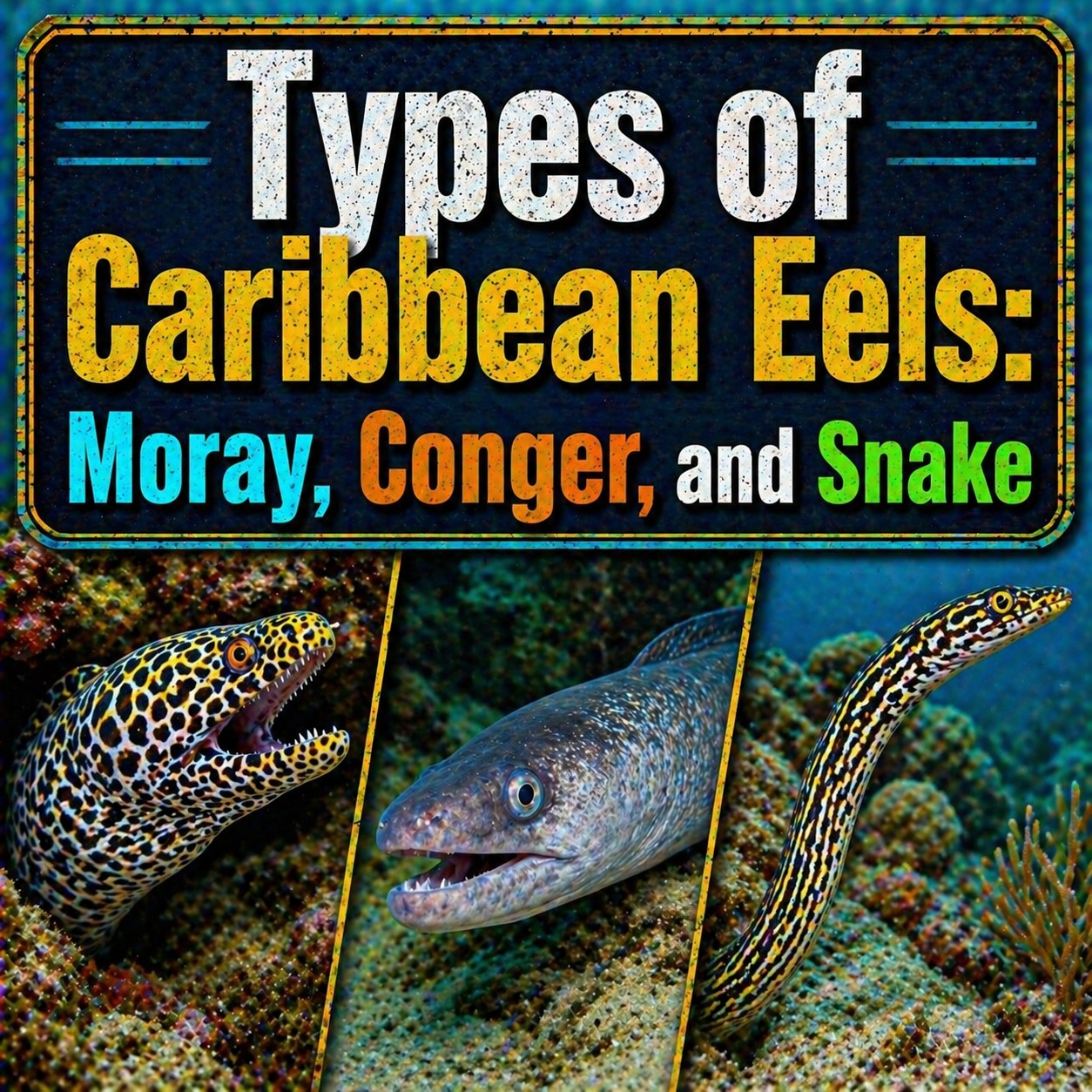
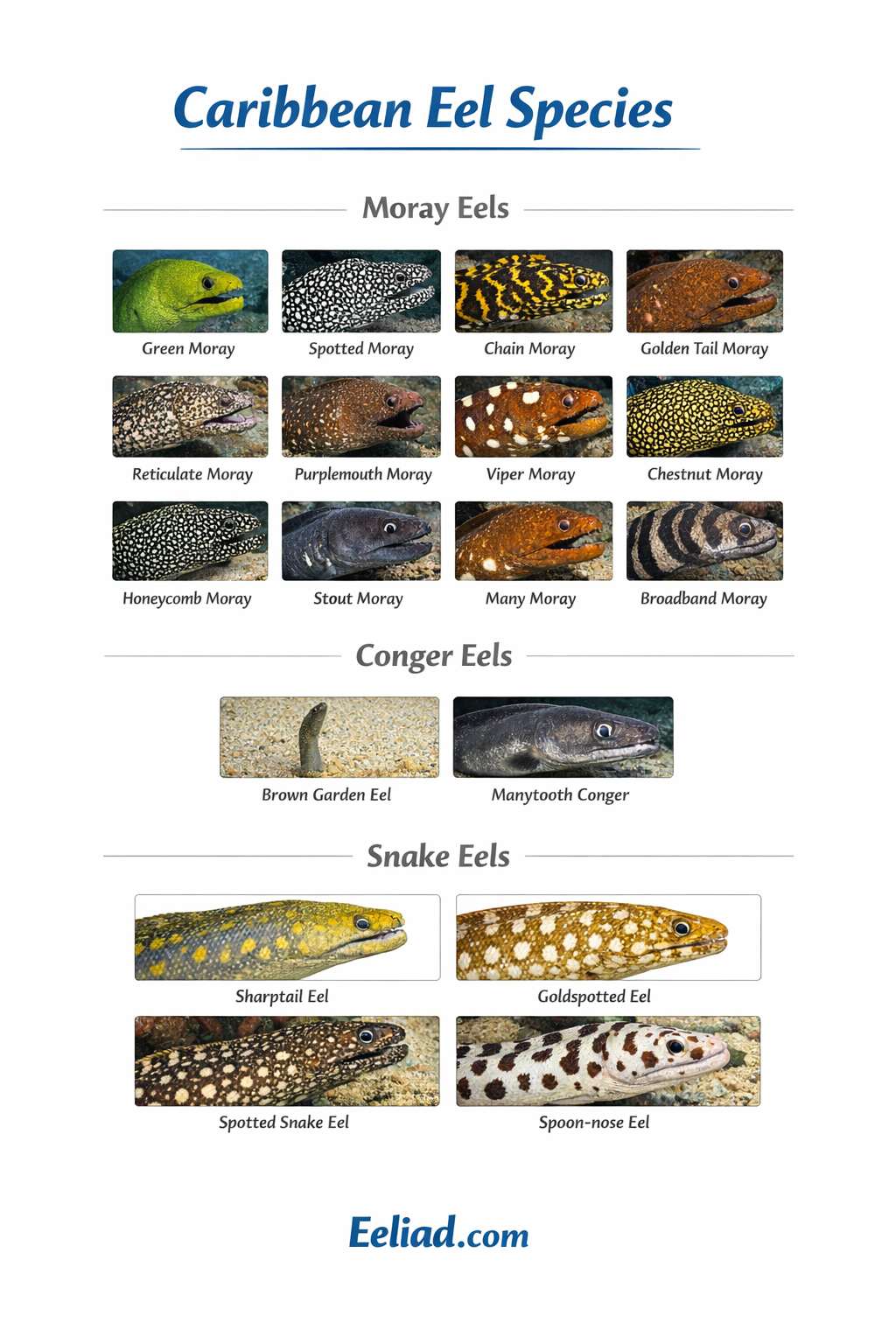
This comprehensive guide explores 17 notable Caribbean eel species, categorized into the powerful Morays, the colonizing Congers, and the elusive Snake eels.
Moray Eels: The Reef’s Apex Ambushers (11 Species)
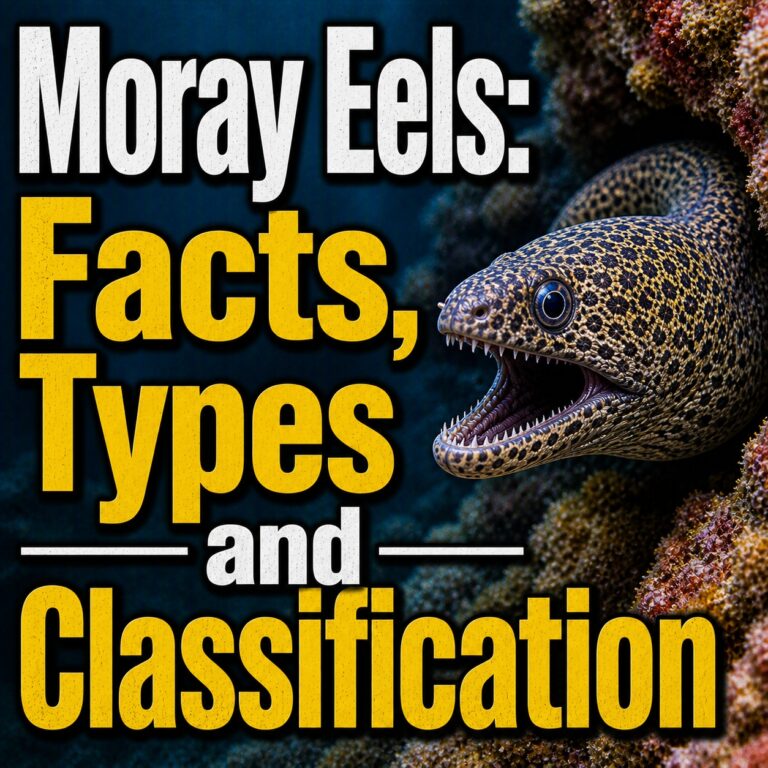
Moray eels belong to the family Muraenidae. They lack pectoral fins and scales, and they exhibit a characteristic “gaping” behavior—a rhythmic opening and closing of the mouth—to pump water over their gills.
1. Green Moray (Gymnothorax funebris)
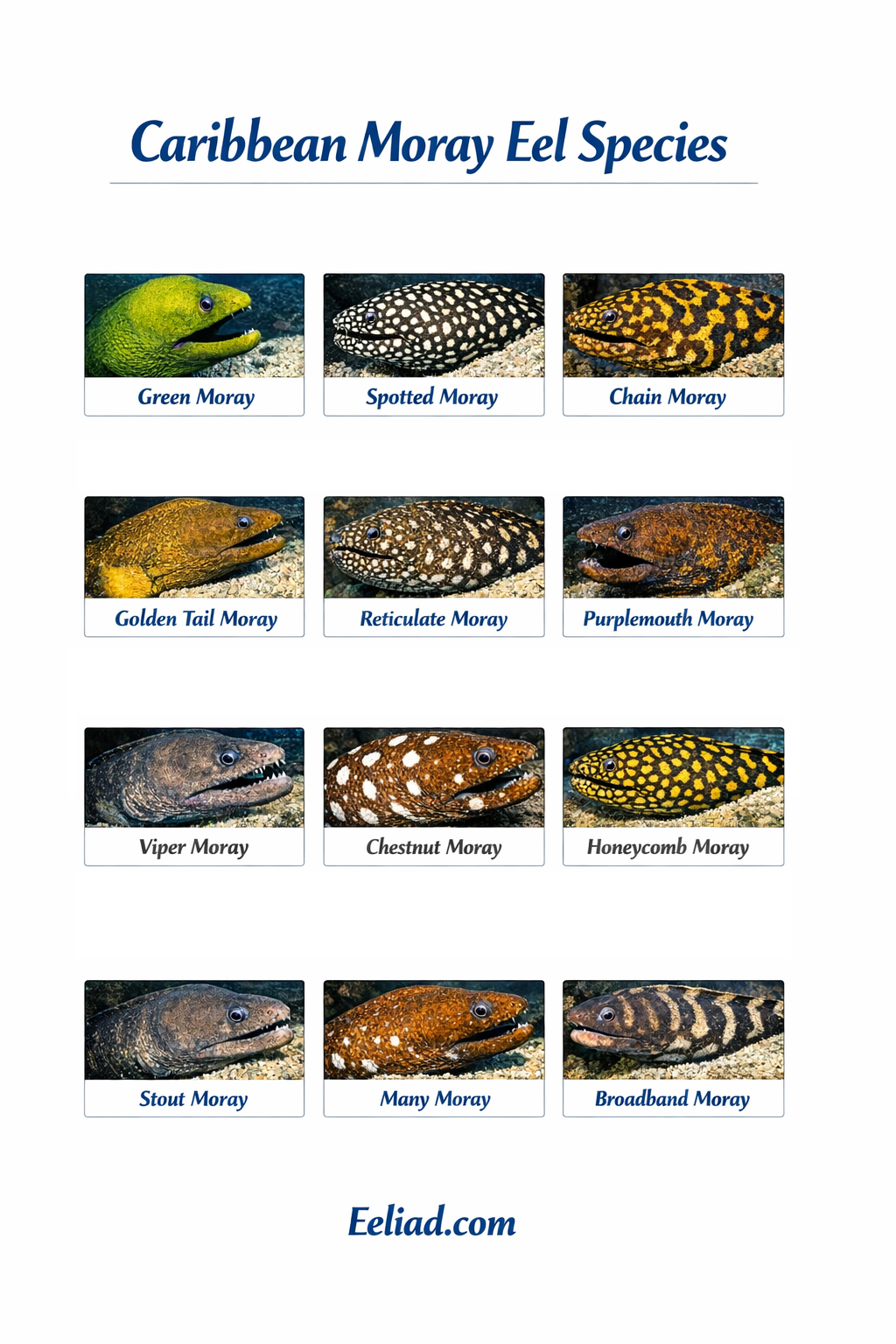
As the largest moray in the Caribbean, the Green Moray commands respect. Although it appears neon or olive green, a yellow mucus layer covering its naturally dark-blue skin creates this optical illusion. These giants reach lengths of up to 2.4 meters and possess thick, muscular bodies designed for wedging into deep reef crevices. Because they are nocturnal, they spend daylight hours tucked away and emerge at night to hunt fish, octopuses, and crabs using a keen sense of smell.
2. Spotted Moray (Gymnothorax moringa)
Snorkelers frequently encounter the Spotted Moray, a medium-to-large predator. A complex white or pale-yellow background heavily dappled with dark brown or black spots drapes its body. This high-contrast pattern provides exceptional camouflage against the sun-dappled textures of shallow reefs. Furthermore, this opportunistic hunter reaches nearly 2 meters in length and occasionally engages in interspecies hunting by following groupers to catch prey.
3. Chain Moray (Echidna catenata)
The Chain Moray breaks the typical “long and slender” mold with its more compact, blunt-headed physique. Its name derives from the beautiful yellow, chain-like markings that crisscross its dark brown or black body. Unlike its fish-eating cousins, the Chain Moray specializes in eating crustaceans. It possesses blunt, molar-like teeth specifically adapted for crushing the hard shells of crabs and shrimp. Consequently, you can often find them in very shallow water, including tide pools and rocky shorelines.
4. Goldentail Moray (Gymnothorax miliaris)
Underwater photographers favor this species due to its stunning coloration. The Goldentail Moray typically features a dark brown body covered in hundreds of tiny gold or yellow flecks. However, its most defining characteristic remains the solid yellow or gold tip of its tail. Growing only to about 60 centimeters, it remains relatively small and secretive, hiding within coral heads until the cover of darkness allows it to forage.
5. Reticulate Moray (Muraena retifera)
Observers often confuse the Reticulate Moray with the Spotted Moray, yet a closer look reveals a distinctive “net-like” pattern of white lines over a brown base. This smaller species rarely exceeds 60 centimeters and thrives in coral rubble zones. Because its intricate skin pattern mimics the shadows and textures of broken reef fragments, it remains virtually invisible to both predators and unsuspecting prey.
6. Purplemouth Moray (Gymnothorax vicinus)
The Purplemouth Moray earns its name from the deep violet or dark lining of its oral cavity, which becomes visible when the eel breathes. Reaching lengths of 1.2 meters, it displays a mottled, yellowish-brown body and striking yellow eyes. This species acts more aggressively and swims faster than many other morays. In addition, it favors shallower reef areas and seagrass beds where it utilizes its speed to ambush small fish from the shadows.
7. Viper Moray (Enchelycore nigricans)
True to its name, the Viper Moray possesses a terrifying profile. Its jaws remain permanently arched, which prevents the eel from fully closing its mouth and leaves its long, needle-sharp teeth visible at all times. This dentition serves as a specialized tool for grasping slippery, fast-moving fish. Growing to 72 centimeters, its body typically features a uniform dark brown or black color.
8. Chestnut Moray (Enchelycore carychroa)
The Chestnut Moray is a diminutive but beautiful resident of Caribbean reefs. It features a rich, reddish-brown body and a white spot located at the corner of its jaw. Like the Viper Moray, its jaws curve slightly. It masters the “micro-habitat” by living in small holes within the coral structure that larger morays cannot access. Its diet consists primarily of very small fish and reef invertebrates.
9. Honeycomb Moray (Gymnothorax saxicola)
The Honeycomb Moray displays one of the most geometric patterns in the ocean. Large, dark, semicircular spots outlined in white or pale cream create a honeycomb appearance. This medium-sized eel frequently inhabits coastal waters and offshore reefs. It functions as a versatile predator, shifting its diet based on availability, though it shows a marked preference for small reef fish during the twilight hours.
10. Stout Moray (Muraena robusta)
The Stout Moray is built for power rather than speed. It possesses a heavy, thick-set body, a short snout, and a distinctive orange-to-yellow interior mouth. Growing to 1.2 meters, it often resides in deeper waters or around rocky ledges. Its physical strength allows it to pull larger prey into the reef structure. Furthermore, its small eyes suggest that it relies almost exclusively on its highly developed sense of smell to track prey.
11. Broadband Moray (Channomuraena vittata)
The Broadband Moray represents a rare and unusual sight. Observers easily identify it by the wide, alternating bands of dark chocolate brown and pale tan that wrap around its body. Its skin often appears loose or wrinkled, adding to its unique aesthetic. Reaching up to 150 centimeters, it typically avoids shallower tourist reefs and prefers the quiet of deep-water caves and ledges instead.
Conger Eels: The Sandy Residents (2 Species)
Conger eels (family Congridae) differ from morays by possessing pectoral fins and a more elongated, pointed snout. In the Caribbean, they represent two very different lifestyles.
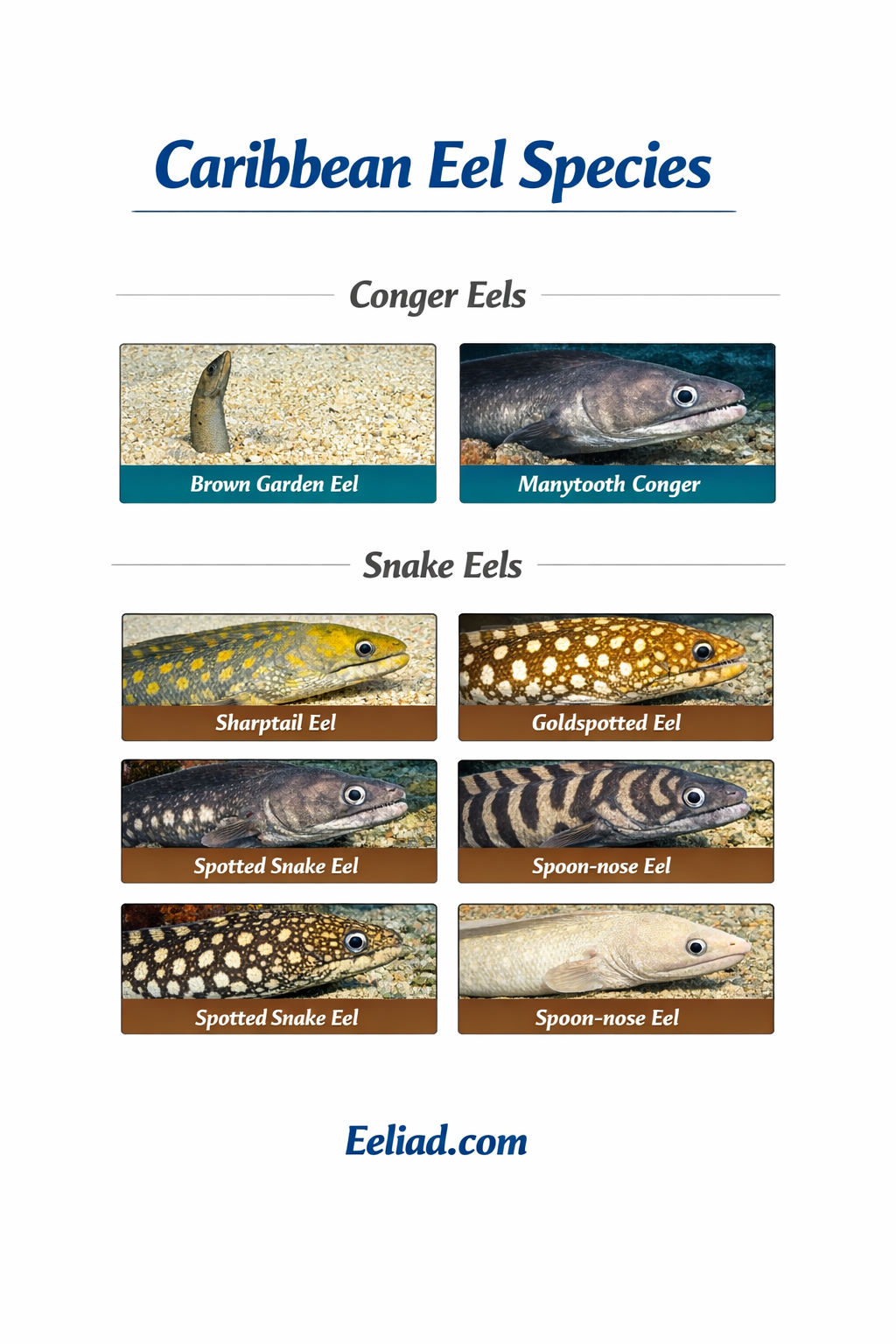
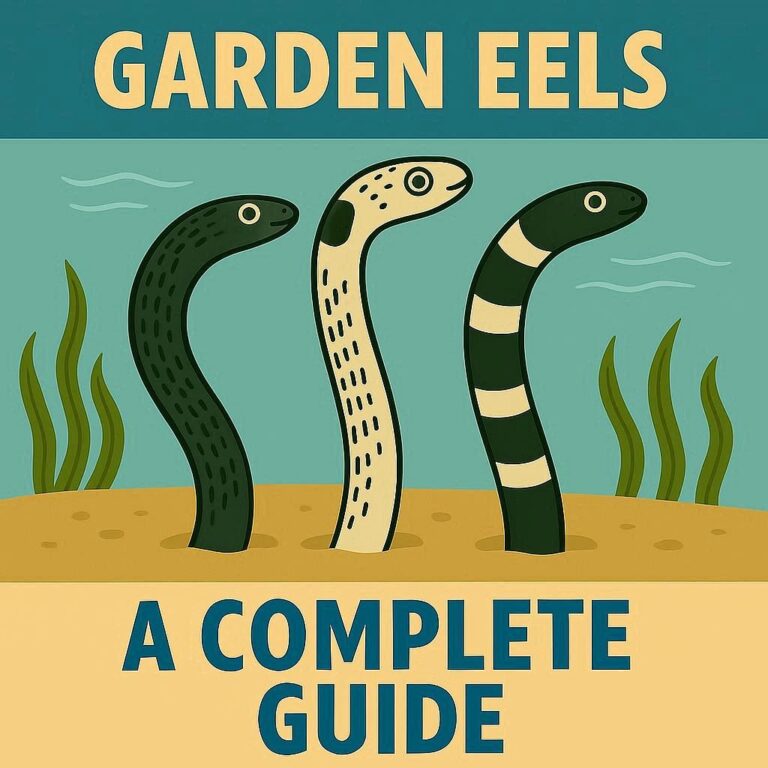
12. Brown Garden Eel (Heteroconger halis)
The Brown Garden Eel offers a whimsical sight. These eels live in massive colonies—sometimes numbering in the hundreds—on sandy slopes. Each eel digs a permanent vertical burrow and spends its day with its upper body extended into the current. Consequently, they look like blades of seagrass as they pick zooplankton out of the water. If a diver approaches, the entire colony vanishes instantly into the sand.
13. Manytooth Conger (Conger triporiceps)
The Manytooth Conger is a more traditional-looking eel, reaching roughly 1 meter in length. It possesses a sleek, bluish-gray body with dark edges on its fins. Unlike the diurnal Garden Eel, the Manytooth Conger remains strictly nocturnal. It hides in reef caves during the day and emerges at night to swim over the reef and sandy flats in search of small fish and invertebrates.
Snake Eels: The Burrowing Mimics (4 Species)
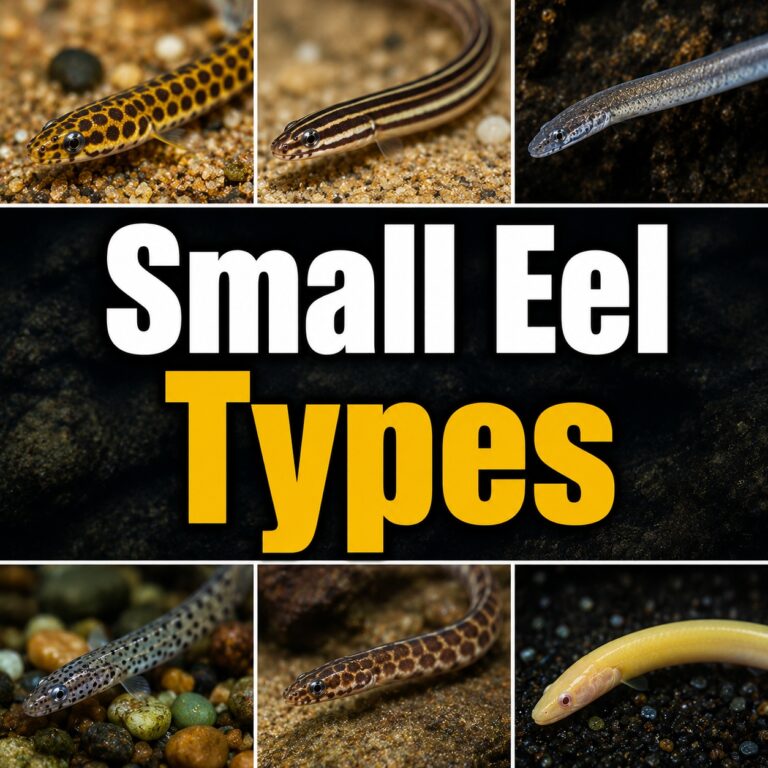
Snake eels (family Ophichthidae) are often mistaken for sea snakes. They have extremely slender bodies and many species possess a hard, pointed tail tip used for burrowing backward into the sediment.
14. Sharptail Eel (Myrichthys breviceps)
The Sharptail Eel is perhaps the most snake-like of the group. It has a long, cream or grayish body adorned with dozens of bright yellow or gold spots. While many eels are nocturnal, the Sharptail often stays active during the day. It can be seen “snaking” through seagrass beds. Additionally, its pointed, finless tail allows it to disappear tail-first into the substrate in a matter of seconds.
15. Goldspotted Eel (Myrophis ocellatus)
The Goldspotted Eel is a slender burrower that reaches about 90 centimeters. It has a tan or olive body covered in small, glowing gold spots. This species specializes in “soft bottom” habitats—areas with plenty of mud or fine sand. It spends daylight hours completely submerged in the sediment, using its sensitive snout to detect the vibrations of small prey moving above it.
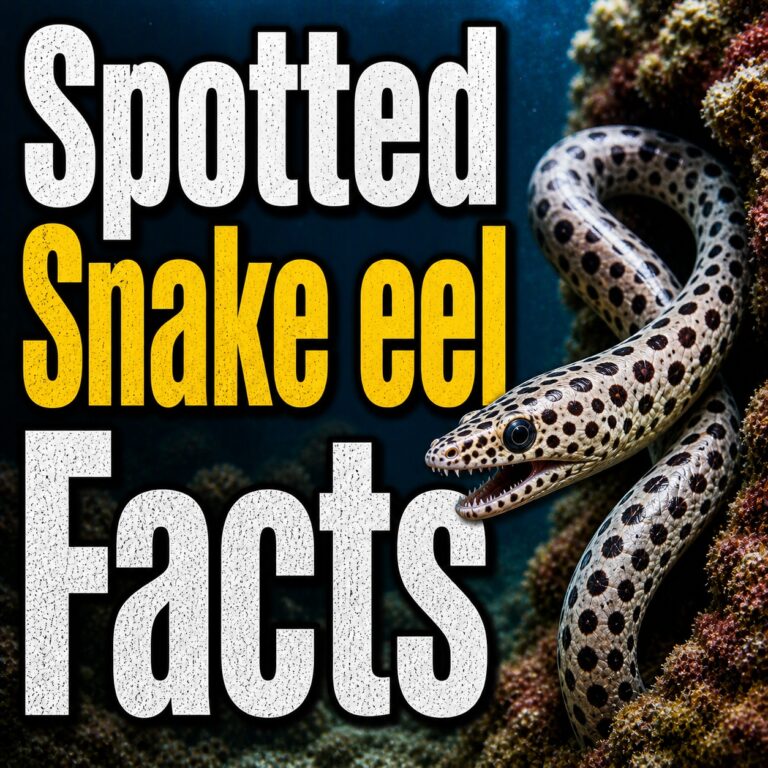
16. Spotted Snake Eel (Ophichthus rufus)
The Spotted Snake Eel masters the art of mimicry. With its dark bars and spots, it closely resembles certain species of venomous sea snakes. This mimicry likely serves as a defense mechanism against predators like sharks and barracudas. Growing to 1.2 meters, it is a nocturnal predator that uses its incredible flexibility to navigate through tight holes in the reef and sand.
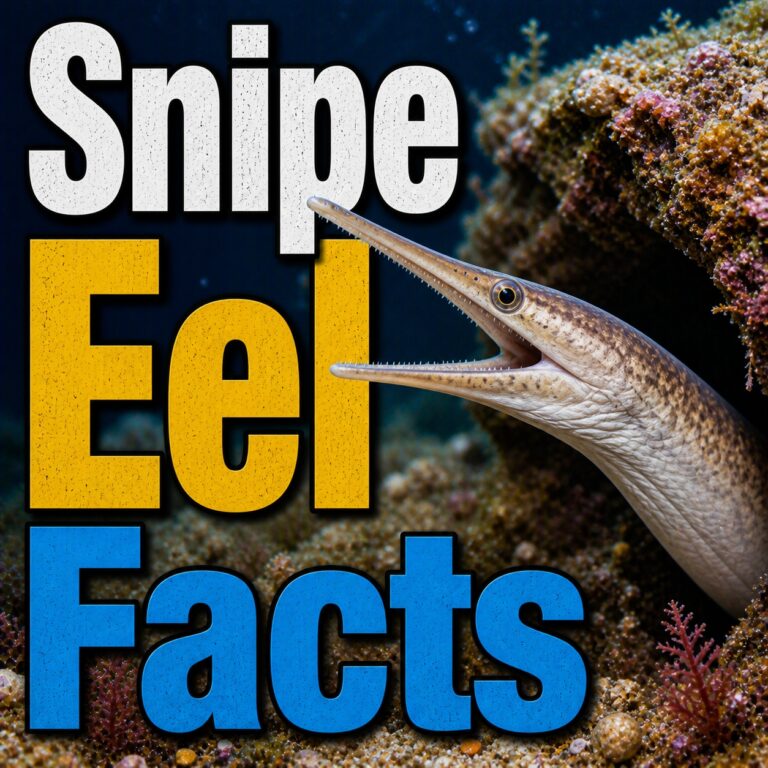
17. Spoon-nose Eel (Echiophis intertinctus)
The Spoon-nose Eel earns its name from its unique, flattened, V-shaped snout. This anatomical feature acts like a biological spade, allowing the eel to move through dense sand with ease. Its body is cream-colored and covered in large, well-defined black spots. Divers usually only see the head of a Spoon-nose Eel as it waits in ambush, ready to snatch any fish that swims too close., ready to snatch any fish that swims too close to its hidden burrow.
Summary of Caribbean Eel Types
| Category | Key Features | Primary Habitat |
| Moray Eels | No pectoral fins, thick bodies, “gaping” mouths. | Coral reefs and rock crevices. |
| Conger Eels | Pectoral fins present, large eyes. | Sandy slopes and reef caves. |
| Snake Eels | Slender bodies, pointed tails for burrowing. | Sand flats and seagrass beds. |
Fascinating Adaptations
| Feature | Description |
| Pharyngeal Jaws | Many Caribbean morays have a second set of jaws in their throat. Once the primary jaws grab prey, the pharyngeal jaws shoot forward to pull the food into the esophagus. |
| Mucus Coating | Eels lack scales. They produce a thick mucus that protects them from sharp coral and parasites, and in the case of garden eels, helps “cement” the walls of their sand burrows. |
| “Threatening” Gape | Eels constantly open and close their mouths. This is not an aggressive gesture; they are pumping water over their gills to breathe. |
By understanding these 17 species, we gain a deeper appreciation for the Caribbean’s biodiversity. Whether it is the towering Green Moray or the shy Garden Eel, each species plays a critical role in maintaining the health and balance of the coral reef ecosystem.
Ecological Importance
Eels play crucial roles in Caribbean ecosystems. Morays regulate reef fish populations, congers contribute to benthic food webs, and snake eels aerate sandy substrates. Their presence indicates healthy reef systems. However, overfishing and habitat loss threaten some species.
Human Interactions
Moray and conger eels are sometimes caught for food, though morays can accumulate toxins. Garden eels attract divers with their colonies, while snake eels are admired for their mimicry. Education and conservation are vital to protect these species.
Conclusion
The Caribbean hosts a remarkable diversity of eels, from the massive green moray to the delicate garden eel. Each species has unique adaptations for survival in coral reefs, sandy flats, and deep waters. Understanding their biology enriches our appreciation of marine ecosystems and highlights the need for conservation.
Frequently Asked Questions: Caribbean Eels
1. Are Caribbean moray eels venomous? No, their bite does not contain venom. However, their mouths harbor bacteria that can cause serious infections, and some species possess a second set of “pharyngeal” jaws in their throat to help swallow prey.
2. Why do eels constantly open and close their mouths? Eels are not being aggressive when they gape. Because they lack gill covers, they must rhythmically pump water through their mouths and over their gills to breathe.
3. Which Caribbean eel is the largest? The Green Moray (Gymnothorax funebris) holds the title. It can grow up to 2.4 meters (8 feet) in length and weigh over 13 kilograms (30 pounds).
4. Can you eat Caribbean eels? While some cultures eat eel, consuming large Caribbean morays is risky. They can carry Ciguatera, a potent toxin that accumulates in the flesh of apex reef predators and causes severe food poisoning in humans.
5. Are eels snakes? No. Although they have long, snake-like bodies, eels are actually a specialized type of fish. They have gills for breathing underwater and, in the case of congers, small pectoral fins.
6. Do eels have scales? Most eels, especially morays, lack scales entirely. Instead, they produce a thick layer of mucus that protects their skin from sharp coral, parasites, and infection.
7. How do Snake Eels burrow so fast? Snake eels possess a hard, pointed, finless tail. This specialized “spike” allows them to dig backward into the sand or mud with incredible speed when they feel threatened.
8. What do Caribbean eels eat? Their diet is diverse. Most hunt small reef fish and octopuses, while specialized species like the Chain Moray use blunt teeth to crush crabs, shrimp, and other crustaceans.