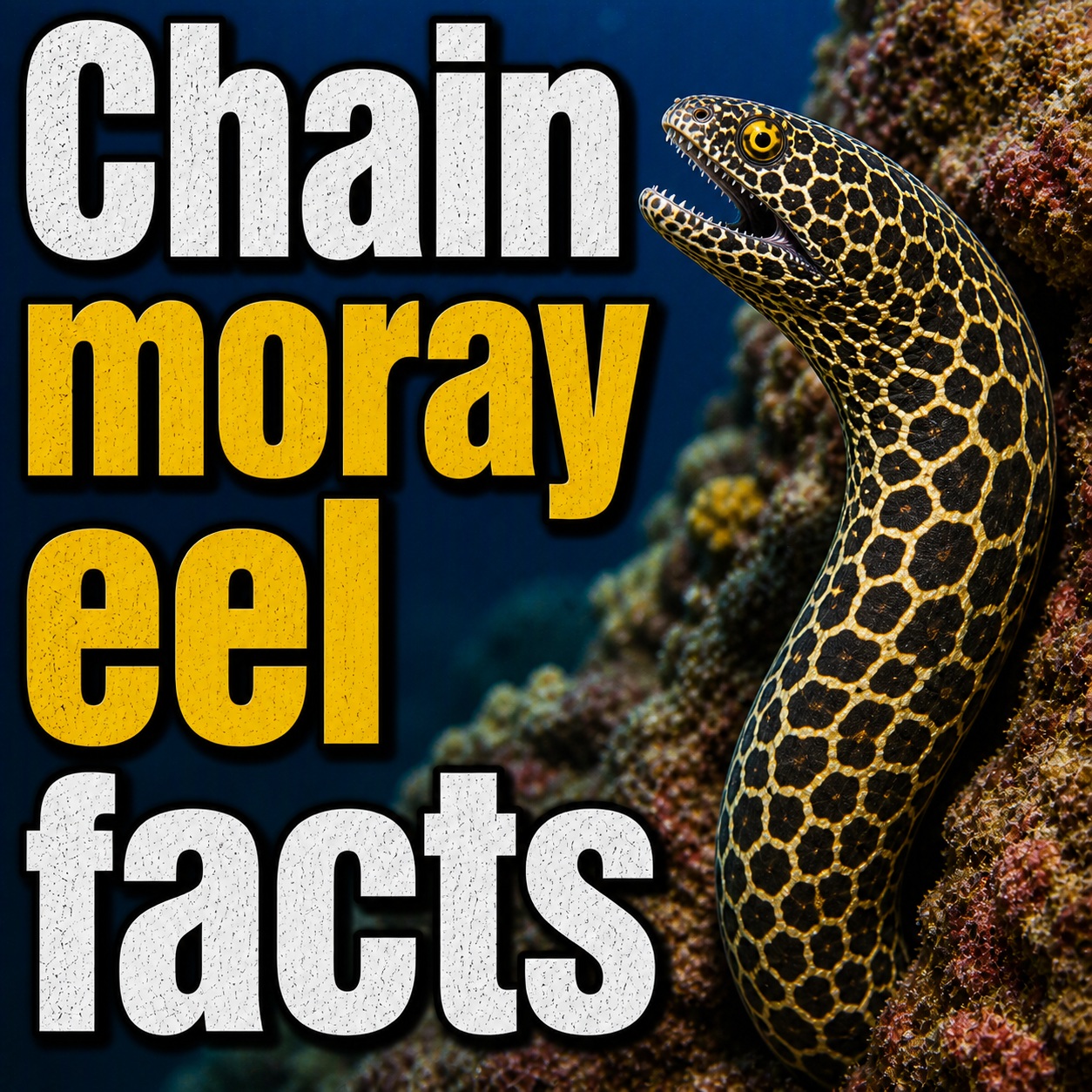
While the massive Green Moray and the needle-toothed Viper Moray often steal the spotlight in marine documentaries, there is a smaller, more intricately patterned resident of the Western Atlantic that deserves equal acclaim. The Chain Moray Eel (Echidna catenata) is a masterpiece of evolutionary adaptation. Unlike many of its cousins that dominate the deep reef, the Chain Moray has carved out a niche in the shallowest, most turbulent waters of the ocean.
In this comprehensive guide, we will explore the “pebble-toothed” anatomy, the tide-pool-hopping behavior, and the dietary specializations that make the Chain Moray one of the most successful small predators in the Caribbean.
Taxonomic Identity: The Pebble-Toothed Lineage
The Chain Moray belongs to the family Muraenidae (the moray eels) and the genus Echidna. This genus is particularly significant because it represents a major evolutionary split in eel biology.
Most moray eels are “needle-toothed,” possessing long, sharp fangs designed to snag slippery fish or soft-bodied octopuses. However, the genus Echidna—which includes the Chain Moray and the popular Snowflake Moray—comprises the pebble-toothed eels. Instead of needles, their mouths are filled with blunt, rounded, molar-like teeth. This shift in dental architecture dictates every aspect of their lifestyle, from where they hide to what they hunt.
Physical Anatomy: The “Chain” Aesthetics
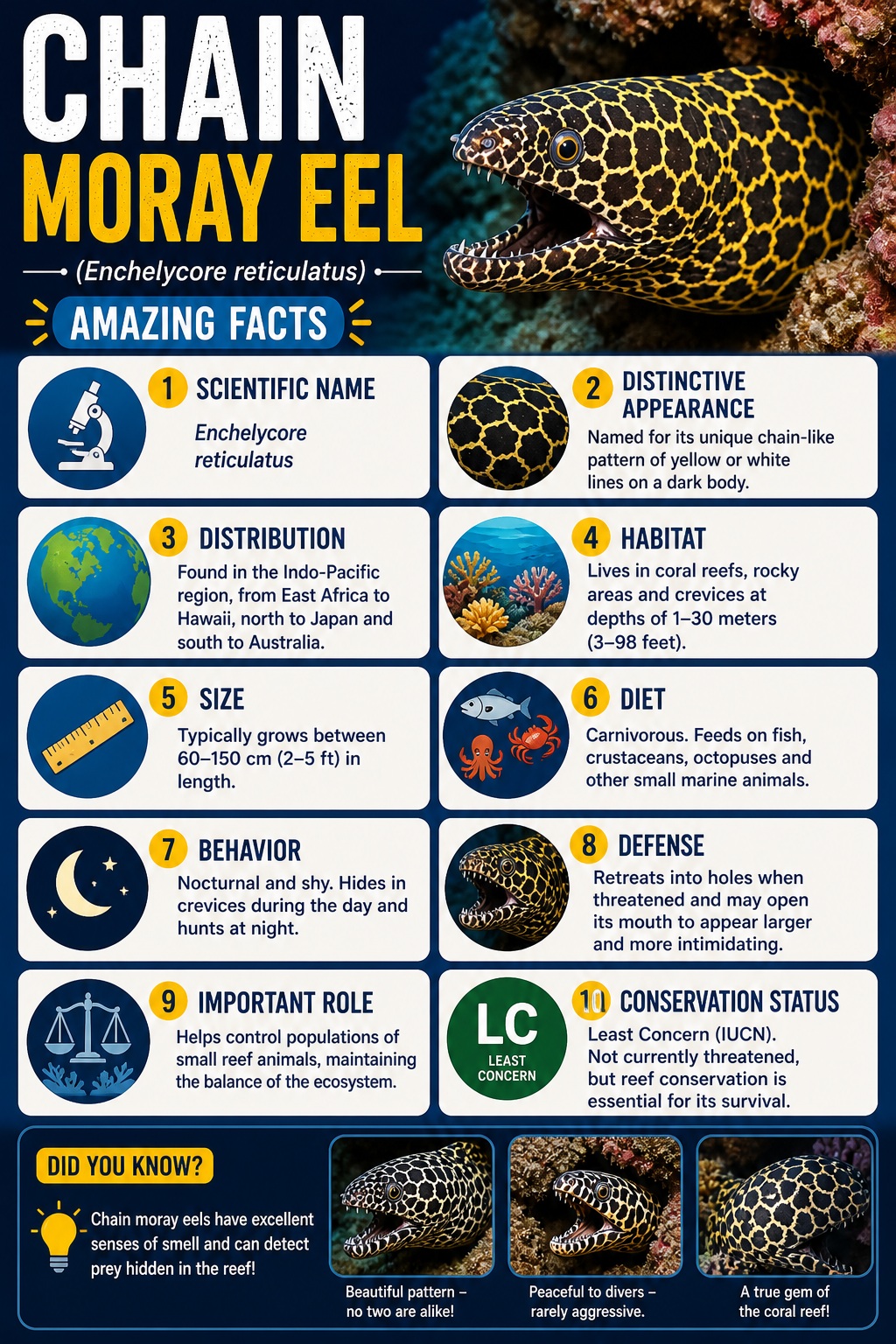
The Chain Moray is aptly named for its striking visual pattern. Its appearance is not just for beauty; it is a highly functional suit of disruptive camouflage.
1. Pattern and Coloration
The base color of a Chain Moray is typically a dark brown, deep black, or even a purplish-gray. Overlaid on this dark background is a network of interlocking yellow, cream, or white lines that resemble the links of a chain.
- The Ocellated Effect: Unlike the spotted snake eel, the Chain Moray’s pattern is more geometric. On the head, the yellow markings often become more concentrated, appearing as small dots or dashes around the eyes.
- Camouflage: This “chain” pattern is designed to mimic the dappled light filtering through shallow water and the jagged shadows of coral rubble and rocky crevices.
2. Size and Proportions
The Chain Moray is a medium-sized eel, making it an accessible sighting for snorkelers in shallow water.
- Maximum Length: They typically reach 30 to 45 centimeters (12 to 18 inches), though rare specimens have been recorded at nearly 70 centimeters (about 2.3 feet).
- Girth: They have a relatively thick, muscular body compared to the slender garden eels. This muscle provides the “crushing” power needed for their specific diet.
3. Finless Aerodynamics
Like all morays, the Chain Moray lacks pectoral and pelvic fins. Its dorsal and anal fins are hidden under a thick layer of skin and are continuous with the tail fin. This lack of protruding appendages allows them to slide through the narrowest cracks in a rock wall without snagging.
Habitat: The Tide Pool Specialist
One of the most unique facts about the Chain Moray is its preferred habitat. While many eels are found at depths of 20 to 100 meters, the Chain Moray is a shallow-water specialist.
1. The Intertidal Zone
You will find Chain Morays in the Western Atlantic, ranging from Bermuda and Florida down through the Caribbean to Brazil. They are most common in:
- Rocky Shorelines: Where the waves crash against the land.
- Tide Pools: They are one of the few eel species that thrive in isolated pools left behind by the receding tide.
- Reef Flats: Shallow areas of coral rubble where the water is often less than a meter deep.
2. Survival Out of Water
The Chain Moray has developed a remarkable resilience to low-oxygen environments. Because they inhabit tide pools, they are sometimes caught “high and dry” between tides. They can survive out of the water for short periods (up to 30 minutes or more) as long as their skin remains damp. They are even known to wiggle across wet rocks to move from one tide pool to another in search of food.
Diet and Hunting: The Crustacean Crusher
The diet of the Chain Moray is almost entirely determined by its unique teeth. If a Green Moray is a “slasher,” the Chain Moray is a “crusher.”
1. The Menu
Chain Morays are crustacean specialists. Their primary prey includes:
- Crabs: Specifically shore crabs and rock crabs that live in the intertidal zone.
- Shrimp: Small reef shrimp found in crevices.
- Small Lobsters: Juvenile spiny lobsters that haven’t yet reached the safety of deeper water.
2. The Crushing Mechanism
When a Chain Moray grabs a crab, its blunt teeth act like a vise. Instead of piercing the shell, the eel uses the massive muscles in its head to apply pressure, cracking the crab’s exoskeleton.
- Pharyngeal Jaws: Like other morays, they have a second set of jaws in their throat. In the Chain Moray, these internal jaws are also blunt and powerful, helping to further break down the shell and pull the meat into the stomach.
3. Diurnal and Nocturnal Flexibility
While most morays are strictly nocturnal, the Chain Moray is often active during the day (diurnal). Because its prey (crabs) are often active in the daytime tide pools, the eel has adapted its schedule to match.
Behavior: Intelligence and Agility
The behavior of the Chain Moray is more “reptilian” than many other fish. They are active, curious, and exhibit a high degree of situational awareness.
1. The “Knotting” Technique
Because the Chain Moray hunts crabs that are often wedged into tight spots, it uses the knotting maneuver frequently. If a crab is holding onto a rock and won’t let go, the eel will tie a knot in its tail and slide the knot up toward its head. By pressing the knot against the rock, the eel gains the leverage needed to winch the crab out of its hiding spot.
2. Sensory Prowess
Eels have a reputation for being “blind,” but the Chain Moray’s eyes are quite functional in the bright, shallow water of the tide pools. However, their primary hunting tool remains their sense of smell. Their tube-like nostrils are constantly sampling the water for the chemical signature of a molting crab or a wounded shrimp.
Life Cycle and Reproduction
The reproductive cycle of the Chain Moray follows the classic, mysterious pattern of the Anguilliformes order.
1. Spawning
Chain Morays are believed to be broadcast spawners. During specific lunar cycles, adults will move to slightly deeper water to release eggs and sperm simultaneously. The fertilized eggs drift in the open ocean.
2. The Leptocephalus Stage
The eggs hatch into Leptocephali—transparent, leaf-shaped larvae.
- Oceanic Journey: These larvae spend months drifting on Atlantic currents, feeding on organic debris. Their transparency is their only protection against the vast array of open-ocean predators.
- Metamorphosis: Once the larva reaches a coastal reef or rocky shore, it undergoes a radical transformation. It loses its leaf-like shape, becomes cylindrical, and develops the “chain” pattern before settling into its first rocky crevice as a juvenile.
Comparison: Chain Moray vs. Snowflake Moray
Since both belong to the Echidna genus, they are often confused. Here is how to tell them apart:
| Feature | Chain Moray (E. catenata) | Snowflake Moray (E. nebula) |
| Primary Range | Atlantic / Caribbean | Indo-Pacific / Red Sea |
| Coloration | Dark with yellow “chain” lines. | White with black/yellow “snowflakes.” |
| Max Size | Approx 45–70 cm. | Approx 60–100 cm. |
| Habitat | Tide pools and rocky shores. | Shallow reefs and lagoons. |
| Diet | Strictly crustaceans. | Crustaceans and small fish. |
VIII. The Aquarium Perspective
The Chain Moray is a favorite among marine aquarists due to its manageable size and striking pattern.
- Ease of Care: They are considered “hardy” but require a specific environment.
- The Escape Artist: Like all eels, they are legendary escape artists. They can find the smallest gap in a tank lid and squeeze through. In the wild, this ability helps them move between tide pools; in a home, it leads to them ending up on the floor.
- Tank Mates: Because they have blunt teeth, they are “reef safe” with fish that are too large to swallow, but they will eat any ornamental shrimp or crabs in the tank.
Conservation and Human Interaction
Currently, the Chain Moray is listed as a species of Least Concern by the IUCN. However, they face several environmental challenges:
- Coastal Development: Because they live in the intertidal zone, they are the first to be affected by sea walls, dredging, and coastal pollution.
- Climate Change: Rising sea levels may alter the tide pool habitats they rely on.
- The “Bite” Risk: While they are not aggressive, their blunt teeth can deliver a powerful, crushing bite if they mistake a human finger for a crab. Because they have a “lock-on” grip, a bite can be difficult to release.
Summary of Facts
- Scientific Name: Echidna catenata
- Teeth: Blunt/Rounded (Pebble-toothed).
- Range: Western Atlantic (Bermuda to Brazil).
- Max Length: ~70 cm.
- Special Ability: Can survive out of water for short periods to navigate tide pools.
- Primary Food: Crabs and shrimp.
Conclusion
The Chain Moray Eel is a brilliant example of how evolution can take a standard body plan—the eel—and tweak it for a high-energy, high-pressure environment like the tide pool. They are the “tough guys” of the shallow water, capable of crushing armor-plated crabs and surviving in oxygen-depleted pools where other fish would perish.
The next time you are walking along a rocky Caribbean shore at low tide, keep an eye on the water-filled cracks. You might just see the golden “chains” of a moray peering back at you, waiting for the tide to return so it can continue its work as the reef’s most efficient crustacean crusher.
Frequently Asked Questions (FAQ)
1. Is the Chain Moray venomous?
No. They do not have venom glands. However, their skin mucus can be toxic if ingested, and their bites can lead to infection due to bacteria in their mouths.
2. Can they change color?
Not significantly. Their pattern is fixed, though their base color may lighten or darken slightly depending on their stress level or the brightness of the environment.
3. Why do they have yellow markings?
The yellow markings provide “disruptive coloration,” which breaks up the eel’s silhouette in the dappled light of shallow water, making it harder for predators like herons or larger fish to spot them.
4. How do they breathe in a tide pool?
They pump water through their mouths and over their gills. If the water becomes low in oxygen, they can slow their metabolism or move to a more oxygen-rich pool.
5. Do they live in groups?
No, they are generally solitary. However, in areas with high food density, you may find multiple Chain Morays living in the same stretch of rocky shoreline, though they will maintain separate “home” crevices.