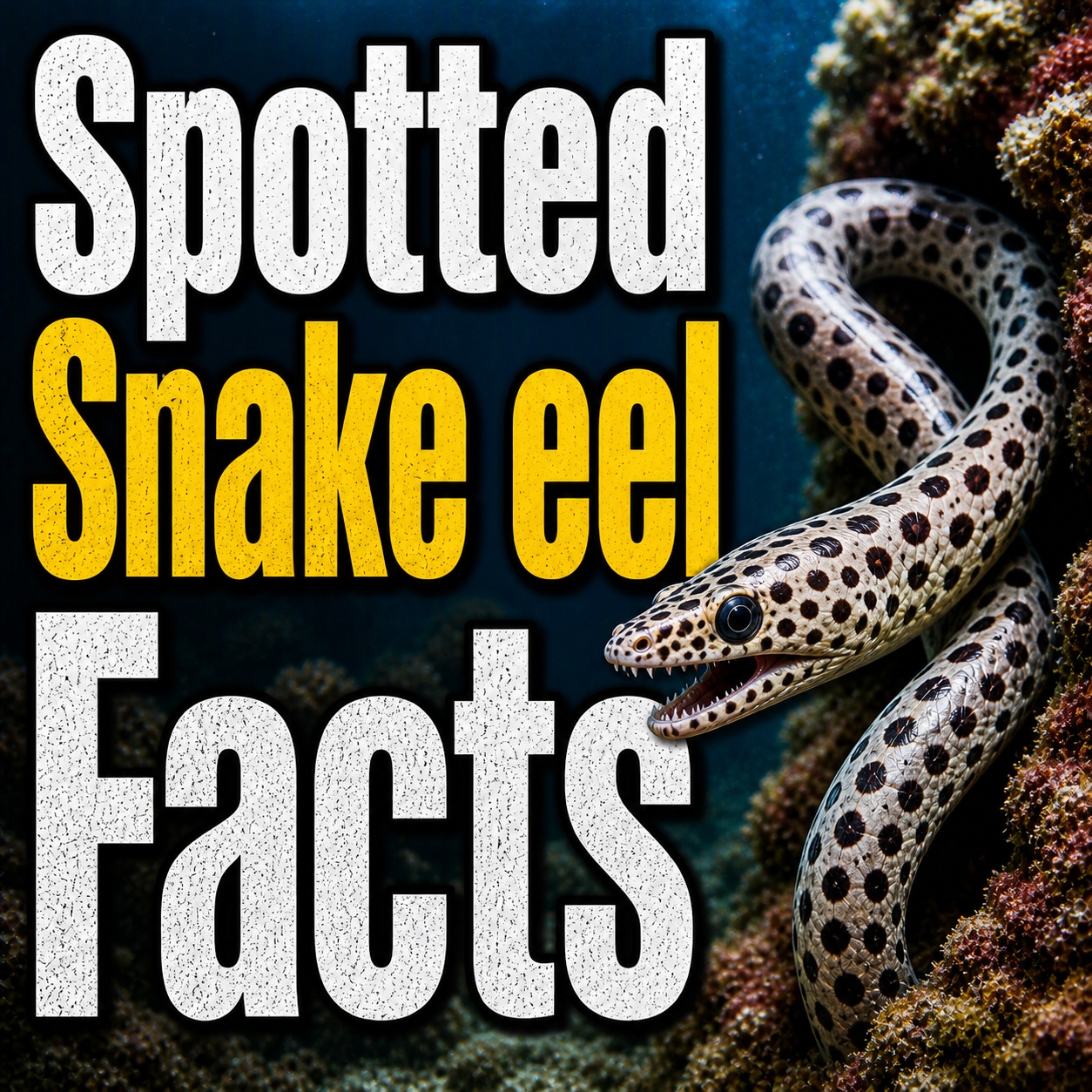
If you are diving in the vibrant waters of the Red Sea, the coast of East Africa, or the reefs of Hawaii and happen to see a “snake” slithering across the sand, don’t panic. You are likely witnessing one of the ocean’s most successful mimics: the Spotted Snake Eel (Myrichthys maculosus).
While its appearance often sends a jolt of adrenaline through unsuspecting divers, the Spotted Snake Eel is a fascinating, non-venomous fish that has mastered the art of camouflage, burrowing, and sensory hunting. In this guide, we will break down the complex biology, behavior, and ecological secrets of this spotted sentinel of the sand.
Taxonomic Identity: Not a Moray, Not a Snake
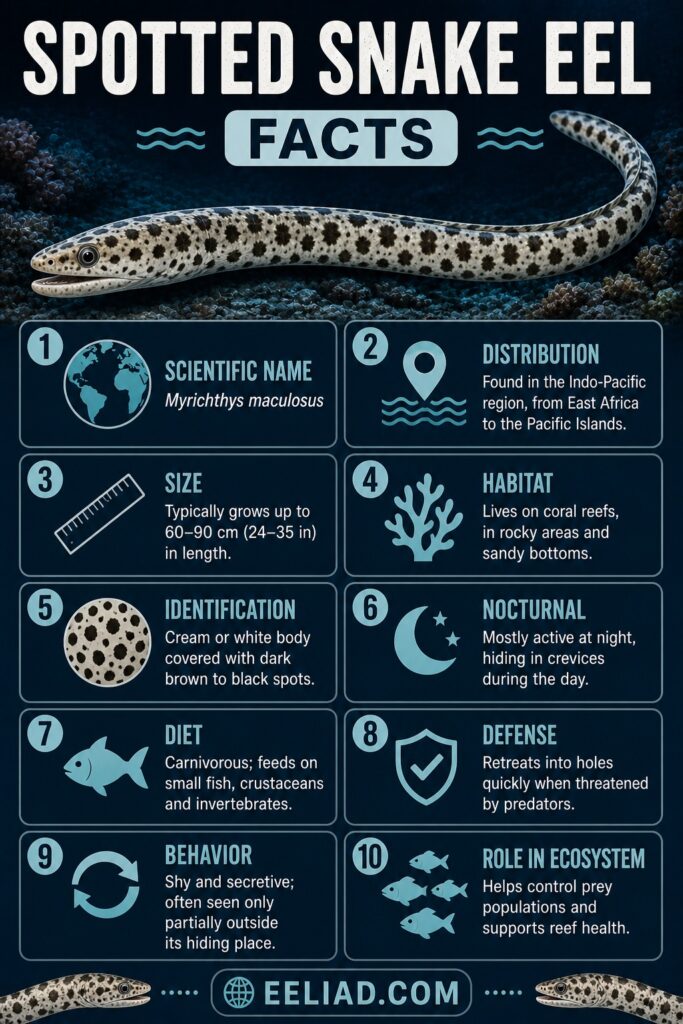
To understand the Spotted Snake Eel, we must first clear up its family tree. It belongs to the order Anguilliformes (true eels) and the family Ophichthidae.
The “Snake Eel” Distinction
Most people are familiar with Moray eels (Muraenidae). However, snake eels are a distinct lineage with several key physical differences:
- The Finless Tail: While a moray eel has a continuous fin that wraps around its tail, the Spotted Snake Eel has a hard, pointed, finless tail tip. This is a specialized tool for digging.
- Pectoral Fins: Spotted Snake Eels possess small pectoral fins located just behind their gill slits, a feature many morays lack.
- Body Shape: They are generally more slender and cylindrical than the muscular, laterally compressed morays.
Biological Note: The genus name Myrichthys comes from the Greek words myros (a male sea eel) and ichthys (fish). The species name maculosus is Latin for “spotted,” perfectly describing its high-contrast aesthetic.
Physical Appearance and Camouflage
The Spotted Snake Eel is a visually striking creature. Its body is typically a creamy white or pale tan, decorated with large, irregular dark brown or black spots.
1. The Pattern of Survival
These spots are not merely decorative; they serve as disruptive camouflage. When the eel is moving over a complex background of coral rubble, sand, and dappled sunlight, the dark spots break up the visual outline of its long body. To a predator like a reef shark, the eel doesn’t look like a single long “snack”—it looks like a series of disconnected shadows or holes in the sand.
2. Size and Proportions
- Average Length: They typically grow to about 60–100 cm (2–3.3 feet).
- Max Length: Rare specimens have been recorded at nearly 1.2 meters (4 feet).
- Girth: They remain relatively slender throughout their lives, rarely thicker than a human wrist, which allows them to slide into the tiniest of reef crevices.
The Mimicry Factor: The Sea Snake Illusion
The Spotted Snake Eel is a classic example of Batesian Mimicry. This is a biological strategy where a harmless animal evolves to look like a dangerous one to deter predators.
Mimicking the Sea Krait
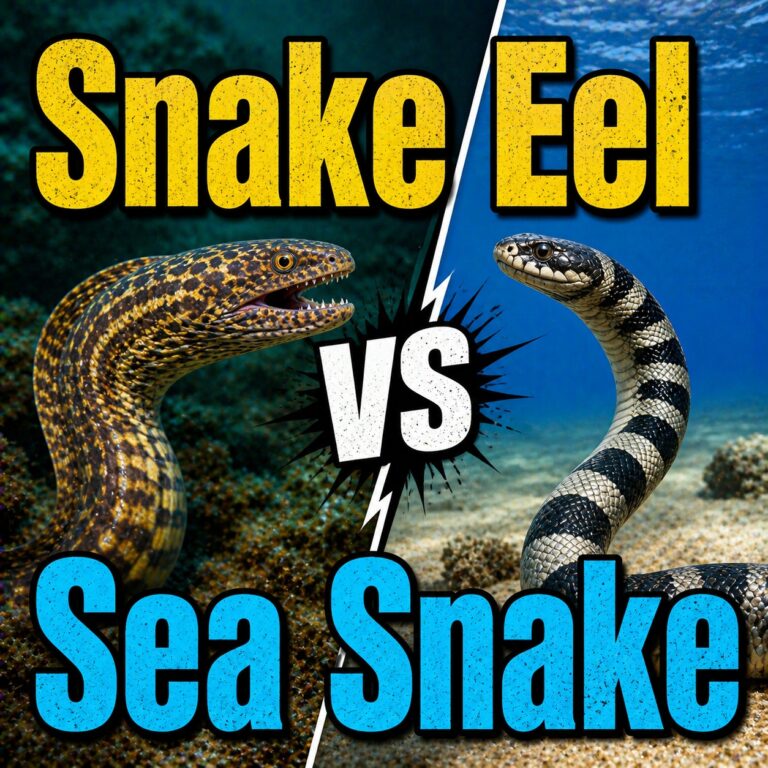
In the Indo-Pacific, the Banded Sea Krait and other sea snakes are highly venomous and avoided by almost all predators. The Spotted Snake Eel mimics the bold, high-contrast patterns of these snakes.
- The Result: A predator that might otherwise eat a slender eel will hesitate or move on, fearing a lethal dose of neurotoxic venom.
- The Tell: You can tell the difference by looking at the tail. Sea snakes have paddle-like tails for swimming; the Spotted Snake Eel has a pointed “spike” tail for burrowing.
Burrowing Mastery: The “Backward Drill”
Perhaps the most impressive physical trait of the Spotted Snake Eel is its ability to disappear into the sea floor in a matter of seconds.
The Mechanics of the Tail
Unlike most fish that swim forward to escape, the snake eel often uses reverse gear.
- The Anchor: The eel presses its hard, calcified tail tip against the sand.
- The Rotation: By undulating its body, it “drills” the tail into the substrate.
- The Vanishing Act: Within 5 to 10 seconds, the eel can bury its entire 3-foot body, leaving nothing but its snout protruding from the sand.
This burrowing ability allows the eel to hide from daytime predators and ambush small prey that swims too close to the “invisible” hunter.
Sensory Anatomy: Hunting in the Dark
The Spotted Snake Eel is primarily crepuscular (active at dawn and dusk) or nocturnal. Since it hunts in low-light conditions and often searches for prey buried deep in the sand, it cannot rely on vision.
The Tubular Nostrils
If you look at the face of a Spotted Snake Eel, you will see two prominent tubes sticking out from the upper lip. These are its anterior nostrils.
- Chemical Detection: These tubes are highly efficient at pulling in water and directing it over the olfactory rosette (the smelling organ).
- Sand-Sniffing: The eel can “smell” a buried crab or a sleeping fish through several inches of sediment. It pokes its snout into the sand like a probe, following the chemical trail until it pinpoints the prey.
Diet and Foraging Behavior
The Spotted Snake Eel is a carnivorous foraging specialist. It doesn’t sit and wait for food to come to it; it actively “mops” the reef floor.
1. The Menu
Their diet consists almost entirely of:
- Crustaceans: Small crabs, ghost shrimp, and snapping shrimp.
- Small Benthic Fish: Gobies or blennies that hide in the sand.
- Marine Worms: Polychaetes found in the substrate.
2. Cooperative Hunting
In a fascinating display of inter-species cooperation, Spotted Snake Eels are often followed by Goatfish or Wrasses.
- The Role of the Eel: As the eel probes the sand and rocks, it flushes out prey that was hiding.
- The Role of the Followers: The fish hover above the eel, snapping up the prey that escapes the eel’s jaws. While it seems one-sided, the presence of multiple predators often overwhelms the prey, increasing the success rate for everyone involved.
The Life Cycle: From Ribbon to Predator
Like all true eels, the Spotted Snake Eel has a life cycle that begins far out at sea.
The Leptocephalus Larva
Eels hatch from eggs into a larval stage called a Leptocephalus.
- Appearance: They are flat, leaf-shaped, and completely transparent.
- Strategy: Being transparent makes them nearly invisible to predators in the open ocean. They drift on currents for months, feeding on “marine snow” (microscopic organic particles).
- Metamorphosis: Once the larva reaches a suitable reef, it undergoes a radical transformation. Its body becomes cylindrical, it develops its signature spots, and its bones calcify to allow for burrowing.
Habitat and Global Distribution
The Spotted Snake Eel is one of the most widely distributed snake eels in the world, thanks to its hardy nature and the long drift-time of its larvae.
Primary Range
- Red Sea and East Africa: Very common in the sandy lagoons of Egypt and Kenya.
- Indo-Pacific: Found throughout Indonesia, the Philippines, and the Great Barrier Reef.
- Oceanic Islands: They have successfully colonized remote spots like Hawaii, Easter Island, and French Polynesia.
Micro-Habitat
Within these regions, they specifically seek out:
- Sandy Slopes: Where they can easily burrow.
- Seagrass Meadows: Which provide both cover and a high density of crustacean prey.
- Coral Rubble: The transition zones between the sand and the reef.
Interaction with Humans and Divers
For divers and snorkelers, the Spotted Snake Eel is a “high-value” sighting because of its bold patterns and snake-like movement.
Is it Dangerous?
- Venom: No. Unlike the sea snakes they mimic, Spotted Snake Eels have no venom glands.
- Bites: They are extremely shy. If a diver approaches, the eel’s first instinct is to dive into the sand or retreat into a hole. They will only bite if someone attempts to grab them, and even then, their teeth are designed for crushing small crabs, not causing major wounds to large mammals.
- Aquarium Trade: They are occasionally kept in home aquariums. However, they are “escape artists” and require a very deep sand bed and a tightly sealed lid, as they can climb out of even the smallest gaps in a tank.
The Slime Shield: Physiological Defenses
Because the Spotted Snake Eel spends its life rubbing against abrasive sand and sharp coral rubble, it has a specialized “skin care” routine.
1. Mucus Production
The eel is scale-less. To protect its skin, it produces a thick, slippery coating of mucus.
- Antibacterial: The mucus contains enzymes that kill bacteria and fungi, preventing infections from the sand.
- Reduced Friction: This “slime” acts as a lubricant, allowing the eel to slide through tight gaps and into the sand with minimal resistance.
2. The “Squeegee” Knot
Like morays, snake eels may occasionally tie their bodies into a knot. They slide this knot from their head to their tail to “squeegee” off excess slime, parasites, or debris, effectively “resetting” their protective coating.
Spotted Snake Eel vs. Sea Snake Comparison
| Feature | Spotted Snake Eel (M. maculosus) | Banded Sea Krait (Laticauda colubrina) |
| Classification | Fish (Eel) | Reptile (Snake) |
| Tail Shape | Pointed, hard spike. | Flattened, paddle-like. |
| Breathing | Gills (Extracts oxygen from water). | Lungs (Must surface for air). |
| Venom | None. | Highly Potent Neurotoxin. |
| Fins | Small pectoral and dorsal fins. | No fins. |
| Scales | None (Smooth/Slimy). | Overlapping reptilian scales. |
Conservation and the Future of the Species
Currently, the Spotted Snake Eel is not listed as endangered. However, they face indirect threats that affect all reef-dwelling species.
- Habitat Loss: The destruction of seagrass beds and coral reefs due to coastal development reduces the eel’s hunting grounds.
- Climate Change: Rising sea temperatures can alter the currents that carry their Leptocephalus larvae, potentially preventing new generations from reaching the reefs.
- Water Quality: As bottom-dwellers, they are highly sensitive to pollutants and heavy metals that settle into the sand.
Conclusion: The Essential Mimic
The Spotted Snake Eel is a master of the “middle ground.” It lives between the sand and the reef, between the day and the night, and between the identity of a fish and the appearance of a snake. By combining an incredible sense of smell, a specialized burrowing tail, and the clever use of mimicry, it has become one of the most successful and widespread eels in the Indo-Pacific.
The next time you see those iconic black spots weaving through the coral rubble, remember that you aren’t looking at a dangerous serpent, but at one of the ocean’s most sophisticated and peaceful foragers—a true ghost of the sand.
Frequently Asked Questions (FAQ)
1. How long can a Spotted Snake Eel stay buried?
They can stay buried for hours, often throughout the entire day. They breathe by pumping water through their mouths and out their gill slits, even while submerged in the sand.
2. Why do they have such large spots?
The large spots act as disruptive camouflage, breaking up the eel’s long silhouette so it doesn’t look like a single target to predators.
3. Do Spotted Snake Eels eat sea snakes?
No. While they look like sea snakes, they do not interact with them as prey. Their mouths are much too small to consume a snake.
4. Can they move on land?
No. Unlike some freshwater eels that can wiggle through damp grass, Spotted Snake Eels are strictly marine and will suffocate and become immobile if removed from the water.
5. How many spots do they have?
The number of spots varies by individual and increases as the eel grows. No two Spotted Snake Eels have the exact same spot pattern—it is as unique as a human fingerprint.