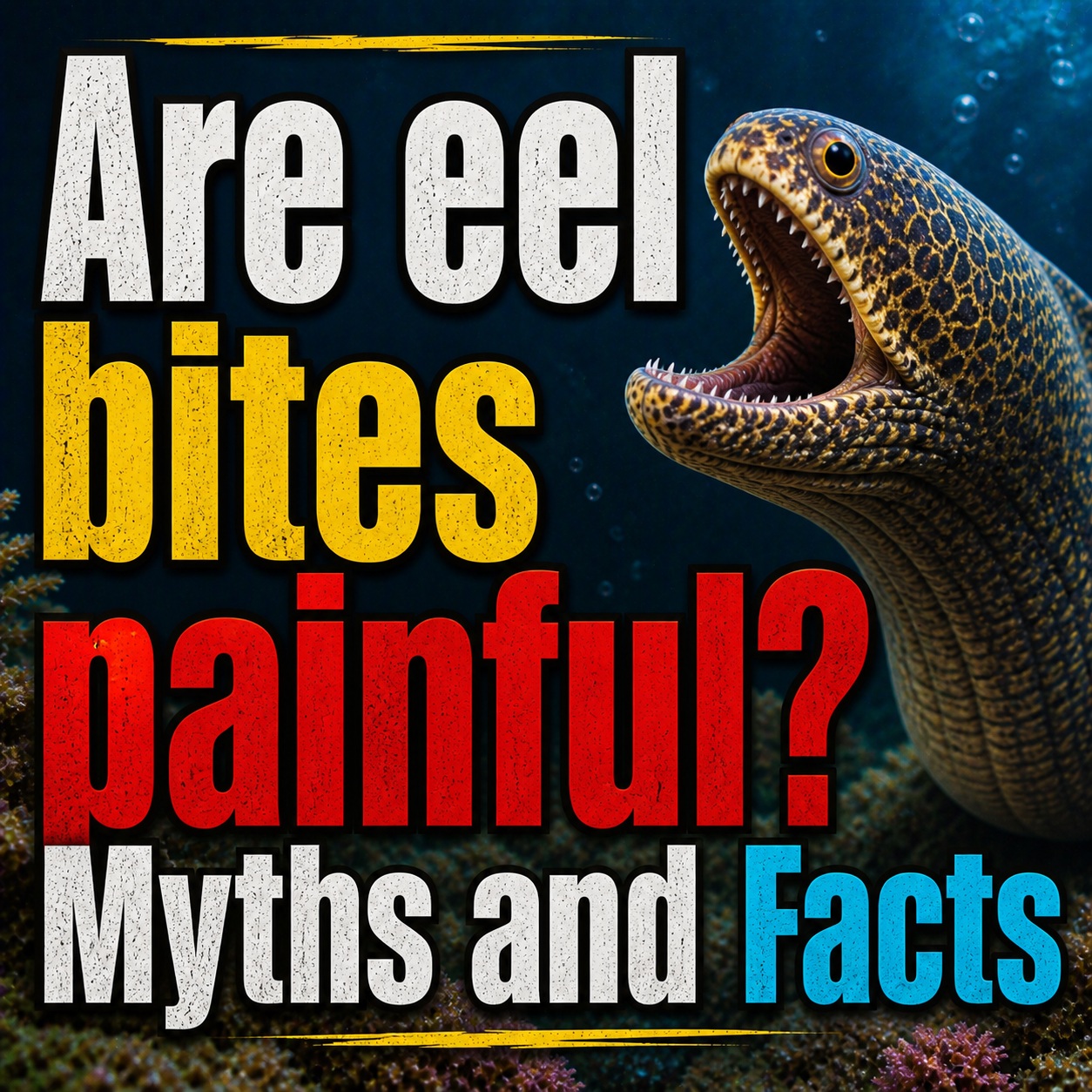
The ocean is home to many formidable predators, but few command as much primal fear as the eel. With their serpentine bodies, needle-sharp teeth, and the habit of lunging from dark crevices, eels—particularly morays—have earned a reputation for being aggressive, venomous monsters of the deep. But behind the fearsome reputation lies a complex biological reality.
To answer the question, “Are eel bites painful?” one must look beyond the initial puncture. The pain of an eel bite is a combination of mechanical power, unique dental architecture, chemical irritants, and a high risk of bacterial infection.
The Serpent-Fish Bite: Pain, Toxicity, and Myths
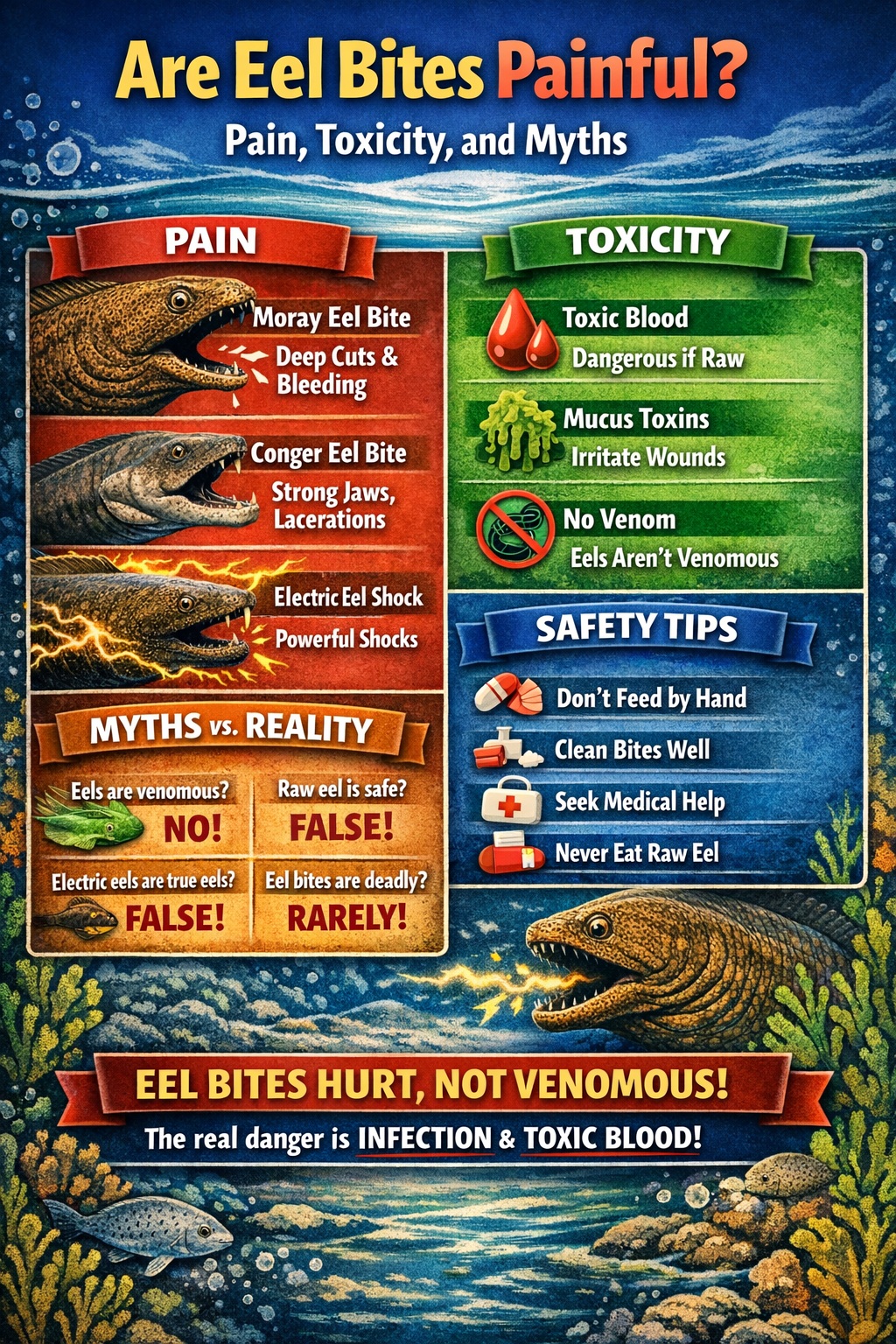
Eel bites can be painful but rarely dangerous. Most eels are not venomous, though their blood contains toxic proteins that are harmful if ingested raw. Myths about “poisonous eels” or “electric morays” are exaggerated—only electric eels deliver shocks, and true eels rely on teeth, not venom.
Understanding Eel Bites
Pain and Injury
- Moray eels have sharp, backward‑pointing teeth and powerful jaws.
- Their bites cause deep punctures, lacerations, and heavy bleeding.
- Pain results from both mechanical injury and mild toxins in their mouth mucus.
- Secondary infections (Vibrio, Pseudomonas bacteria) are the main medical concern.
- Conger eels can also bite defensively but prefer to flee.
- Freshwater eels are timid; bites occur only when provoked.
Electric Eels
- Not true eels—classified as knifefish (Gymnotiformes).
- They deliver electric shocks up to 860 volts, causing intense pain and muscle spasms.
- Danger arises from indirect effects such as paralysis or drowning, not venom.
Key Facts
- Eel blood is toxic only when raw; cooking at 60 °C for 5 minutes destroys toxins.
- No eel species inject venom through bites.
- Electric eels use electricity, not venom, for defense.
⚗️ Toxicity and Venom Clarified
| Type | Description | Risk to Humans |
|---|---|---|
| Venom | Injected through fangs or stingers (e.g., snakes) | None—eels lack venom glands |
| Toxin | Harmful if ingested or enters bloodstream | Present in eel blood |
| Eel Blood | Contains ichthyotoxins, protein‑based hemotoxins | Toxic raw, harmless when cooked |
| Mucus Toxins | Found in some morays (hemagglutinin, crinotoxin) | Cause local pain, not systemic poisoning |
The Mechanical Trauma: Why the Bite is Brutal
The sheer physical mechanics of an eel bite distinguish it from that of most other fish. When a shark bites, it often uses a “sawing” or “shaking” motion to sever tissue. An eel, however, functions like a high-tension biological trap.
The “Double-Jaw” System
The primary reason an eel bite is so difficult to escape is the pharyngeal jaw. Most fish use suction to draw food into their throats. Because moray eels live in tight, narrow holes, they cannot expand their throats to create suction. Instead, they evolved a second set of jaws located deep in their throat.
When a moray strikes, its primary jaws (the ones you see) grab the prey. Instantly, the pharyngeal jaws launch forward from the throat, sink into the flesh, and physically drag the prey down into the esophagus. For a human victim, this feels like being bitten by two animals at once. It creates a “locking” sensation that makes it nearly impossible to pull away without causing massive tissue tearing.
Backward-Curving Teeth
Most moray eels possess teeth that curve backward toward the throat. This is an evolutionary adaptation to ensure that slippery prey, like fish or octopuses, cannot wiggle free. For a human, this means that the instinctive reaction to “pull back” actually drives the teeth deeper into the muscle and tendons, turning small puncture wounds into deep, jagged lacerations.
Toxicity and Venoms: Fact vs. Fiction
A common debate among divers and scientists is whether eels are truly venomous. While they do not have a venom delivery system like a rattlesnake or a stonefish, they are far from “clean.”
1. Crinotoxins: The Burning Slime
Eels do not have scales. To protect their sensitive skin from parasites and sharp coral, they produce a thick coating of mucus. This slime often contains crinotoxins—chemical irritants that are toxic to other fish. When an eel bites a human, this toxic slime is forced into the wound. This is why victims often report an intense, burning pain that feels far worse than a simple cut should. The toxins cause immediate inflammation, redness, and throbbing.
2. Hemotoxins in the Blood
It is a little-known fact that eel blood is toxic to humans and other mammals. It contains a protein that can cause severe muscle cramping and can even stop a heart if it enters the bloodstream directly. While the eel does not “inject” its blood into you during a bite, the presence of these proteins in their body underscores their “toxic” nature. This is also why eel must always be cooked thoroughly; heat neutralizes these dangerous proteins.
3. Are any eels actually venomous?
For decades, scientists believed no eel was truly venomous. However, recent studies on the Yellow-edged Moray (Gymnothorax flavimarginatus) suggest that some species may possess primitive venom glands in their mouths. While not as advanced as a cobra’s, these glands may release anticoagulants that prevent the victim’s blood from clotting, causing the wound to bleed excessively.
The Bacteria Factor: The “Dirty” Bite
Even if the mechanical damage is minor, the biological aftermath of an eel bite is often the most dangerous part. Eels are scavengers and apex predators that live in holes where organic matter decays. Their mouths are literal “petri dishes” for virulent bacteria.
- Vibrio Species: These bacteria thrive in marine environments and can cause rapid, flesh-eating infections if they enter a deep wound.
- Secondary Infection: Because eel bites are often deep punctures, the bacteria are “injected” far beneath the skin’s surface, where oxygen is low—the perfect environment for anaerobic bacteria to multiply.
Without immediate and specific antibiotic treatment, an eel bite can lead to Sepsis or Necrotizing Fasciitis (flesh-eating disease).
Debunking the Myths of Eel Aggression
To stay safe in the water, it is important to separate folklore from biological fact.
Myth 1: Eels hunt humans.
Fact: Eels have almost zero interest in humans as food. Most bites occur due to mistaken identity. Eels have very poor eyesight but an incredible sense of smell. If a diver is wearing shiny jewelry (which looks like fish scales) or has recently handled bait, the eel may strike the hand thinking it is a meal.
Myth 2: An eel won’t let go until it hears thunder.
Fact: This is a myth also applied to snapping turtles. An eel will let go once it realizes it has bitten something too large to swallow. The reason it seems like they won’t let go is due to the backward-curving teeth mentioned earlier; the eel often struggles to unhook itself from your skin just as much as you struggle to get away.
Myth 3: Electric eels are the same as moray eels.
Fact: Electric eels are not actually eels—they are a type of knifefish. While a moray bite is mechanically painful, an “attack” from an electric eel is a high-voltage shock that can cause heart failure. They live in different environments (freshwater vs. saltwater) and have entirely different defense mechanisms.
Myths vs. Reality Table
| Myth | Reality |
|---|---|
| “Eels are venomous.” | False—no venom glands or injection mechanism. |
| “Electric eels are true eels.” | False—they are knifefish related to catfish. |
| “Eel bites are deadly.” | Rarely—painful but treatable with cleaning and antibiotics. |
| “Raw eel is safe to eat.” | False—its blood is toxic until cooked. |
| “Morays attack divers.” | False—bites occur only when provoked or fed by hand. |
First Aid and Treatment
If you or a buddy are bitten by an eel, follow these steps to minimize permanent damage:
- Do Not Yank: If the eel is still attached, try to stay calm. Pushing your hand toward the eel’s throat may help disengage the backward-curving teeth better than pulling away.
- Immediate Irrigation: Flush the wound with clean, fresh water or sterile saline immediately to remove as much toxic mucus and bacteria as possible.
- Pressure: Apply firm pressure to stop bleeding, as the “pharyngeal jaw” often nicks small arteries.
- Seek Medical Help: This is non-negotiable. An eel bite requires professional cleaning and a specific course of antibiotics (often involving Ciprofloxacin or Doxycycline) to combat marine-specific bacteria.
Conclusion
So, are eel bites painful? Absolutely. They are a “perfect storm” of injury: the mechanical trap of the pharyngeal jaws, the tearing action of backward-facing teeth, the chemical burn of crinotoxins, and the looming threat of serious infection.
However, the eel is not a villain. It is a shy, misunderstood resident of the reef that uses its mouth to breathe and its jaws to survive. By respecting their space and avoiding the temptation to feed them or stick hands into dark crevices, humans can coexist with these fascinating, toothy “serpents” without ever feeling the sting of their bite.
Frequently Asked Questions
Q1: Are eel bites painful?
Yes, especially moray bites—they cause deep cuts and bleeding.
Q2: Are eels venomous?
No, they have toxins in blood and mucus but no venom glands.
Q3: Can eel blood kill you?
Only if raw blood enters your body; cooking neutralizes toxins.
Q4: Do electric eels bite?
No, they shock instead of biting.
Q5: Why do moray eels bite divers?
Usually mistaken identity or provocation during feeding.
Q6: Can an eel bite off a finger?
Yes. Large Green Morays have enough jaw strength to sever a human finger, and their pharyngeal jaws make the process of “pulling” the digit into the throat very powerful.
Q7: How can I avoid being bitten?
Never hand-feed eels and never stick your hands into reef holes. Always maintain a respectful distance (at least 3–5 feet) when observing them.
Q8: Are eel toxins used in medicine?
Research explores ichthyotoxins for potential biomedical applications.