
In the vast and competitive world of the ocean, the ability to disappear is a survival superpower. For eels, hiding is not just a passive behavior; it is a specialized ecological strategy that allows them to function as some of the most effective ambush predators on the planet. From the sun-drenched coral reefs of the Caribbean to the crushing depths of the midnight zone, eels have mastered the art of the “hidden life.”
This article explores the diverse habitats, complex burrowing techniques, and behavioral secrets that answer the question: Where do eels hide?
The Coral Fortress: Moray Eels in the Reef
The most iconic image of a hidden eel is the head of a moray protruding from a rocky crevice. Coral reefs offer a three-dimensional labyrinth that perfectly suits the eel’s elongated, flexible body.
1. Deep Reef Crevices
Moray eels lack the hard skeletons of many other fish, allowing them to compress their bodies into incredibly tight spaces. They favor holes within the framework of Scleractinian (stony) corals. These “fortress” holes provide 360-degree protection from large predators like sharks and barracudas.
- Territoriality: Eels often return to the same “home” hole for months or years.
- The Gaping Breath: Because they hide in tight spaces with low water flow, they must constantly open and close their mouths to pump oxygen over their gills.
2. Under-Ledge Sanctuaries
Larger species, such as the Green Moray, often hide under massive coral overhangs or limestone ledges. These areas provide shade and a wide field of view, allowing the eel to strike at passing fish while remaining almost entirely shielded from above.
The Subsurface World: Burrowing and Sand-Dwellers
Not all eels rely on solid structures. A vast number of species have evolved to turn the sea floor itself into a hiding spot.
3. Sandy Flats and Seagrass Beds
Snake eels and Sharptail eels have a unique anatomical feature: a hard, calcified, and finless tail tip. This “spike” allows them to burrow backward into the sand.
- The Disappearing Act: By rotating their bodies, they “drill” into the substrate until only their eyes and nostrils remain visible. This allows them to monitor the water column while being physically buried.
- Seagrass Camouflage: In seagrass meadows, eels hide among the roots and blades. Their long, thin bodies mimic the swaying vegetation, making them nearly invisible to both prey and predators.
4. The “Garden” of Eels
One of the most remarkable hiding strategies belongs to the Garden Eel. These eels live in massive colonies on sandy slopes. Each individual constructs a permanent vertical burrow lined with a specialized mucus that “glues” the sand grains together, preventing collapse.
- Colonial Defense: By hiding in a “garden,” they benefit from hundreds of pairs of eyes. If one eel detects a threat and retreats into its burrow, the entire colony follows suit in a wave of disappearing bodies.
Fresh Water and Estuaries: The Mud-Dwellers
European and American eels spend the majority of their adult lives in freshwater rivers, lakes, and muddy estuaries. In these environments, the hiding spots shift from coral to sediment.
5. Benthic Mud and Silt
Eels in rivers are masters of the “mud hide.” They can burrow several inches into the soft silt at the bottom of a riverbed. This is particularly useful during the winter months or during periods of low water levels. Their thick mucus coating protects their skin from the abrasive grit of the mud.
6. Submerged Timber and Root Systems
In forested river systems, eels favor the tangled root systems of willow trees and fallen logs. These “snags” provide the same labyrinthine protection as a coral reef. Eels will wedge themselves into the rotting wood or sit in the slack water created behind large rocks.
The Deep Sea: Hiding in the Midnight Zone
As we move into the bathypelagic zone (the deep sea), the concept of “hiding” changes. In the open, dark water, there are no rocks or sand to hide in.
7. Depth as a Hiding Spot
For deep-sea species like the Gulper Eel or the Snipe Eel, the primary hiding spot is the darkness itself. Many deep-sea eels utilize Vertical Migration. They hide in the extreme depths during the day, where sunlight cannot reach, and move toward the surface under the cover of night to feed.
8. Marine Snow and Detritus
Some deep-water eels have been observed hiding within large clumps of “marine snow”—falling organic debris—or even inside the discarded “houses” of giant larvaceans. In the empty expanse of the deep ocean, any floating structure becomes a potential blind.
Behavioral Secrets: Why and How They Stay Hidden
Eels do not just hide physically; they hide behaviorally and chemically.
9. Nocturnal Specialization
The majority of eels are nocturnal. By remaining hidden during the day, they avoid the “visual” predators of the reef, such as groupers and birds. At night, they use their superior sense of smell to navigate the reef while their prey is asleep and vulnerable.
10. Chemical Stealth
Eels have a highly developed olfactory system (sense of smell). While hiding, they can “taste” the water to detect predators long before they are seen. Furthermore, their thick mucus layer may mask their own scent, making it harder for sharks—which rely on electroreception and smell—to pinpoint their exact location within a crevice.
The Great Escape: Juvenile Hiding Tactics
The smallest eels, known as glass eels or elvers, have the most difficult job of hiding because they are preyed upon by almost everything in the water.
11. Transparency as Hiding
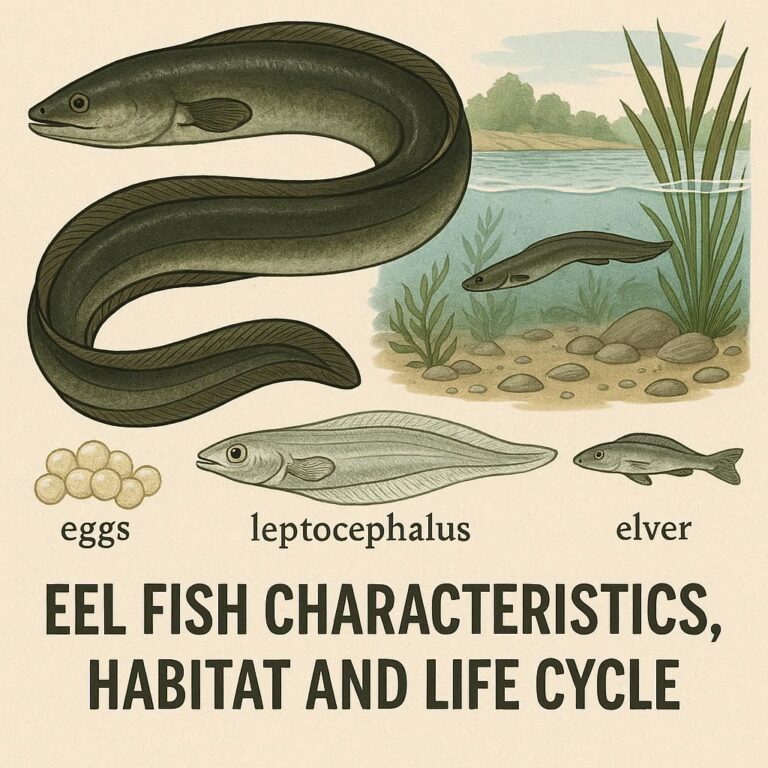
Before they develop color, juvenile eels are almost completely transparent. Their “hiding spot” is their own body. By being see-through, they can drift in the open water column as larvae (Leptocephali) without being easily spotted by predators.
12. The “Crevice Crawl”
As they enter rivers, juvenile eels hide in the smallest spaces imaginable—between individual grains of gravel or under small pebbles. This “interstitial” hiding allows them to move upstream through rapids without being swept away or eaten.
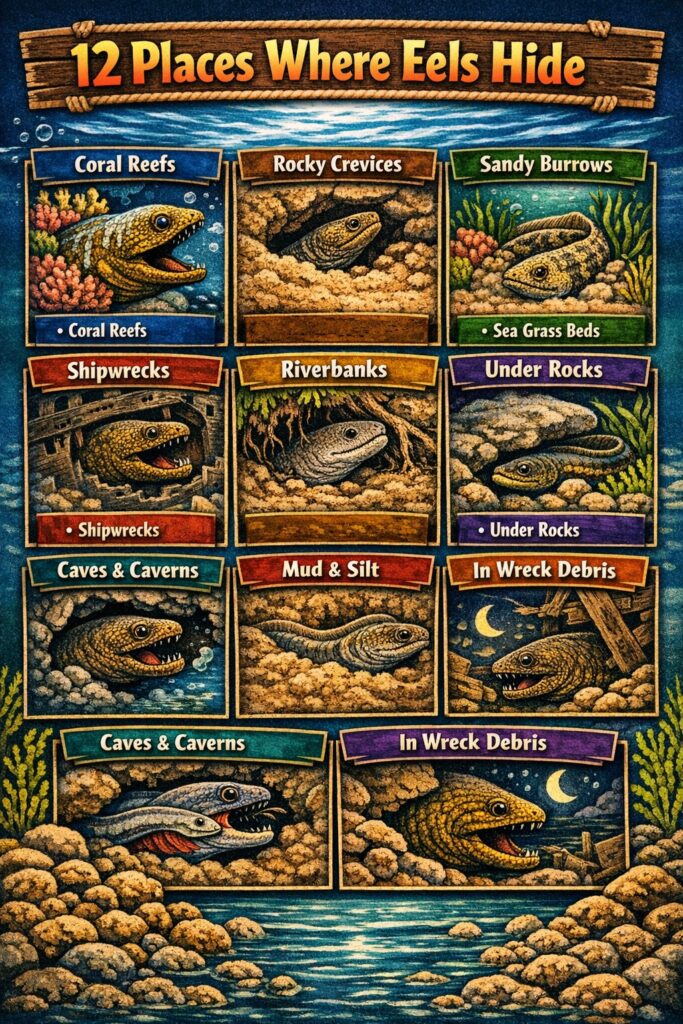
Eel Hiding Spots by Environment Table
| Environment | Primary Hiding Spot | Specialized Technique |
| Coral Reef | Crevices and Caves | Body compression / Pharyngeal jaw anchoring |
| Sandy Flats | Substrate | Backward burrowing with pointed tail |
| Rivers | Mud and Root Snags | Mucus-assisted silt burrowing |
| Open Ocean | Midnight Zone | Diel vertical migration |
| Seagrass | Root mats | Camouflage and body mimicry |
🧠 Behavioral Hiding Strategies
- Burrowing Reflex: Rapid retreat into sand or mud.
- Camouflage: Skin patterns blend with coral or sediment.
- Territorial Retreat: Return to the same crevice repeatedly.
- Mucus Shield: Slippery coating helps escape predator grip.
Conclusion: The Master of the Blind Spot
The eel is a creature that has evolved to thrive in the shadows. Whether it is the Sharptail Eel drilling into the Caribbean sand or the Manytooth Conger waiting in a deep-sea cave, their survival depends on their ability to stay out of sight. By understanding where eels hide, we gain a deeper appreciation for the complexity of the underwater ecosystem. They are not just “slimy fish”; they are the masters of the oceanic blind spot, maintaining the balance of the reef from the safety of their hidden homes.
Frequently Asked Questions
1. Can eels hide on land?
Some eels, like the European eel, can move across damp land to reach new bodies of water. During this time, they “hide” in tall, wet grass or under damp leaves to stay moist.
2. How do eels choose a hole in the reef?
They look for holes with multiple exits if possible, and they prefer spaces that are narrow enough that a larger predator (like a shark) cannot fit its head inside.
3. Do all eels hide alone?
While most are solitary, Garden Eels hide in colonies, and occasionally, multiple moray eels will share a large cave if there is enough space and food.
4. Why do eels hide their tails?
The tail is the most vulnerable part of an eel because it lacks the defensive teeth of the head. By keeping their tails tucked deep into a hole or buried in sand, they protect their vital organs.
5. Do eels hide from humans?
Yes. Most eels are naturally shy and will retreat deeper into their holes if they see a diver, unless they have been “tamed” by frequent hand-feeding (which is discouraged by experts).