

To the casual observer, an eel looks like a creature caught between worlds. It possesses the sleek, undulant movement of a snake but lives entirely within the aquatic realm. This physical ambiguity often leads to a common question: Do eels have bones?
The short answer is a resounding yes. Eels are not cartilaginous like sharks or rays, nor are they invertebrates like jellyfish. They are teleost fish, meaning they possess a complex, fully ossified (bony) skeleton. However, the architecture of an eel’s skeleton is a masterpiece of evolutionary engineering, specifically designed to facilitate their unique “anguilliform” locomotion.
In this comprehensive exploration, we will deconstruct the skeletal anatomy of the eel, compare it to other aquatic species, and explain how their bones allow them to survive in environments ranging from the crushing depths of the abyss to the muddy banks of freshwater rivers.
Key Features of Eel Skeletal Anatomy
1. Vertebral Column
- Highly elongated with 100–250 vertebrae, depending on species.
- Provides flexibility for serpentine swimming.
- Divided into precaudal vertebrae (before the tail) and caudal vertebrae (tail region).
- Vertebrae are relatively short but numerous, allowing smooth undulation.
2. Notochord
- Runs along the body axis beneath the vertebrae.
- In eels, the notochord sheath remains mineralized and provides mechanical stability.
- Acts as a secondary support system when bone mass is reduced during migration.
3. Bone Loss During Migration
- European eels (Anguilla anguilla) undergo skeletal resorption during their 5,000 km spawning migration.
- Osteoclasts break down bone tissue to release minerals for metabolism.
- Despite bone loss, the notochord maintains structural strength.
4. Fins and Appendages
- Pelvic fins absent — a defining trait of Anguilliformes.
- Continuous dorsal, anal, and caudal fins form a ribbon around the tail.
- Pectoral fins are small or reduced.
5. Larval Skeletal Traits (Leptocephalus Stage)
- Transparent, gelatinous body with W‑shaped myomeres (muscle segments).
- Sharp larval teeth and elongated rostrum.
- Skeleton is cartilaginous and lightly ossified, later replaced by adult bone structures.
The Hidden Architecture: the Skeletal System of Eels
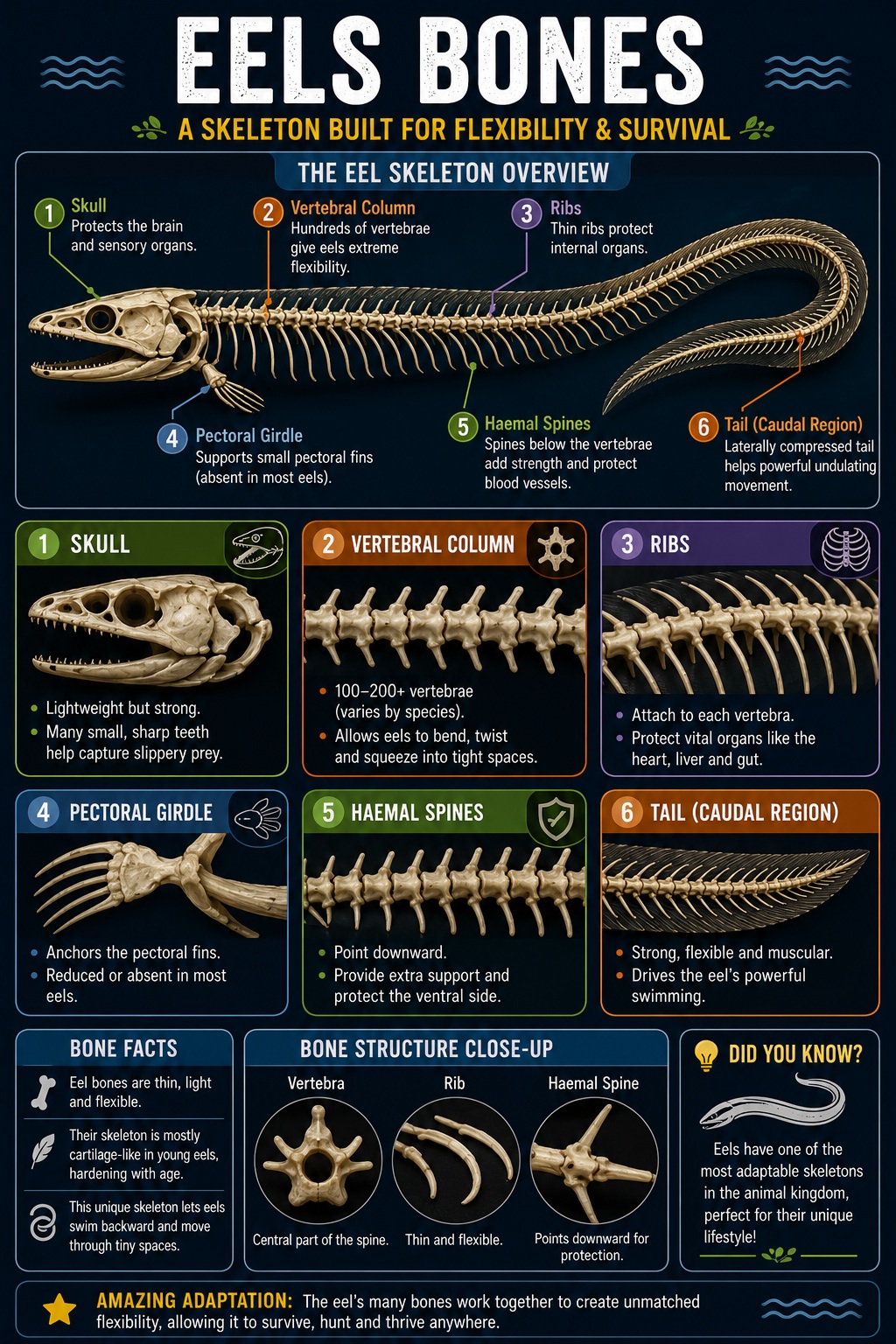
Eels have a unique skeletal anatomy: their elongated bodies are supported by hundreds of small vertebrae, a flexible notochord, and reduced or absent pelvic fins. Unlike many fish, their skeleton adapts during life — losing bone mass during migration while maintaining strength through the mineralized notochord.
1. The Teleost Framework: Why Eels Are Bony Fish
Eels belong to the superorder Teleostei, which encompasses the vast majority of living fish species. Unlike the Chondrichthyes (sharks, rays, and chimaeras), whose skeletons are made of flexible cartilage, teleosts have skeletons made of calcium-rich bone.
The eel’s skeleton provides three primary functions:
- Structural Support: It maintains the fish’s shape against water pressure.
- Protection: The skull and ribs protect vital organs like the brain, heart, and liver.
- Locomotion: It serves as a rigid series of levers that muscles pull against to create movement.
2. The Vertebral Column: The Engine of Undulation
The most striking feature of an eel’s skeleton is its length. While a human has 33 vertebrae and a typical perch might have around 40, some species of eel can have over 100 to 700 vertebrae, depending on the species.
The Mechanics of Anguilliform Locomotion
Eels move using a method called anguilliform swimming. Unlike a tuna, which primarily uses its tail (caudal fin) for propulsion, an eel uses its entire body.
- High Vertebral Count: The sheer number of vertebrae allows for extreme flexibility. Each joint between vertebrae offers a small range of motion, but when multiplied by hundreds, the eel can coil, twist, and tie itself into knots.
- The S-Wave: Muscles along the body contract in a metachronal wave, creating an “S” shape that pushes against the water. Because the skeleton is bony rather than cartilaginous, it provides the necessary “snap-back” or elastic recoil that makes this movement energy-efficient.
3. The Skull and Jaw: Specialized for Predation
If the spine is the engine, the skull is the cockpit. Eel skulls are highly specialized based on their diet and hunting style.
The Moray Eel’s Secret: Pharyngeal Jaws
The Moray eel (Muraenidae) possesses one of the most remarkable skeletal adaptations in the animal kingdom: a second set of jaws.
- Oral Jaws: The outer jaws capture the prey.
- Pharyngeal Jaws: Located in the throat, these bony jaws can launch forward into the mouth, “handing” the prey down into the esophagus. This is a mechanical necessity because eels cannot create the suction force that other fish use to swallow prey.
Bone Density and Burrowing
Species like the Garden Eel or the Snake Eel have reinforced, reinforced snouts and thickened skulls. These “hardened” bones allow them to use their heads as biological drills to burrow tail-first or head-first into sandy substrates without sustaining brain damage.
4. What’s Missing? The Evolution of Loss
One of the reasons people mistake eels for being boneless is the absence of certain skeletal structures found in “standard” fish. Over millions of years, eels have undergone a process of evolutionary reduction.
- Pelvic Fins and Girdle: Most eels have completely lost their pelvic fins and the associated bony girdle. This creates a streamlined, tube-like shape that reduces drag and allows them to slip into narrow crevices.
- Pectoral Girdle: While many eels retain small pectoral fins, the bony structure connecting them to the spine is often reduced or disconnected, allowing for a “loose” neck area that aids in swallowing large prey.
- Reduced Operculum: The bony gill cover (operculum) in eels is often reduced to a small, flexible structure. This is why eels have small, circular gill openings rather than the large slits seen on salmon or bass.
5. The “Pin Bone” Challenge: Eels in the Culinary World
For those who enjoy eating eel (such as Japanese Unagi), the presence of bones is very much an experiential reality.
Eels possess intramuscular bones, often called “pin bones.” These are fine, Y-shaped or needle-like bones embedded within the muscle tissue, separate from the main ribs.
- Why are they there? These bones provide extra support for the complex muscle blocks (myomeres) that eels use for their undulating swim.
- Culinary Preparation: Because these bones are numerous and difficult to remove manually, traditional eel preparation involves techniques like butterflying (removing the central spine) and long-duration steaming or grilling, which softens the intramuscular bones until they are barely noticeable to the palate.
6. Do All Eels Have the Same Bones? (Species Comparison)
| Feature | Moray Eel | Electric Eel* | Conger Eel |
| Vertebrae Count | ~140-200 | ~200+ | ~250-300 |
| Pharyngeal Jaws | Yes (Highly developed) | No | No |
| Pectoral Fins | No | Yes | Yes |
| Bone Density | Very High | Moderate | High |
*Note: The Electric Eel is technically a “knifefish” (Gymnotiformes) rather than a “true eel” (Anguilliformes), but it shares a similar elongated bony structure.
Fossil Record: The Preservation of Eel History
Because eels have true bones made of calcium phosphate, they leave behind a fossil record. Cartilaginous fish like sharks usually only leave behind teeth, but eel fossils dating back to the Cretaceous period show nearly perfectly preserved skeletons.
These fossils reveal that ancient eels were remarkably similar to modern ones, suggesting that their skeletal design reached a state of “evolutionary perfection” for their niche millions of years ago.
Common Misconceptions About Eel Bones
“Eels are just big worms.”
Worms are invertebrates with no skeleton at all (hydrostatic skeletons). Eels have a complex central nervous system protected by a bony spinal column.
“Electric eels have ‘battery’ bones.”
Electric eels do have bones, but their electricity is generated in specialized muscle tissues (electrocytes). Their skeleton actually acts as an insulator to protect their own vital organs from the shocks they produce.
“If you break an eel’s back, it can’t move.”
Like all vertebrates, if the spinal cord within the bony vertebrae is severed, the eel will be paralyzed. However, because their nervous system is decentralized in some ways, some eels show reflexive “post-mortem” movement long after the skeleton is no longer under brain control.
Conclusion: A Masterpiece of Flexibility
The skeleton of an eel is a contradiction: it is rigid enough to protect the animal and provide a base for powerful muscles, yet flexible enough to allow the animal to coil like a rope.
By possessing hundreds of vertebrae, eliminating unnecessary fins, and developing specialized jaws, the eel has used its bony framework to become one of the most successful predators in the ocean. So, the next time you see an eel gracefully gliding through a coral reef, remember that beneath that smooth, slimy skin lies one of the most sophisticated bony architectures in the natural world.