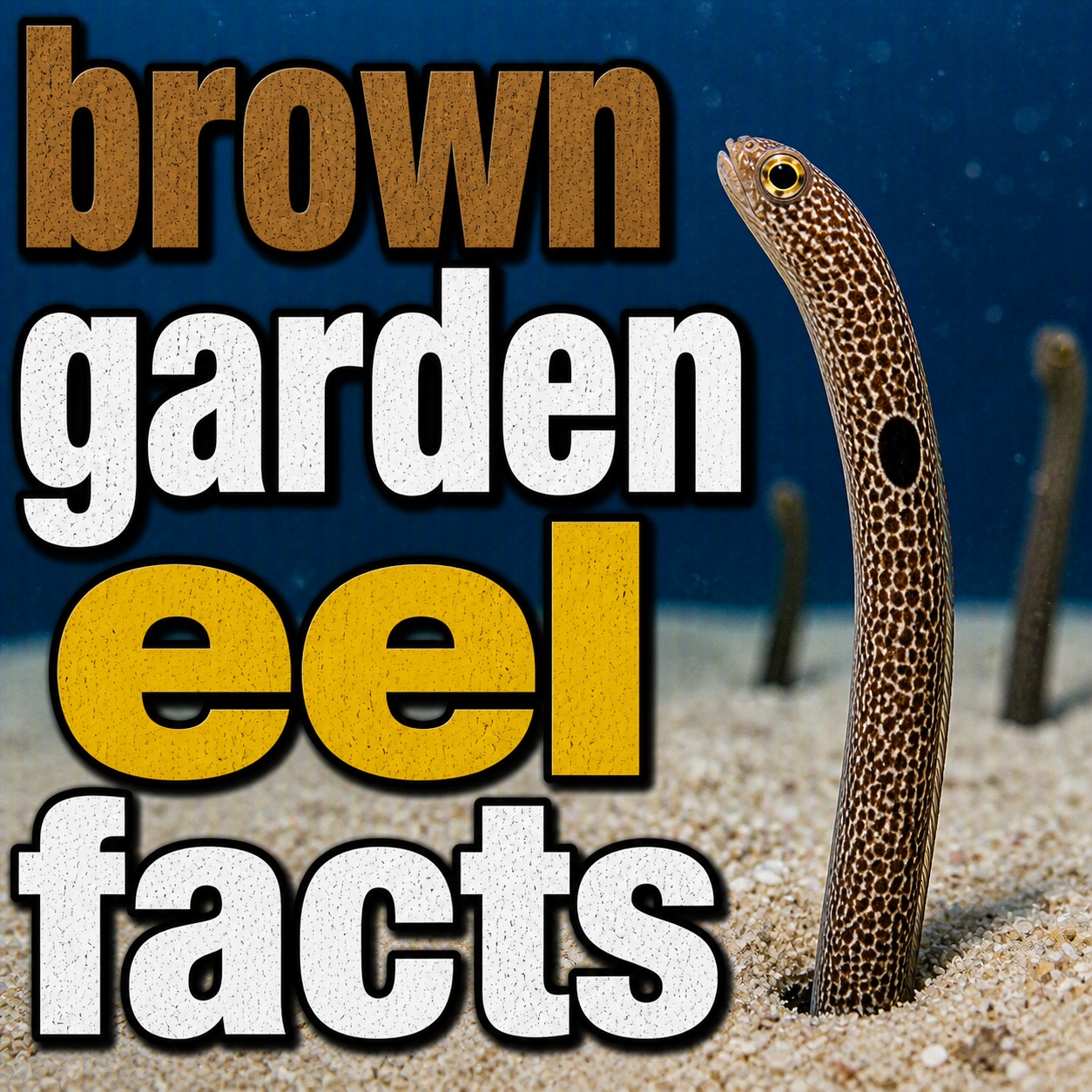
Imagine a field of tall, swaying grass at the bottom of the sea. As you swim closer, the “grass” suddenly vanishes, retreating into the sand in a synchronized wave of movement. You haven’t discovered a magical plant; you’ve encountered a colony of Brown Garden Eels (Heteroconger longissimus).
Among the hundreds of eel species inhabiting our oceans, the garden eel is perhaps the most specialized for a life of “stationary motion.” Unlike the prowling moray or the burrowing snake eel, the Brown Garden Eel has turned its entire existence into a permanent residence within the sand. In this 2000-word guide, we will explore the biological architecture, social dynamics, and survival secrets of the ocean’s most introverted predators.
Taxonomic Identity and Physical Anatomy
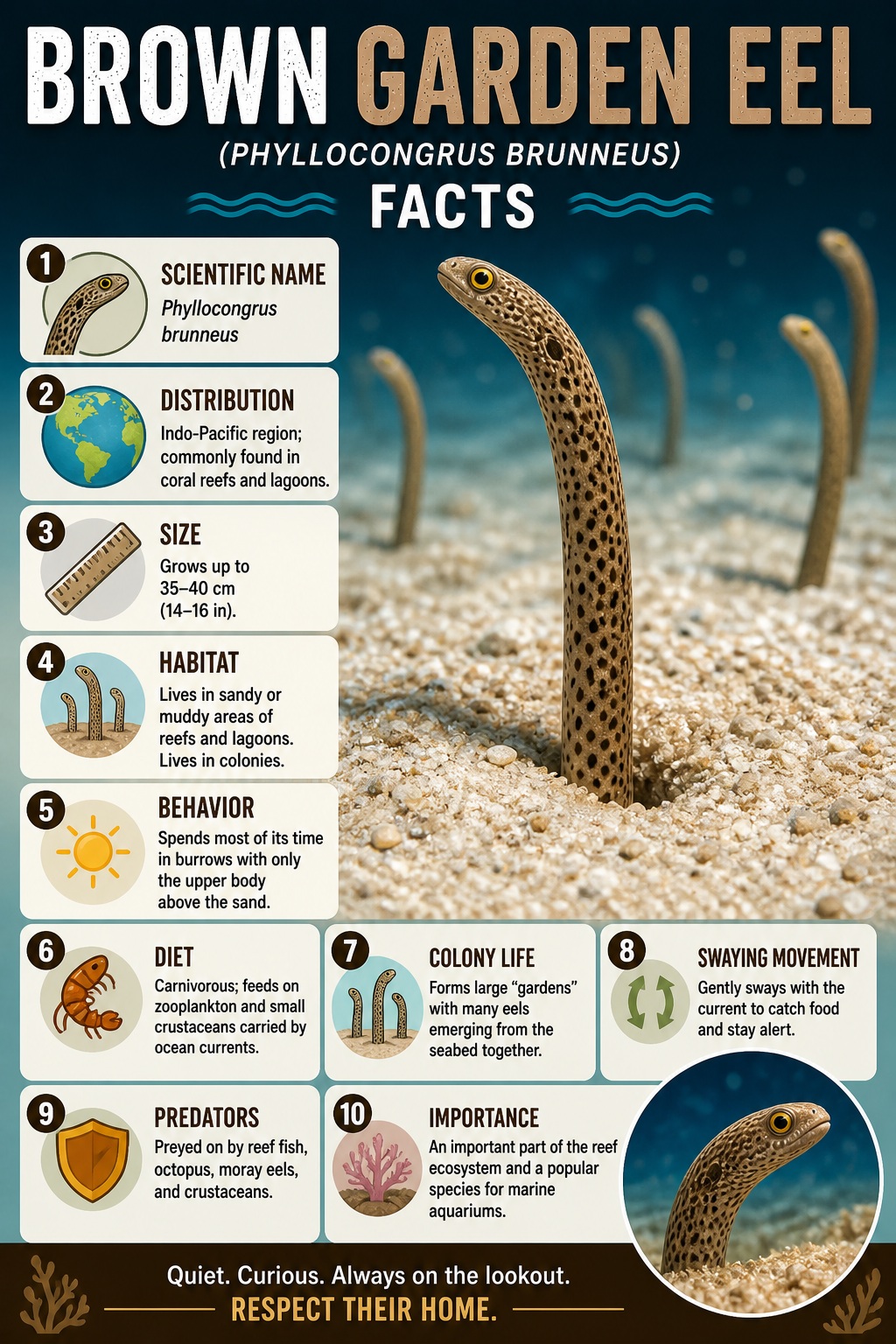
The Brown Garden Eel belongs to the family Congridae and the subfamily Heterocongrinae. While they are true eels, they have diverged significantly from their cousins to adapt to a life spent 75% submerged.
1. The “Pencil” Silhouette
The Brown Garden Eel is exceptionally slender.
- Length: They can grow up to 40–60 centimeters (15–24 inches) in length.
- Girth: Despite their length, they are rarely thicker than a common pencil. This thin profile is an evolutionary necessity, allowing them to exert minimal energy when retreating into their burrows.
2. Coloration and Camouflage
The “Brown” in their name is a bit of a simplification. Their bodies are covered in a fine mottled pattern of brown, tan, and grey specks.
- Disruptive Coloration: This pattern mimics the appearance of coarse sand and coral rubble. When they are extended from their burrows, they blend into the background, making it difficult for predators like jacks or snappers to pinpoint an individual eel from the “grass” at large.
- Large Eyes: They possess large, prominent eyes relative to their head size. This is critical for their survival, as they must visually spot tiny, microscopic plankton drifting in the current while simultaneously watching for the shadow of an approaching predator.
The Subterranean Home: Habitat and Engineering
Brown Garden Eels are found in the tropical and subtropical waters of the Atlantic Ocean, including the Caribbean, the Gulf of Mexico, and the coast of West Africa. They are not random wanderers; they are meticulous “real estate” pickers.
3. The Perfect Neighborhood
A garden eel colony requires very specific environmental conditions:
- Deep Sand Flats: They need a substrate of fine to medium-grained sand that is at least as deep as their body length.
- Constant Currents: They are almost always found on sandy slopes or flats adjacent to reefs where there is a steady, predictable current. The current is their “delivery service,” bringing a constant stream of food to their doorstep.
- Depth Range: They are typically found at depths between 10 and 60 meters (33–200 feet), though they can occasionally be found deeper.
4. Burrowing: The Mucus “Wallpaper”
The most fascinating aspect of their habitat is the burrow itself. Unlike a snake eel that burrows to move from place to place, a garden eel builds a permanent home.
- Tail-First Entry: They use their hardened, pointed tails to “drill” backward into the sand.
- The Glue: As they burrow, they secrete a thick, specialized mucus from their skin. This mucus acts as a biological “cement,” coating the walls of the burrow and preventing the loose sand from collapsing inward. This creates a smooth, reinforced tube that the eel can slide in and out of with zero friction.
The “Conveyor Belt” Diet: Passive Predation
While moray eels are active hunters that track prey by scent, Brown Garden Eels are passive planktivores. They don’t chase their food; they wait for the ocean to bring it to them.
5. The Planktonic Menu
Their diet consists almost entirely of:
- Copepods and Zooplankton: Tiny drifting crustaceans.
- Crustacean Larvae: The microscopic early stages of crabs and shrimp.
- Fish Eggs: High-protein morsels drifting in the current.
6. The Feeding “Dance”
If you watch a colony of garden eels feeding, they appear to be “dancing” or bobbing their heads. This is a highly calculated move. They orient their bodies against the current, swaying back and forth to intercept individual plankton.
- Selective Feeding: They have incredible visual acuity. They pick out individual specks of food from the water column, snapping their mouths shut with lightning speed.
- The Anchor: They never fully leave their burrows. The bottom third of their body remains anchored inside the tube, allowing for an instantaneous “snap-back” retreat if a predator appears.
Behavior and Social Dynamics: Safety in the Colony
Brown Garden Eels are rarely found alone. They live in massive colonies that can number in the hundreds or even thousands of individuals. This social structure is their primary defense mechanism.
7. The “Wave” Defense
Because they are vulnerable when extended, the colony acts as a collective early-warning system.
- Peripheral Vision: Hundreds of pairs of eyes are constantly scanning 360 degrees.
- The Domino Effect: If an eel on the edge of the colony detects a predator, it vanishes into its hole. This movement is seen by its neighbors, who also retreat. This creates a visual “wave” of disappearing eels that moves across the colony, ensuring that by the time a predator arrives at the center, every eel has vanished.
8. Territorial Spacing
Despite living in a colony, garden eels are not “social” in the sense of being friendly. They are highly territorial about their personal space.
- The Reach Rule: Each burrow is spaced just far enough away so that two neighbors cannot touch each other when fully extended.
- Aggression: If one eel tries to “move in” on another’s territory or if two burrows are too close, the eels will engage in “gaping” displays, opening their mouths wide and lunging at each other to maintain their boundary.
Reproduction and the Life Cycle
Like many eels, the reproductive habits of the Brown Garden Eel were a mystery for decades. We now know they follow a pattern common to many oceanic eels but adapted for their colonial lifestyle.
9. Spawning Rituals
During mating season, territorial boundaries are briefly ignored.
- Intertwining: Neighboring eels (typically a male and female) will lean out of their burrows and intertwine their bodies.
- External Fertilization: They release eggs and sperm simultaneously into the water column. Unlike some fish that guard their nests, garden eels leave their offspring to the mercy of the currents.
10. The Leptocephalus Stage
The eggs hatch into Leptocephali—transparent, leaf-shaped larvae.
- The Drifters: These larvae spend several months drifting in the open ocean. Their transparency is their only protection against the vast array of predators in the pelagic zone.
- Settling: Once they reach a certain size, the larvae undergo a metamorphosis. They develop the cylindrical shape of an eel and “settle” onto a suitable sandy flat. The juvenile eel immediately digs its first burrow, which it will likely inhabit—or stay very close to—for the rest of its life.
The Role of the Brown Garden Eel in the Ecosystem
Garden eels are more than just a visual curiosity; they are essential to the health of the sandy environments surrounding coral reefs.
- Nutrient Cycling: By consuming plankton and releasing waste into the sand, they help fertilize the substrate, supporting the growth of beneficial bacteria and small interstitial organisms.
- A Food Source: While they are hard to catch, they are a vital prey item for specialized hunters like Sand Tilefish, Rays, and certain species of Triggers that are capable of blowing water into the burrows to “flush” the eels out.
Comparison: Brown Garden Eel vs. Other Eels
| Feature | Brown Garden Eel | Moray Eel | Snake Eel |
| Hunting Style | Passive (Plankton) | Active (Fish/Octopus) | Foraging (Crabs/Worms) |
| Social Structure | Highly Colonial | Solitary/Territorial | Solitary/Burrowing |
| Movement | Stationary (Anchored) | Free-swimming | Burrowing/Swimming |
| Defense | Group awareness/Retreat | Teeth/Size/Mucus | Burrowing/Mimicry |
The “Wildcard” Secrets of the Garden Eel
The “Eye-Spot” Illusion
Some researchers have noted that from a distance, the dark eyes of the garden eel combined with their swaying movement make them look like the tentacles of a larger, more dangerous animal (like a large anemone or jellyfish). This may deter smaller predators from approaching the “field.”
The Current Whisperers
Garden eels are so sensitive to water movement that they can detect the minute pressure changes of an approaching boat engine or a diver’s fins from dozens of meters away. This “lateral line” sensitivity is what makes them one of the most difficult fish for underwater photographers to capture.
Conservation and Challenges
Currently, the Brown Garden Eel is not listed as endangered, but they face modern threats:
- Habitat Destruction: Coastal development and dredging can destroy the specific sand flats they require.
- Climate Change: Changes in ocean currents can disrupt the “plankton conveyor belt” they rely on for food.
- The Aquarium Trade: While beautiful, they are incredibly difficult to keep in captivity. They require specialized tanks with very deep sand beds and a constant supply of live plankton. Many individuals die from stress during transport or from starvation in “standard” home aquariums.
Conclusion: The Ocean’s Living Wallpaper
The Brown Garden Eel is a masterpiece of niche evolution. By trading the ability to roam for the safety of a permanent home, they have conquered the vast, open sandy deserts of the ocean—areas where most other fish would be far too exposed to survive.
They remind us that in the ocean, survival isn’t always about being the biggest or the fastest; sometimes, it’s about being the most patient. The next time you find yourself over a Caribbean sand flat, look for the swaying “grass” on the horizon. If you move slowly and hold your breath, you might just get a glimpse into the secret, bobbing world of the Brown Garden Eel—the quietest, most disciplined colony in the sea.
Frequently Asked Questions (FAQ)
1. Do Brown Garden Eels ever leave their holes completely?
Almost never. Aside from the larval stage, garden eels are tethered to their burrows. If an eel is forced out by a predator, it will immediately attempt to dig a new hole or find an abandoned one, as it is completely defenseless in open water.
2. How do they breathe while their bottom half is in a hole?
They pump water through their mouths and out their gill slits, which are located at the front of their bodies. As long as their head is out of the hole, they can breathe perfectly.
3. Why are they called “Brown” Garden Eels specifically?
To distinguish them from the Spotted Garden Eel (Heteroconger hassi), which is more common in the Indo-Pacific and has much larger, more distinct black spots on a white body.
4. Can they bite humans?
No. Their mouths are tiny—designed only for catching microscopic plankton. They are completely harmless to humans and will hide long before you get close enough to touch them.
5. How long do they live?
In the wild, their lifespan is estimated to be between 5 and 10 years, though data is difficult to collect due to their shy nature.