

Eels are renowned in the animal kingdom for their ability to escape from danger, often using specialized, high‑stakes tactics to evade predators — even after being swallowed whole.
While many eel escapes happen quietly in living rooms, several high-profile “Houdini” acts have made international headlines. These stories highlight the incredible resilience, strength, and biological drive of these creatures.
1. The “Inky” of the Eel World: The National Aquarium Escape
In a story that sounds like a Pixar movie script, an eel at a major national aquarium once managed to navigate through its tank’s overflow system, travel down a series of drainage pipes, and successfully reach the local harbor.
Staff realized the eel was missing during a morning head-count. After tracing the plumbing, they discovered that the eel had squeezed through a grate that was thought to be “impenetrable.” This incident became a case study for public aquariums worldwide, leading to the “Double-Grate” standard now used in professional exhibits.
2. The 2017 “Slime-pocalypse” (Oregon Highway)
While not an escape from a tank, this is the most famous instance of eels “escaping” human containment. A truck carrying 7,500 pounds of hagfish (often called “slime eels”) crashed on an Oregon highway.
When stressed, these creatures release a fibrous protein that turns into a thick, expanding slime upon contact with water. The “escaped” eels covered cars and the highway in tons of gelatinous sludge. It took bulldozers and fire hoses hours to clear the road. The photos of “slimed” sedans went viral, cementing the eel’s reputation as a creature that is impossible to handle.
3. The Great “Carpet Trek” of the European Eel
A famous anecdotal account shared in biological circles involves a European Eel kept in a research facility in the UK. Researchers arrived one morning to find the eel missing from its high-security tank. They found it three rooms away, tucked behind a filing cabinet.
The eel had:
- Pushed open a weighted lid.
- Dropped four feet to the floor.
- Slithered across 50 feet of industrial carpet.
- Survived for at least six hours out of water by using its skin to breathe. The eel was returned to its tank and made a full recovery, proving that “dry land” is only a minor inconvenience for a determined eel.
4. Japanese Eels Escaping from the Stomach of Predatory Fish
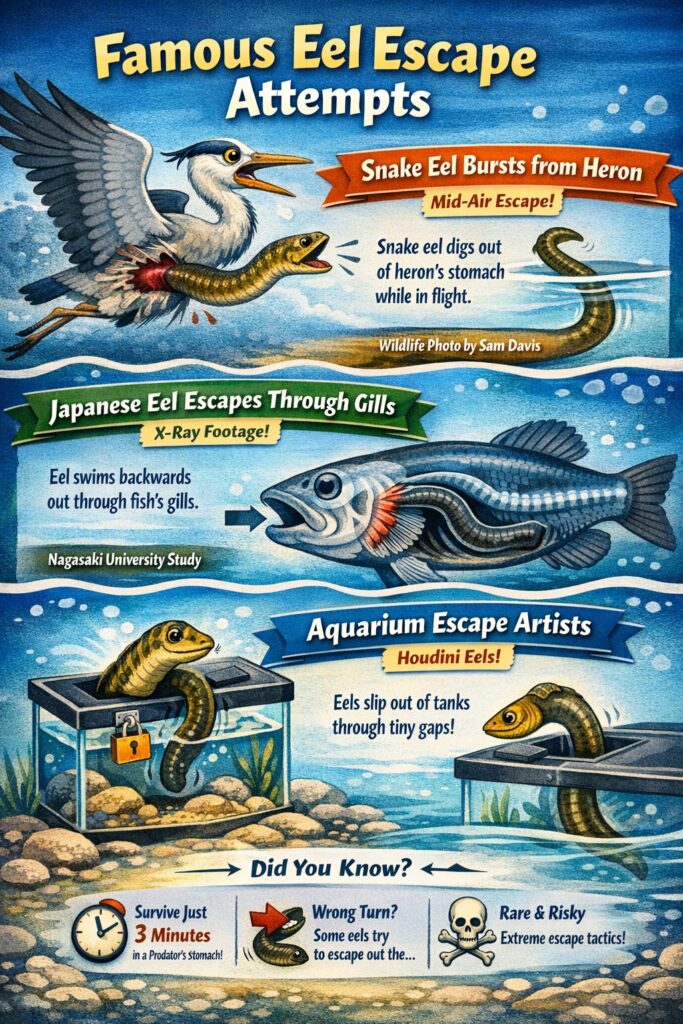
Japanese eels have become famous for their unbelievable escape acts — even after being swallowed. Recent research shows they can reverse‑swim out of predators’ stomachs through the gills, a feat captured for the first time on X‑ray video.
- Species: Anguilla japonica (Japanese eel).
- Discovery: Scientists at Nagasaki University, Japan, filmed juvenile eels escaping from predatory fish (Odontobutis obscura) using X‑ray videography
- Mechanism:
- After being swallowed, the eel reverses direction tail‑first.
- It wriggles back up the predator’s esophagus, then pushes through the gill openings.
- The entire escape takes about 56 seconds on average.
- Success Rate: Out of 32 captured eels, 28 attempted escape, 13 reached the gills, and 9 fully escaped.
- Significance: This is the first documented case of prey escaping alive from inside a predator’s digestive tract. It demonstrates extreme flexibility and oxygen tolerance.
- Research Impact: The study, published in Current Biology (2024), opens new insights into predator‑prey dynamics and survival adaptations unseen before.
5. “Moonwalking” Eels — The Viral Footage
- Media Coverage: Newsweek dubbed them “Eaten Eels Moonwalking Out of Their Predators.”
- Technique: The eels appear to “moonwalk” backward, tail‑first, through the predator’s throat and gills.
- Observation Method: Scientists injected the eels with barium sulfate, making them visible under X‑rays.
- Behavioral Insight:
- The eels sense pressure and chemical cues inside the predator’s stomach.
- They instinctively reverse their swimming motion, using serpentine undulations to navigate the narrow digestive tract.
- Evolutionary Advantage: Juvenile eels are particularly vulnerable, so this escape reflex likely evolved as a last‑chance survival mechanism.
6. Eel Escaping from a Heron’s Stomach
- Incident: A viral wildlife photo showed a live eel protruding from a heron’s throat, apparently trying to escape after being swallowed.
- Explanation:
- The eel likely entered the bird’s esophagus alive and attempted to burrow outward.
- Herons swallow prey whole, and eels’ muscular bodies allow them to resist digestion briefly.
- In rare cases, eels have been seen forcing their way out through the bird’s neck or mouth, sometimes fatally injuring the predator.
- Ecological Note: Such events highlight the eel’s extraordinary resilience and the risks predators face when consuming elongated, muscular prey.
7. Aquarium Escape Artists
Species: Moray eels (saltwater) and spiny eels (freshwater).
Method:
- Eels use their elongated, slippery bodies to squeeze through tiny openings in aquarium lids, filter gaps, or feeding holes.
- They can push up lightweight covers or slide through tubing gaps.
Outcome:
- Escapes are common in home aquariums, often resulting in eels found on the floor or behind tanks.
- Owners must secure lids, seal openings, and lower water levels to prevent escapes.
Footage Reference: 📹 An Encounter with an Electric Eel | Primal Survivor: Escape — National Geographic, YouTube (9 May 2022).
Why These Escapes Capture Attention
These stories go viral because they challenge our understanding of what a “fish” can do.
- Survival Instinct: Most fish die within minutes of leaving water. The fact that an eel can survive a “commute” across a room fascinates the public.
- The “Houdini” Factor: Humans are naturally drawn to escape stories. Seeing a creature without limbs outsmart locks, grates, and lids feels like a triumph of nature over engineering.
- Visual Impact: Whether it’s the 2017 highway slime or a video of a Moray eel “walking” on a reef, the visuals are always striking and slightly alien.
Lessons for the Home Aquarist
If a million-dollar facility with professional biologists can lose an eel to an escape attempt, it can happen to anyone. These famous cases reinforce three “Pro Rules”:
- Size Doesn’t Matter: If the head fits, the eel fits.
- Distance is Irrelevant: An eel won’t stay next to the tank; it will head for the darkest, dampest corner of your house.
- The Slime Protects: An eel’s slime coat is its “space suit,” allowing it to survive journeys that would kill any other aquatic pet.
Pro Tip: If you ever find your eel on the floor, do not assume it is dead. They can survive for hours in a semi-dried state. Gently place them back in a quarantine tank with high oxygen—many “miracle” recoveries have been documented!
🔬 Why These Escapes Matter
- Scientific Breakthrough: The Japanese eel study is the first direct observation of prey escaping from inside a predator using imaging technology.
- Behavioral Insight: It reveals that eels possess reversible locomotion, allowing them to swim backward efficiently.
- Evolutionary Significance: Demonstrates how flexible body design and oxygen efficiency can enable survival even in extreme conditions.
- Broader Implications: May inspire biomimetic designs in robotics — flexible, reversible movement in confined spaces.
🧠 Key Takeaways
| Phenomenon | Species | Escape Route | Success Rate | Method Observed | Source |
|---|---|---|---|---|---|
| Stomach Escape | Japanese Eel (Anguilla japonica) | Through esophagus → gills | 9/32 successful | X‑ray videography | Current Biology, 2024 |
| “Moonwalk” Escape | Juvenile Japanese Eel | Tail‑first reverse swimming | ~28 attempts | Barium contrast X‑ray | Newsweek |
| Heron Incident | Unidentified eel species | Through throat/neck | Rare | Wildlife observation | Field reports |
In short: Japanese eels are true escape artists of the aquatic world — capable of reversing through a predator’s digestive tract, moonwalking out through gills, and even attempting to flee from birds’ stomachs. These remarkable feats redefine what scientists thought possible in animal survival behavior. Newsweek ScienceBlog.com