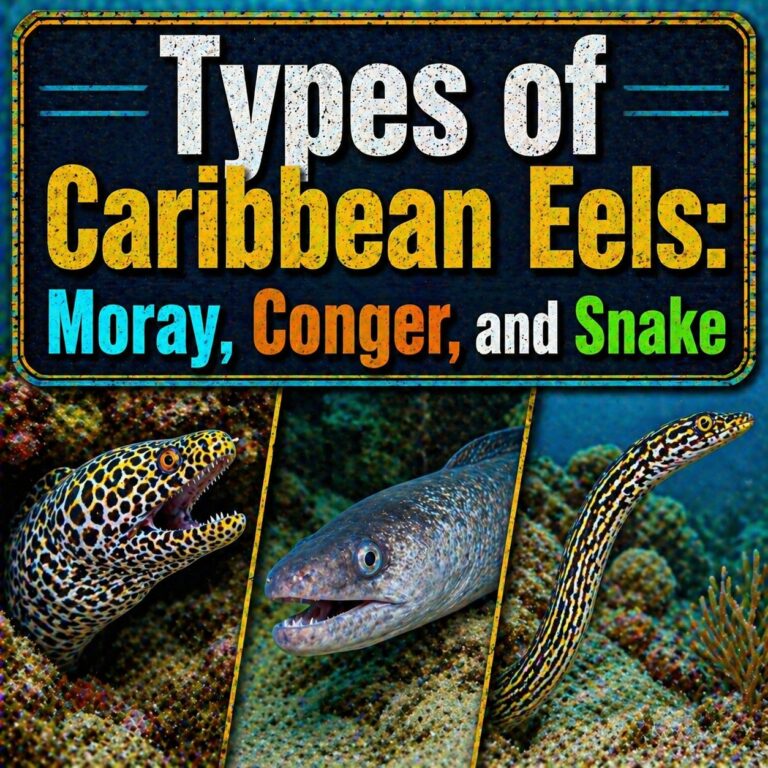
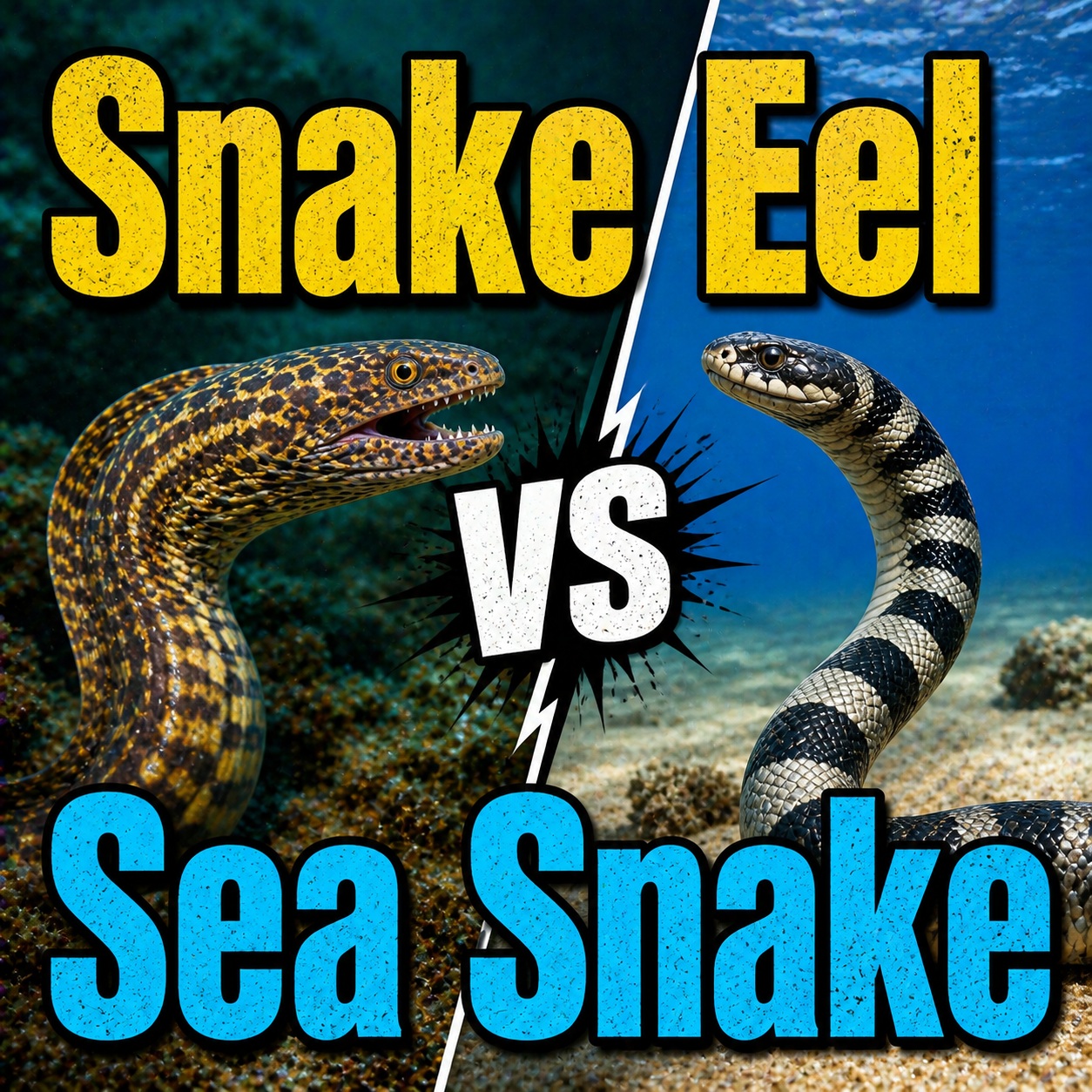
At first glance, a long, slender creature gliding through tropical waters might seem unmistakably serpentine. Divers often encounter these mysterious forms—some burrowing in sand, others weaving gracefully through coral reefs—and assume they’re all “sea snakes.” Yet, many of these are not snakes at all. They’re snake eels, a group of fascinating fish that have evolved to mimic the appearance and movement of true snakes.
Despite their similar shapes, snake eels and sea snakes belong to entirely different branches of the animal kingdom. Snake eels are fish, members of the Ophichthidae family, while sea snakes are reptiles, part of the Elapidae family, which also includes cobras and kraits. Their resemblance is a striking example of convergent evolution—where unrelated species develop similar traits to adapt to similar environments.
This article explores their anatomy, behavior, ecology, and cultural significance, revealing how two very different creatures came to share the same serpentine silhouette beneath the waves.
🧬 Biological Classification
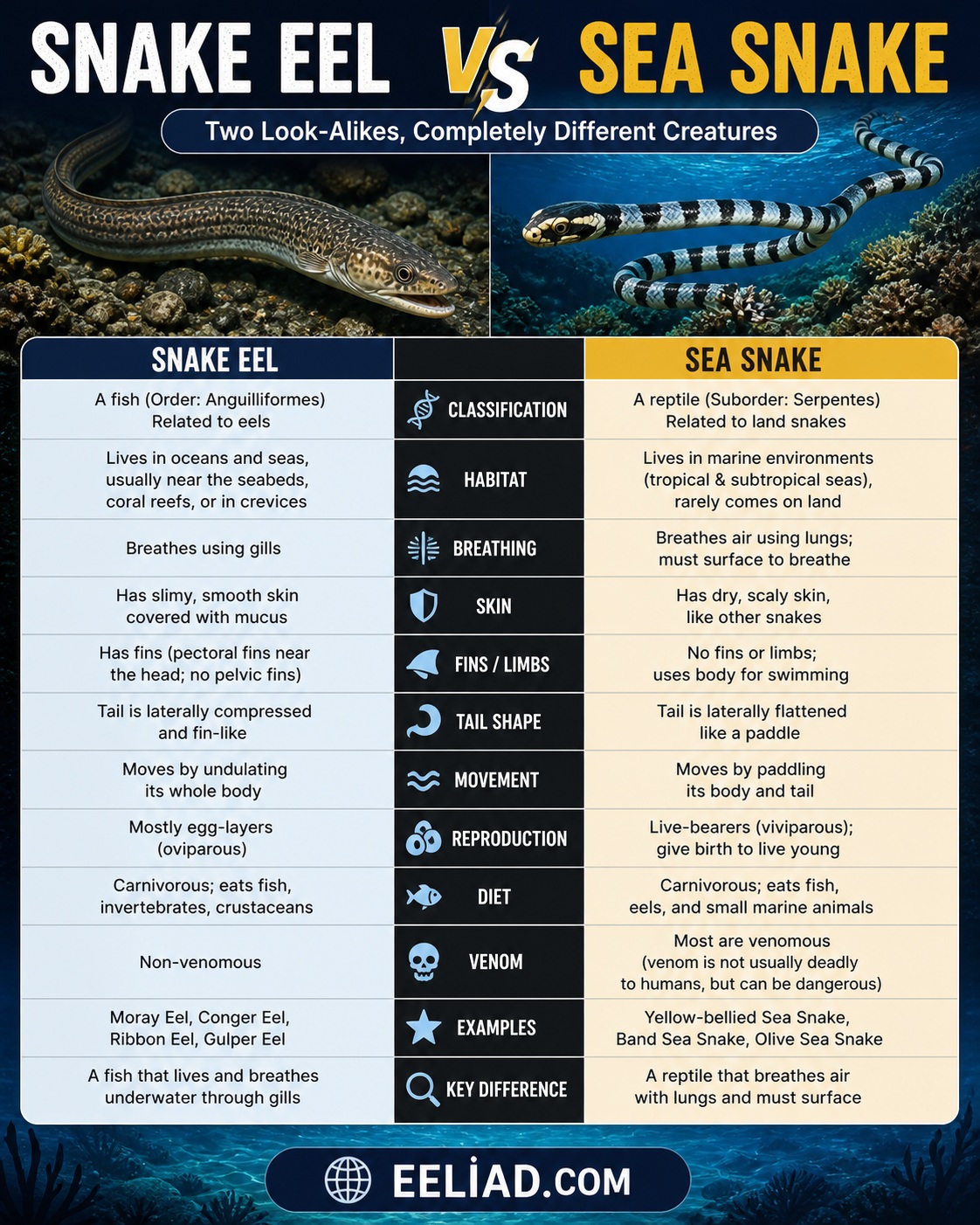
| Feature | Snake Eel (Family Ophichthidae) | Sea Snake (Subfamily Hydrophiinae) |
|---|---|---|
| Kingdom/Class | Animalia / Actinopterygii (Fish) | Animalia / Reptilia (Reptile) |
| Respiration | Breathes underwater using gills | Breathes air through lungs; must surface |
| Skin Texture | Smooth, slimy, covered in mucus | Dry, shiny scales made of keratin |
| Fins | Has a continuous dorsal fin along the back | No fins; uses a paddle-like tail for swimming |
| Tail Shape | Rounded or tapering | Flattened, paddle-shaped |
| Reproduction | Lays eggs underwater or gives live birth (varies by species) | Mates in water but lays eggs on land |
| Venom | Non-venomous | Highly venomous, used for hunting fish |
| Habitat | Burrows in sand or mud; found in reefs and coastal areas | Tropical waters of Indian and Pacific Oceans |
| Behavior | Hides in holes, hunts small fish and crustaceans | Active swimmer, hunts small fish and fish eggs |
🌊 Key Visual Differences
- Snake Eel: Has a visible dorsal fin running along its back; often burrows with only the head exposed.
- Sea Snake: Has no fins, a flat tail, and must swim to the surface every 30 minutes to breathe.
- Color Patterns: Both can have banded or spotted patterns, but coloration alone isn’t reliable for identification.
🧬 Taxonomy and Classification
Snake Eels: The Burrowing Fish
Snake eels belong to the order Anguilliformes, which includes all true eels. Within this order, the family Ophichthidae encompasses over 300 species known for their elongated bodies and burrowing habits. They are ray-finned fish (class Actinopterygii), equipped with gills, fins, and scales so small they’re nearly invisible.
Their name, derived from Greek roots meaning “serpent-like,” reflects their appearance and behavior. Snake eels are found in tropical and subtropical waters worldwide, often hiding in sandy or muddy seabeds with only their heads exposed.
Sea Snakes: The Marine Reptiles
Sea snakes, on the other hand, are true snakes—air-breathing reptiles belonging to the subfamily Hydrophiinae within the Elapidae family. This group includes some of the most venomous species on Earth, such as cobras and coral snakes.
There are about 60 species of sea snakes, most of which live in the warm coastal waters of the Indian and Pacific Oceans. Unlike snake eels, sea snakes evolved from terrestrial snakes that returned to the sea millions of years ago, adapting their lungs, scales, and tails for aquatic life.
🫁 Breathing and Physiology
Snake Eels: Masters of Underwater Respiration
Snake eels breathe through gills, just like other fish. Their gill openings are small and positioned behind the head, allowing them to remain buried in sediment while still drawing oxygen from the water. This adaptation helps them stay hidden from predators and ambush prey efficiently.
They can remain submerged indefinitely, as their oxygen exchange is continuous through water flow over their gills.
Sea Snakes: Air-Breathing Divers
Sea snakes, being reptiles, must surface to breathe air. They possess lungs that extend nearly the entire length of their body, enabling them to store large volumes of air and stay underwater for up to 30 minutes or more.
Interestingly, sea snakes also absorb some oxygen through their skin, a rare trait among reptiles. This partial cutaneous respiration allows them to extend their dives and conserve energy. However, they are still dependent on surfacing regularly, which makes them vulnerable to predators and environmental changes.
🐠 Body Structure and Movement
Snake Eels: Flexible and Fin-Driven
Snake eels have a continuous dorsal fin running along their back, merging with the caudal (tail) and anal fins to form a smooth ribbon-like edge. This fin structure gives them remarkable flexibility and control while swimming or burrowing.
Their bodies are muscular and cylindrical, tapering toward the tail, which is often rounded or pointed rather than flattened. This shape is ideal for digging into sand or mud, where they spend most of their lives.
Sea Snakes: Streamlined and Paddle-Tailed
Sea snakes lack fins entirely. Instead, they have evolved a flattened, paddle-shaped tail, similar to that of an oar, which propels them through water with graceful undulations. Their scales are keeled (ridged), helping reduce drag and improve maneuverability.
Their bodies are laterally compressed—flattened from side to side—making them efficient swimmers but clumsy on land. Some species, like the sea kraits, retain partial terrestrial ability and come ashore to lay eggs, while others are fully marine and give birth underwater.
🧫 Skin and Texture
Snake Eels: Smooth and Mucus-Covered
The skin of a snake eel is smooth and coated with mucus, which reduces friction and protects against parasites. Their scales are microscopic, giving them a slippery, scaleless appearance. This mucus also helps them glide through sediment and escape predators.
Sea Snakes: Scaled and Shiny
Sea snakes have keratinized scales, similar to land snakes, but adapted for aquatic life. These scales are smaller and more tightly packed, forming a waterproof barrier that prevents excessive salt absorption. Their skin periodically sheds, helping remove parasites and maintain hydrodynamic efficiency.
🪸 Habitat and Distribution
Snake Eels
Snake eels inhabit shallow coastal waters, coral reefs, and estuaries. Many species burrow into sandy or muddy substrates, emerging at night to hunt. They are found in tropical and subtropical oceans worldwide, including the Caribbean, Indo-Pacific, and Mediterranean regions.
Some species, like the banded snake eel (Myrichthys colubrinus), mimic the coloration of venomous sea snakes—a clever defense mechanism known as Batesian mimicry.
Sea Snakes
Sea snakes are restricted to warm tropical waters, primarily in the Indian Ocean, Southeast Asia, and northern Australia. They prefer coral reefs, lagoons, and coastal shallows where prey is abundant.
Unlike snake eels, sea snakes rarely burrow. They swim freely in open water or among coral structures, hunting small fish and eels. Some species, such as the yellow-lipped sea krait (Laticauda colubrina), venture onto land to rest or lay eggs, while others are fully pelagic.
🍽️ Diet and Feeding Behavior
Snake Eels: Ambush Predators
Snake eels are carnivorous ambush hunters. They feed on small fish, crustaceans, and worms, using their sharp teeth to seize prey that passes near their burrow. Their jaws are strong and hinged, allowing them to swallow prey whole.
Their hunting strategy relies on stealth—remaining hidden until the perfect moment to strike. Some species even use their burrows as traps, waiting for prey to wander close before lunging out.
Sea Snakes: Active Hunters
Sea snakes actively pursue prey, primarily small fish and fish eggs. Their venom, delivered through short, fixed fangs, immobilizes prey almost instantly. Despite their potency, sea snakes are generally non-aggressive toward humans and rarely bite unless provoked.
Their hunting style is agile and precise, often weaving through coral crevices or chasing schools of fish. Once prey is captured, they swallow it whole, aided by flexible jaws similar to those of terrestrial snakes.
🐣 Reproduction and Life Cycle
Snake Eels
Reproductive strategies vary among species. Some snake eels lay adhesive eggs that stick to the seabed, while others give birth to live young. Their larvae, known as leptocephali, are transparent and drift with ocean currents before metamorphosing into juvenile eels.
This planktonic stage can last several months, allowing wide dispersal across oceans.
Sea Snakes
Sea snakes exhibit two reproductive modes:
- Sea kraits (genus Laticauda) lay eggs on land.
- True sea snakes (genus Hydrophis and others) give birth to live young underwater.
Gestation lasts several months, and females produce 2–10 offspring at a time. The young are fully independent at birth, capable of swimming and hunting immediately.
☠️ Venom and Defense
Snake Eels: Harmless Mimics
Snake eels are non-venomous and pose no threat to humans. Their primary defense is camouflage and mimicry. Many species resemble venomous sea snakes in color and movement, deterring predators who mistake them for dangerous reptiles.
Sea Snakes: Potent Predators
Sea snakes possess neurotoxic venom that is among the most powerful in the animal kingdom—more potent than that of cobras. However, their venom yield is small, and they rarely bite humans.
Their bright coloration often serves as a warning signal, advertising their toxicity to potential predators.
🌍 Ecological Importance
Snake Eels
Snake eels are crucial to benthic (seafloor) ecosystems. Their burrowing activity aerates sediments, allowing oxygen to penetrate deeper layers, which supports microbial life and nutrient cycling. By preying on small fish, crustaceans, and worms, they help regulate populations and maintain balance in reef and coastal environments. Their mimicry of sea snakes also plays a role in predator-prey dynamics, discouraging attacks from larger fish and marine mammals.
Sea Snakes
Sea snakes are apex micro-predators in coral reef ecosystems. Their venom allows them to control populations of small reef fish, preventing overpopulation that could destabilize coral health. They also serve as prey for larger predators such as sharks and sea eagles, forming an important link in the food chain. Because they are sensitive to pollution and habitat degradation, their presence is often considered an indicator of reef health.
⚖️ Human Interactions
Snake Eels
Snake eels are generally harmless to humans. Divers often mistake them for sea snakes, but snake eels lack venom. Their burrowing behavior means they are rarely encountered in open water. However, fishermen sometimes catch them accidentally in nets or hooks. In some cultures, snake eels are consumed as food, though they are less popular than other eel species due to their tough skin and bony structure.
Sea Snakes
Sea snakes, despite their potent venom, are not aggressive toward humans. Most bites occur when fishermen accidentally handle them in nets. Fatalities are rare, but their venom is medically significant. In some regions, sea snakes are harvested for their skin, meat, and even venom (used in medical research). Conservationists warn against overexploitation, as many species are already vulnerable due to habitat loss.
🧠 Evolutionary Insights
Snake eels and sea snakes exemplify convergent evolution—different lineages developing similar traits to thrive in similar environments. Both evolved elongated, serpentine bodies to navigate narrow reef crevices and sandy substrates. Yet, their evolutionary paths diverged dramatically:
- Snake eels evolved from fish ancestors, retaining gills and fins while adapting to burrowing lifestyles.
- Sea snakes evolved from terrestrial snakes, modifying lungs, scales, and tails to survive underwater.
This convergence highlights how environmental pressures shape body forms across unrelated species.
📜 Cultural and Folklore Significance
Snake Eels
In some coastal cultures, snake eels are seen as mysterious creatures of the seabed. Their resemblance to snakes has led to myths portraying them as guardians of hidden treasures or omens of change. Fishermen often regard them with caution, not because of venom but due to superstition about their snake-like appearance.
Sea Snakes
Sea snakes hold a more prominent place in folklore. In Pacific Island traditions, they are sometimes revered as spiritual beings or messengers of the gods. Their striking patterns and deadly venom have made them symbols of danger, mystery, and respect. In modern culture, they are often featured in documentaries as examples of extreme marine adaptation.
🚨 Conservation Challenges
Both snake eels and sea snakes face threats from human activity:
- Snake Eels: Habitat destruction from coastal development, dredging, and pollution reduces sandy and muddy substrates where they burrow. Bycatch in fishing nets also impacts populations.
- Sea Snakes: Coral reef degradation, climate change, and pollution threaten their habitats. Overfishing and direct harvesting for skins and meat further reduce numbers.
Conservation efforts focus on protecting reef ecosystems, regulating fisheries, and raising awareness about the ecological roles of these species.
🔬 Scientific Research and Future Directions
Researchers continue to study both groups for insights into evolution, ecology, and medicine:
- Snake Eels: Their burrowing behavior and mimicry strategies are of interest to behavioral ecologists. Genetic studies help clarify their evolutionary relationships within Anguilliformes.
- Sea Snakes: Their venom is studied for potential medical applications, including painkillers and treatments for neurological disorders. Their unique respiratory adaptations also provide clues about reptilian evolution in aquatic environments.
Conclusion
Snake eels and sea snakes may look alike, but they represent two distinct evolutionary stories. Snake eels are fish, breathing through gills and burrowing in sand, while sea snakes are reptiles, air-breathing and venomous, gliding through coral reefs. Their similarities are a testament to nature’s ability to shape diverse creatures into similar forms when faced with the same environmental challenges.
For divers, fishermen, and coastal communities, recognizing the differences is more than academic—it’s essential for safety, conservation, and appreciation of marine biodiversity. Snake eels remind us of the hidden life beneath the seabed, while sea snakes embody the delicate balance of reef ecosystems. Together, they enrich our understanding of the ocean’s complexity and the evolutionary creativity of life.