The peacock eel (Macrognathus siamensis) introduces a wonderful, snake-like elegance to any freshwater aquarium. However, these fish deviate significantly from standard aquarium fish regarding their daily habits and medical sensitivities. Because they lack standard protective scales, peacock eels display vulnerability to water pollutants, incorrect substrates, and mental stress.
Aquarists frequently panic when their new pet vanishes into the sand or refuses meals for days at a time. This comprehensive manual breaks down the critical difference between instinctive nocturnal habits and genuine medical emergencies. By learning to decode their unique physical signals, you can keep your striped companion thriving for over a decade.
Why Is My Peacock Eel Hiding All the Time?
If you rarely see your peacock eel, you are experiencing standard ownership. Beginners often ask why their peacock eel hides all the time. First, you must recognize that these animals possess a naturally nocturnal lifestyle. In their native Southeast Asian habitats, they spend daylight hours tucked away from predatory birds and large fish. Therefore, they only emerge to hunt when the sun sets.
However, constant hiding during the night indicates a secondary problem. If your tank lacks sufficient visual cover, the eel feels entirely vulnerable. You can solve this issue by adding hollow logs, rocky crevices, or pieces of bamboo. Additionally, aggressive tank mates like territorial cichlids will terrify your eel. Consequently, the eel will stay hidden to avoid physical harm. You should check the tank with a flashlight an hour after turning off the lights to confirm if your eel explores the habitat in the dark.
Peacock Eel Buried in Sand: Normal Behavior or a Problem?
Seeing your peacock eel buried in sand all day might alarm you, but this actually indicates a happy, comfortable animal. These fish utilize their pointed, flexible snouts to dig into the riverbed. This instinct allows them to escape predators and hunt for buried worms. A healthy eel will often submerge its entire body, leaving only its tiny eyes and snout visible at the surface of the sand.
Normal Burrowing Process
- Eel uses pointed snout to displace fine sand grains
- Muscular body wriggles downward in a serpentine motion
- Eel rests completely submerged with only eyes and nose exposed
Conversely, this normal behavior transforms into a major problem if you choose the wrong substrate. If you fill your aquarium with sharp gravel or crushed coral, the coarse grains will tear the eel’s delicate skin. These micro-tears quickly invite deadly bacterial infections. Therefore, you must provide a soft sand bed that measures at least two to three inches deep. If your peacock eel stops burrowing entirely and sits exposed on bare glass, it is experiencing severe environmental stress or physical illness.
Why Is My Peacock Eel Not Eating?
A hunger strike represents one of the most frustrating challenges for any keeper. When an aquarist notes that their peacock eel stopped eating suddenly, the root cause usually boils down to an incorrect diet. Inexperienced keepers often try to feed these carnivores dry flakes or processed pellets. However, wild peacock eels consume live invertebrates, so they completely ignore artificial options.
To fix a stubborn eater, you must offer fragrant live or frozen foods. Thawed bloodworms, chopped earthworms, blackworms, and brine shrimp will trigger their intense sense of smell. If your peacock eel is not eating despite you offering proper food, look at the tank dynamics. Fast-moving fish like tinfoil barbs or danios will routinely steal food before your slow-moving eel can even navigate out of its cave. You can bypass this competition by using long feeding tongs to deliver the food directly to the eel’s mouth during nighttime hours.
Why Is My Peacock Eel Losing Weight?
Observing a peacock eel losing weight is a grave concern that requires immediate intervention. If your eel continues to look emaciated despite consuming regular meals, internal parasites are likely ravaging its system. Wild-caught specimens frequently carry roundworms or tapeworms that drain their nutritional energy. To cure this, you must treat the aquarium with an antiparasitic medication like praziquantel, ensuring the product explicitly states it is safe for scaleless fish.
Furthermore, a lack of dietary variety can cause muscle wasting. If you only feed your eel a single type of low-quality frozen food, it will suffer from severe nutrient deficits. You should rotate through a diverse menu of earthworms, krill, and enriched bloodworms. Finally, double-check that your eel actually swallows the food. Sometimes, an eel will take food into its mouth but spit it back out due to mouth rot or poor water quality.
Peacock Eel Breathing Fast: Causes and Fixes
A peacock eel breathing fast signals an atmospheric or chemical crisis inside the aquarium. You can monitor their respiration by watching the movement of their operculum, which is the protective flap covering their gills. Rapid, shallow puffing indicates that the fish cannot extract enough oxygen from the water column.
| Potential Cause | Immediate Consequence | Effective Fix |
| Ammonia or Nitrite Spike | Chemical burning of delicate gill tissues | Execute an immediate 50% water change and add a detoxifying water conditioner. |
| Elevated Water Temperature | Hot water holds significantly less dissolved oxygen | Slowly lower the heater setting and position a cooling fan near the surface. |
| Low Surface Agitation | Carbon dioxide builds up while oxygen depletes | Install a heavy-duty air stone or adjust the filter output to create bubbles. |
Because peacock eels dwell exclusively at the bottom of the tank, they feel the effects of low oxygen first. This happens because oxygen concentrations remain lowest near the substrate. If you observe your eel pumping its gills rapidly, check your water parameters with a liquid testing kit immediately.
Peacock Eel Cloudy Eyes: Symptoms, Treatment, and Prevention
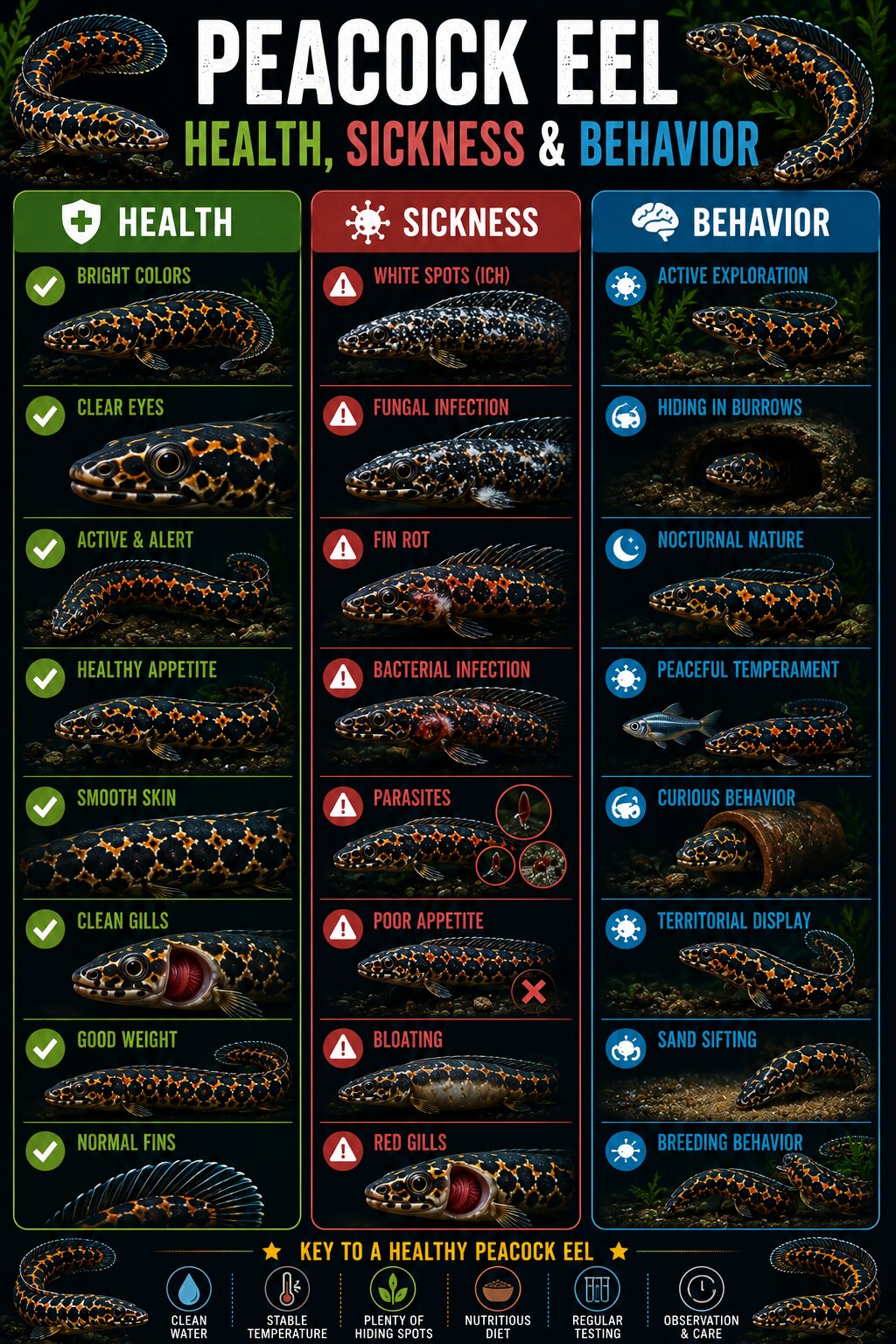
Developing peacock eel cloudy eyes points directly to an environmental failure or physical trauma. When the clear lens over the eye turns white, milky, or opaque, the fish is suffering from a damaged mucous membrane. This condition often arises when high concentrations of organic waste material pollute the water column.
Cloudy Eye Progression
- High Dissolved Organic Waste
- Mucous Membrane Weakens
- Bacterial Attack on Lens
- Opaque, Milky Vision
High nitrates act as a chronic immune system suppressant. When nitrates climb past 40 parts per million, opportunistic bacteria easily attack the eye tissue. To treat this issue, you must increase your water change schedule to drop nitrate levels below 20 parts per million. Additionally, add a dose of aquarium salt, using a conservative ratio of one tablespoon per five gallons of water. This dosage will stimulate the eel’s natural slime coat production without damaging its skin. If the cloudiness persists or changes into a fuzzy growth, you must treat the tank with an antibacterial medication like erythromycin.
Why Is My Peacock Eel Staying at the Surface?
A healthy peacock eel belongs at the bottom of the aquarium. Therefore, seeing your peacock eel staying at the surface indicates a severe, life-threatening emergency. If your eel swims laps near the top or actively gulps atmospheric air, the water column is likely toxic.
Ammonia and nitrite molecules bind to the hemoglobin in an eel’s blood, which completely prevents the transport of oxygen. To save your pet, you must immediately change half of the water volume. Furthermore, check your filter intake. Eels will occasionally climb up to the surface if they are desperately searching for an escape route due to an aggressive tank mate. If your eel is staying in one spot near the top rim, verify that your lid is completely locked down, as they will readily jump out of the tank.
Peacock Eel Swimming Upside Down: What It Means
If you spot your peacock eel swimming upside down or note your peacock eel laying on side, the animal has lost its equilibrium. This terrifying behavior typically stems from a malfunctioning swim bladder, which is the internal organ that controls buoyancy. A bacterial infection within the bladder or sudden physical trauma can cause the eel to flip over uncontrollably.
Additionally, extreme pH shock can cause a fish to lose control of its nervous system. If you introduce an eel to a new tank without matching the acidity levels of the shipping water, the sudden chemical shift will shock its brain. To treat an eel struggling with equilibrium, lower the water level in a dedicated quarantine tank so the animal can reach the surface effortlessly. You can read deeper analyses of fish swim bladder disorders and rehabilitation options on popular community resources like the MonsterFishKeepers Forums.
Peacock Eel Turning Pale: Common Causes Explained
A sudden loss of coloration provides an excellent visual measurement of your pet’s current stress level. When you find your peacock eel turning pale, you must audit your husbandry routines. Eels naturally fade in color during the night when they sleep, but they should regain their rich, deep brown patterns within minutes of the lights turning on.
Chronic paleness during the day suggests that the eel feels completely exposed. If the tank features bright white decorations or lacks adequate plant cover, the eel will wash out its colors to match its surroundings. Furthermore, sudden temperature drops will slow down the eel’s metabolic rate, which drains the vividness of its skin patterns. Keep your aquarium temperature stable between 23 and 28 degrees Celsius to ensure proper metabolic health and vibrant coloration.
Other Common Signs of Peacock Eel Illness
Peacock Eel White Spots
If you observe tiny, salt-like grains covering your eel’s body, your tank is facing an outbreak of Ich (Ichthyophthirius multifiliis). This external parasite burrows under the skin to feed on tissue. Because peacock eels lack scales, standard copper treatments will kill them. Instead, you must raise the tank temperature to 30 degrees Celsius over 24 hours to accelerate the parasite’s life cycle. Concurrently, dose the tank with a half-strength, formalin-based medication that explicitly states it is safe for scaleless species.
Peacock Eel Rubbing Against Substrate
When an eel repeatedly darts sideways to scratch its body against the sand or rocks, it is practicing a behavior called “flashing.” Eels flash when invisible skin parasites, gill flukes, or high ammonia levels irritate their skin. You can view detailed treatment logs and ask for custom diagnoses from experienced keepers on the Fishkeeper.
Stress Identification Matrix
Gulping at surface ──> Ammonia toxicity / Oxygen depletion
Flashing / Scratching ──> External skin parasites / Flukes
Continuous exposure on glass ──> Severe territorial bullying
Peacock Eel Not Coming Out at Night
If your eel is not coming out at night, it is likely experiencing intimidation from its tank mates. If predatory or boisterous fish roam the tank during the dark hours, the eel will remain tightly hidden to protect itself. To solve this issue, ensure that your community tank contains plenty of separate hiding structures so that every nocturnal resident can occupy its own distinct territory without fighting.
Frequently Asked Questions
Is it normal for a peacock eel to hide for a week without eating?
Yes, newly introduced peacock eels frequently hide for several days up to a week while they adjust to a new environment. You should avoid disturbing the substrate during this time, and only offer live food at night to encourage them to emerge.
Can I use copper-based medications to treat my peacock eel?
No, you must never use copper-based treatments on peacock eels. Eels absorb chemicals directly through their scaleless skin, meaning standard dosages of copper or malachite green will quickly poison and kill them.
What should I do if my peacock eel jumps out of the aquarium?
If you find your eel on the floor, put it back into a bucket of tank water immediately. Eels produce a thick mucus layer that allows them to survive out of water for several hours, though you will need to add a stress-coat conditioner to help repair their damaged slime coat.
Why is my peacock eel ignoring sinking pellets?
Peacock eels are strict carnivores that rely on motion and scent to find live prey. They do not recognize dry, processed pellets as an actual food source, so you must feed them raw, meaty frozen options like bloodworms or krill.
How deep should the sand bed be for a peacock eel?
You should maintain a soft, fine sand bed that is at least two to three inches deep. This depth ensures that your eel can submerge its entire body comfortably without scratching its belly on the glass bottom.
What temperature range do peacock eels require?
Peacock eels require a stable tropical temperature between 23 and 28 degrees Celsius. Sudden drops in water temperature will suppress their immune system and cause them to stop eating.
Why are the eyes of my peacock eel turning white?
White, cloudy eyes indicate poor water quality or a physical scratch on the eye lens. You can fix this issue by executing regular water changes to drop nitrates below 20 parts per million and adding a mild dose of aquarium salt.