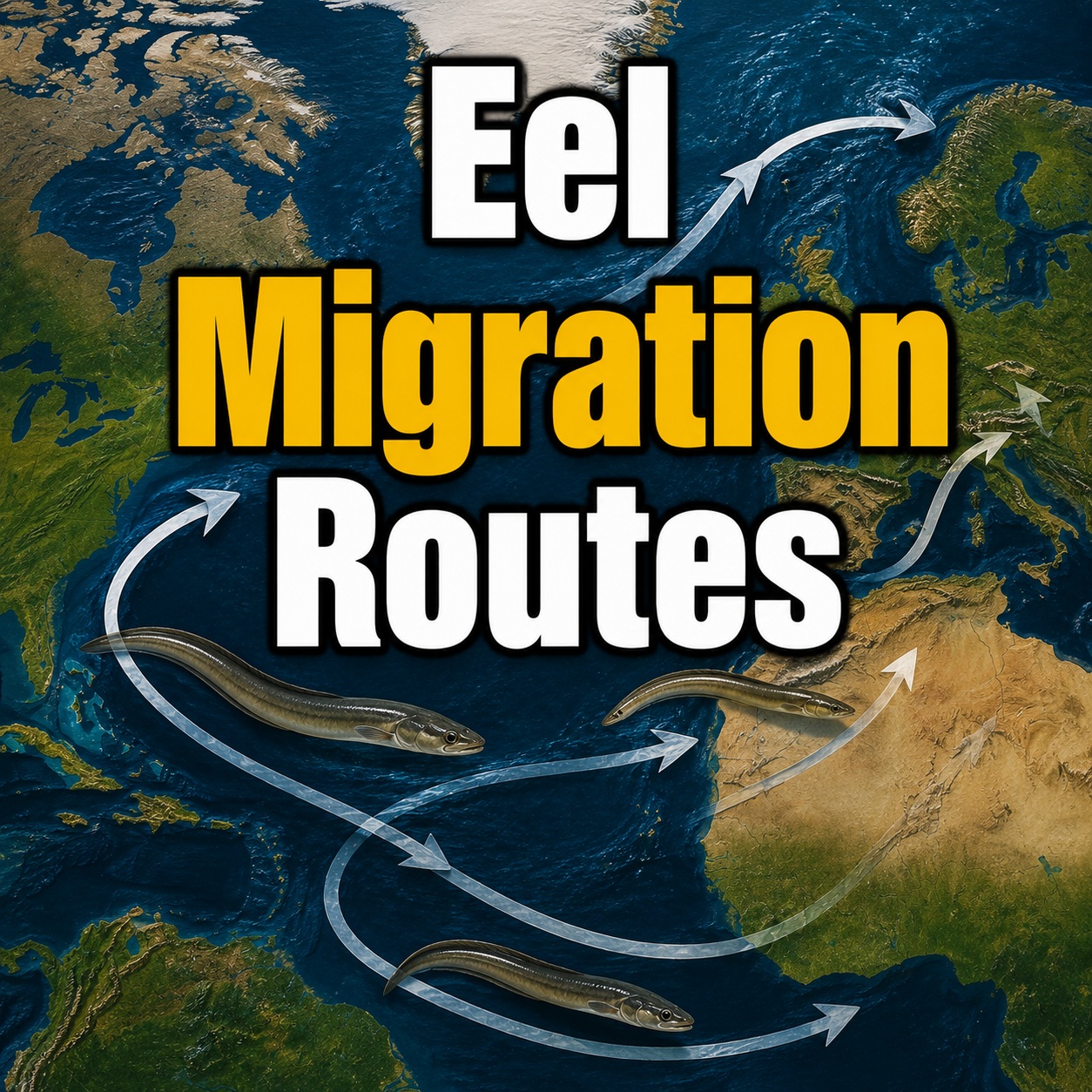
The migration of the eel is widely considered one of the greatest unsolved mysteries of the natural world. While most migratory fish, like salmon, move from the ocean to freshwater to spawn (anadromous), eels do the exact opposite. They are catadromous, spending their lives in rivers and traveling thousands of miles into the deep ocean to give birth and die.
Below is a detailed breakdown of the major global migration routes and the biological mechanics that make these journeys possible.
1. The Atlantic Route: The Sargasso Sea Mystery
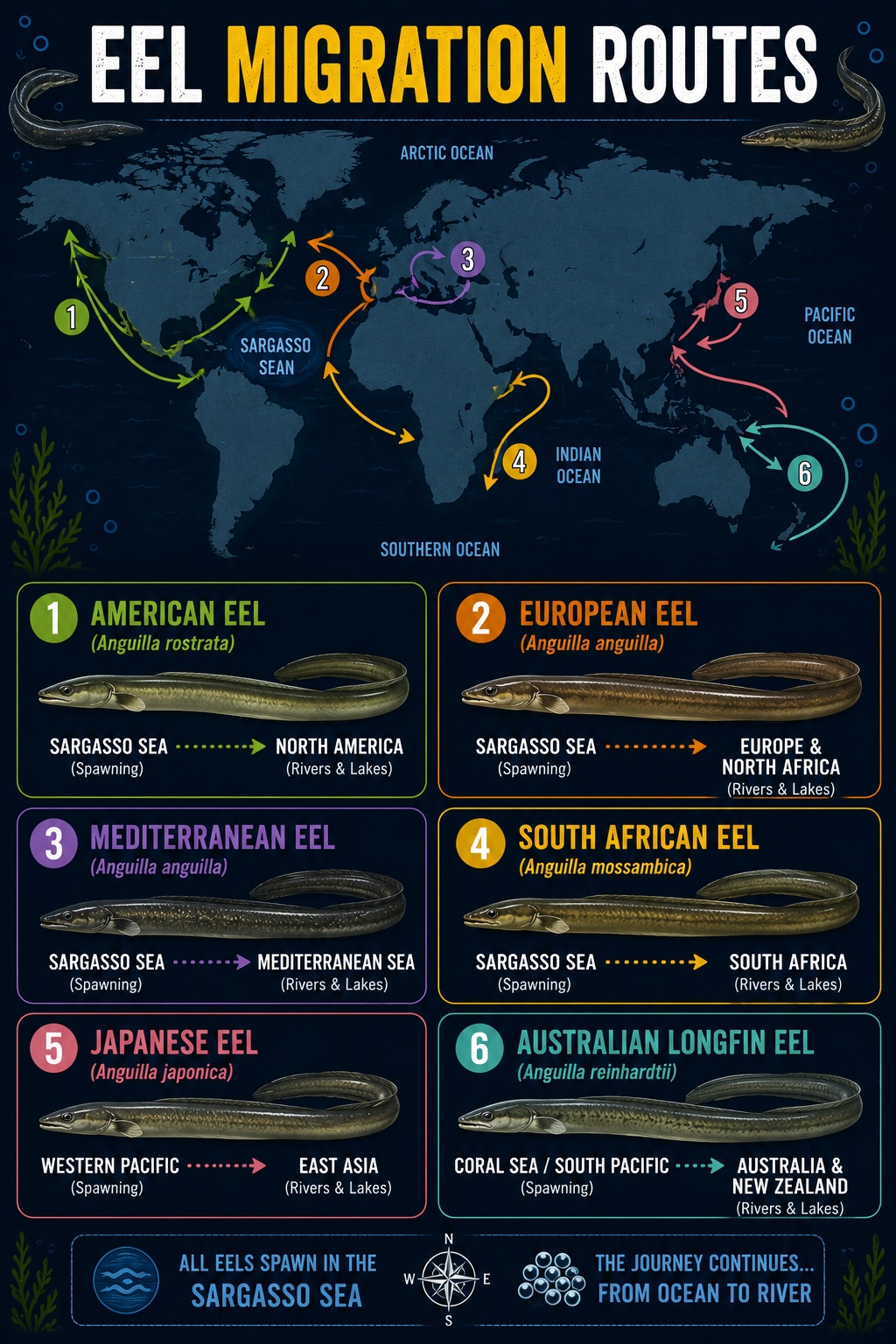
This is the most famous and well-studied migration route, involving both the American Eel (Anguilla rostrata) and the European Eel (Anguilla anguilla).
The Destination
Both species, despite living on different continents, converge on the Sargasso Sea—a vast, calm region in the North Atlantic Ocean characterized by mats of floating seaweed (Sargassum).
The Path
- The American Journey: Eels from the East Coast of the U.S. and Canada travel south-southeast. This journey is relatively short, spanning roughly 1,500 to 2,500 kilometers.
- The European Marathon: European eels face a staggering 7,000 to 10,000 kilometer swim. They leave rivers in the UK, Scandinavia, and the Mediterranean, traveling west across the Atlantic.
The Mechanism: “The Great Gyre”
Eels don’t just swim; they use the ocean’s conveyor belt.
- Adults swim against or across currents to reach the Sargasso.
- Larvae (Leptocephali) hitch a ride on the Gulf Stream. It takes about one year for American larvae to reach the coast, while European larvae may drift for up to three years before reaching their continental homes.
2. The Indo-Pacific Routes: Deep Trench Spawning
While the Atlantic eels have one central hub, Indo-Pacific species utilize several different deep-water trenches.
The Japanese Eel (Anguilla japonica)
Japanese eels leave the rivers of Japan, Taiwan, and China to spawn near the West Mariana Ridge.
- Distance: Approximately 2,500 to 3,000 kilometers.
- Current Reliance: They rely on the Kuroshio Current to carry their larvae back North to the East Asian coasts.
The Giant Mottled Eel (Anguilla marmorata)
This is the most widely distributed eel in the world. Because they live across a vast area (from East Africa to French Polynesia), they have multiple localized spawning grounds. Instead of one “Sargasso Sea,” they use various deep-ocean trenches located near the Philippines, Indonesia, and Madagascar.
3. The South Pacific Route: New Zealand and Australia
The Longfin Eel (Anguilla dieffenbachii) and the Shortfin Eel (Anguilla australis) perform some of the most impressive vertical and horizontal migrations.
- The Route: They leave the freshwaters of New Zealand and Australia and head North toward the Tonga Trench and the Fiji Basin.
- The Depth: During the day, migrating eels dive to depths of 600 to 1,000 meters to avoid predators and stay in cooler water, which slows their metabolism. At night, they rise closer to the surface to utilize warmer currents.
Since eels migrate through the trackless “void” of the open ocean, they utilize a suite of high-tech biological tools:
- Magnetoreception: Eels have microscopic crystals of magnetite in their snouts, allowing them to sense the Earth’s magnetic fields. This acts as a global GPS.
- Olfactory Fingerprinting: It is believed that eels “smell” the chemical signature of specific ocean currents. They can detect changes in salinity and mineral content from hundreds of miles away.
- Celestial Cues: Some research suggests that while near the surface at night, eels may use polarized light or moon phases to maintain their heading.
Migration Challenges and the Future
The eel’s migration route is currently under threat from multiple human-made factors, which has led to the European Eel being classified as Critically Endangered.
Barriers: The Dam Problem
Eels are the most “blocked” fish in the world. Hydroelectric dams often prevent Elvers from reaching the upstream habitats they need to grow. Even worse, Silver Eels heading back to the sea are often killed by the massive turbines of these same dams.
Climate Change and Current Shifts
The migration of the larvae depends entirely on the stability of the Gulf Stream. As the ocean warms and the North Atlantic currents shift or slow down, larvae may be swept into waters that are too cold for survival or miss their continental targets entirely.
Parasites
The swim bladder parasite (Anguillicola crassus), introduced from Asia, infects the eel’s swim bladder. For a fish that needs to perform precise “depth-cycling” during a 7,000 km swim, a damaged swim bladder is a death sentence, preventing them from ever reaching the Sargasso.
Timeline of the Migration Journey
| Stage | Action | Physiological State |
| Departure | Leave river in Autumn. | Silver Eel: High fat, thick skin. |
| The Crossing | 6–12 months of swimming. | Fasting: Stomach has withered; eyes are enlarged. |
| The Spawning | Reach spawning grounds at 400m+ depth. | Final Metamorphosis: Gonads fully develop for the first time. |
| The End | Release eggs/sperm. | Death: Adults die; larvae begin the drift back to land. |
Global Routes
| Eel Species | Origin | Spawning Ground | Distance |
| European Eel | Europe / N. Africa | Sargasso Sea | 7,000 – 10,000 km |
| American Eel | North America | Sargasso Sea | 2,000 – 4,000 km |
| Japanese Eel | East Asia | West Mariana Ridge | 3,000 km |
| Longfin Eel | New Zealand | Tonga Trench | 5,000 km |
the Migration Cycle
| Stage | Location | Direction | Duration |
| Larvae (Leptocephalus) | Sargasso Sea to Coast | Toward Land | 1–3 Years |
| Glass Eel / Elver | Estuaries to Rivers | Upstream | Months |
| Yellow Eel | Rivers and Lakes | Sedentary (Growth) | 5–20 Years |
| Silver Eel | Rivers to Sargasso Sea | Downstream / Oceanic | 6 Months |
Conclusion: The Final Sacrifice
The migration route of the eel is a journey of total commitment. From the moment the Silver Eel leaves its river, it is a “living ghost.” It is a fish that has given up its ability to eat, dissolved its own bones for fuel, and re-engineered its eyes and skin for an environment it hasn’t seen since birth.
When they finally reach the Sargasso Sea, they release their eggs and sperm in one final, massive burst of energy. Their mission complete, the adult eels die, leaving their transparent, leaf-shaped children to begin the 7,000-kilometer odyssey all over again. The cycle is a testament to the sheer endurance of life and remains one of the most beautiful—and haunting—narratives in the natural world.
FAQ about Eel Migration
Do eels migrate in the Pacific? Yes, the Japanese Eel (Anguilla japonica) performs a similar migration to a region near the Mariana Trench.
How fast do they swim? Silver eels average about 12 to 30 miles (20–48 km) per day.
Can they navigate around dams? Only if “eel ladders” are installed. These are specialized ramps with climbing surfaces that allow the eels to bypass the concrete walls.