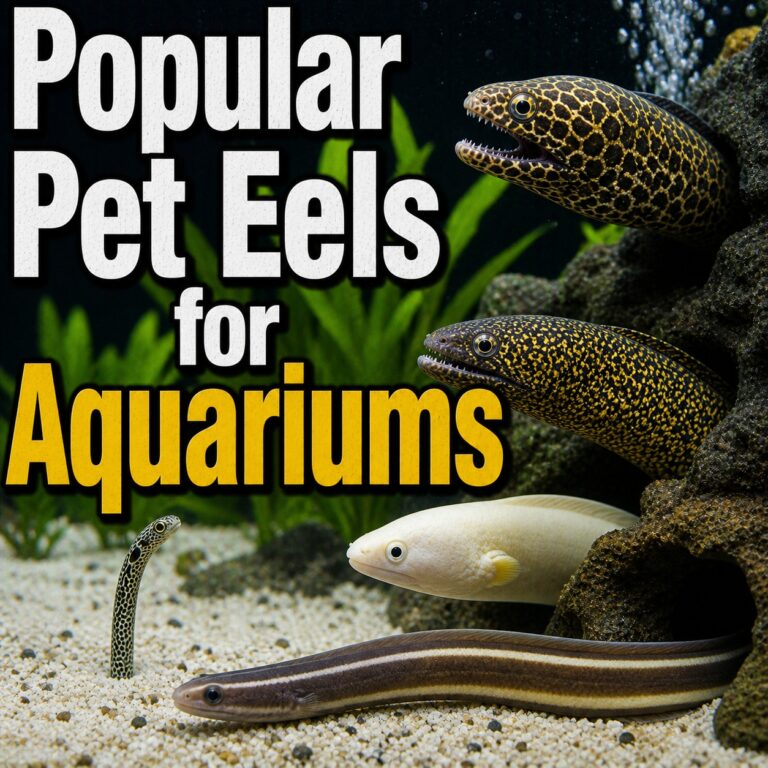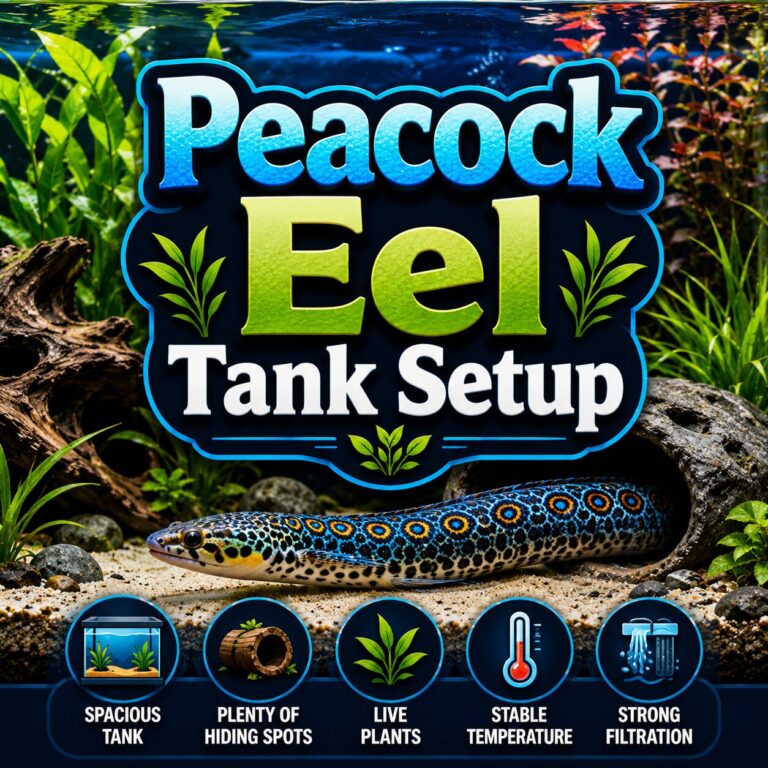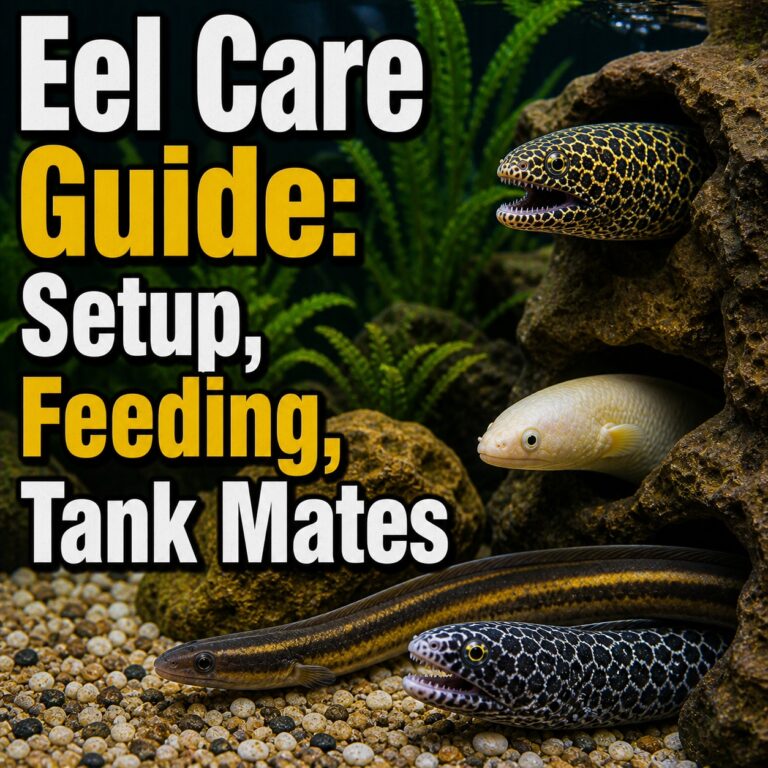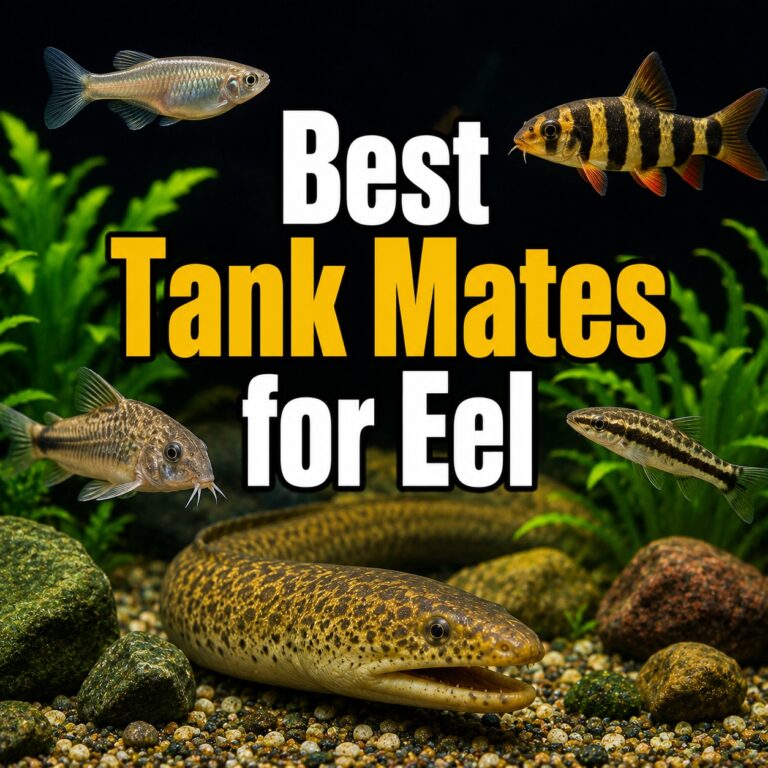
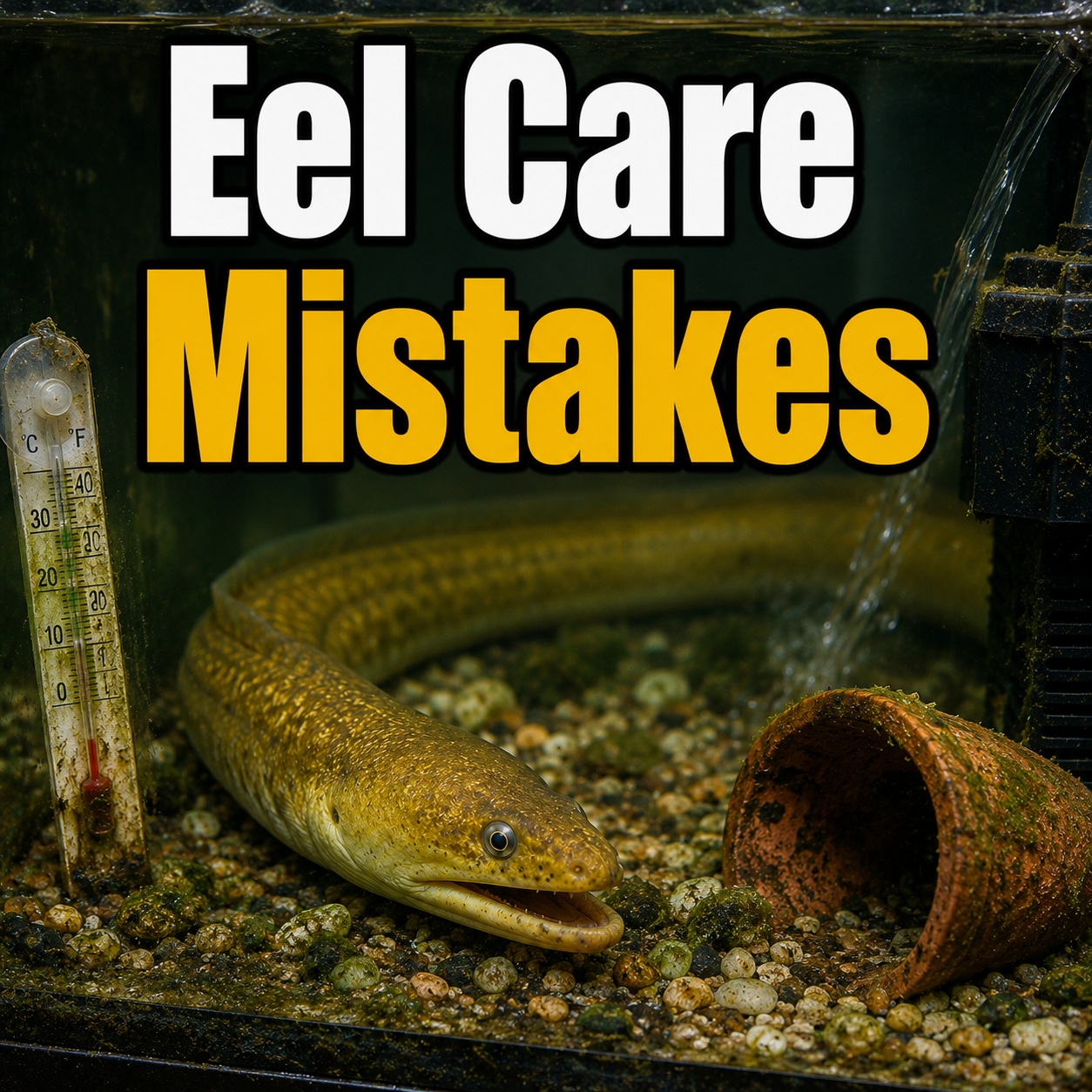
Caring for eels, whether freshwater or marine, is a unique challenge because they don’t behave like “standard” fish. Most eel fatalities in the home aquarium are preventable and stem from a few common misunderstandings about their anatomy and behavior.
Here are the most frequent eel care mistakes and how to avoid them.
1. The “Great Escape”: Inadequate Lids
Eels are the Houdinis of the aquatic world. Their bodies are pure muscle, and they are covered in lubricating mucus that allows them to squeeze through impossibly small gaps.
- The Mistake: Leaving small openings for power cords, filter intakes, or using a lightweight mesh lid.
- The Fix: Use a tight-fitting, weighted, or locking lid. Every single gap—even those around the filter—should be plugged with sponge or mesh. If a lid can be pushed up, an eel will eventually push it.
2. Substrate Sabotage: Using Sharp Gravel
Freshwater Spiny Eels (like the Fire, Peacock, or Zig-Zag) spend much of their lives buried in the substrate with only their snouts poking out.
- The Mistake: Using standard aquarium gravel or crushed coral.
- The Fix: You must use fine sand. Sharp gravel can scratch the eel’s delicate skin as it burrows, leading to “Red Leg” (bacterial infections) or fungal outbreaks that are often fatal.
3. The “Goldfish Trap”: Poor Nutrition
Many owners believe that “feeder fish” are the natural and best diet for eels.
- The Mistake: Feeding a diet primarily of goldfish or rosy red minnows.
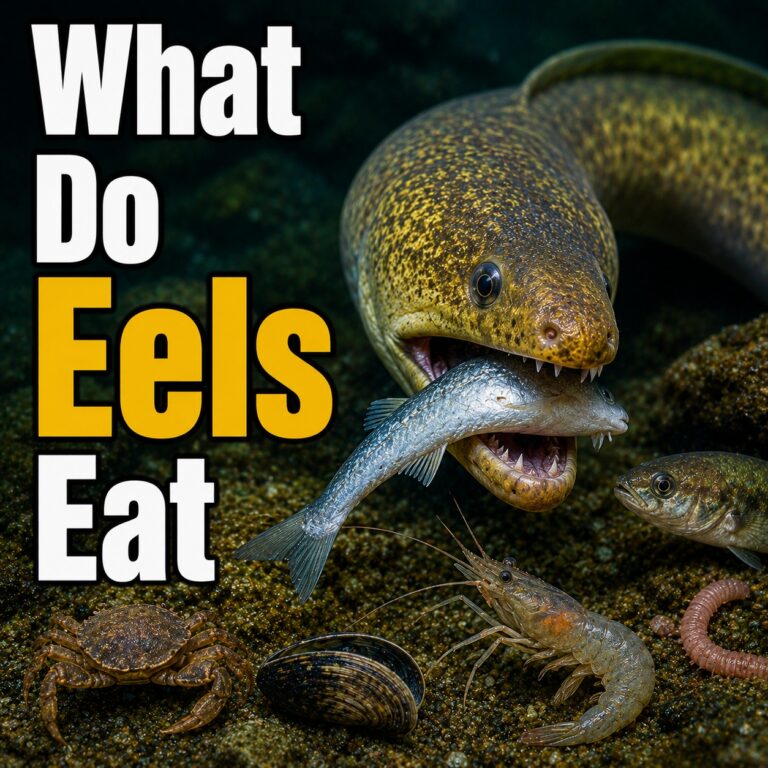
- The Fix: Goldfish contain thiaminase, an enzyme that destroys Vitamin B1 (Thiamine). Over time, this leads to neurological tremors and death. Feed a varied diet of frozen-thawed shrimp, silversides, clams, and earthworms.
4. Starvation by Competition
Eels have poor eyesight and are often very shy. In a tank with aggressive, fast-moving fish (like Barbs, Cichlids, or Tangs), the eel may never get a chance to eat.
- The Mistake: Simply “dumping” food into the tank and assuming the eel is getting its share.
- The Fix: Use Target Feeding. Use extra-long tongs to bring the food directly to the eel’s cave. Eels hunt primarily by smell; they need the food held near them long enough to “scent” it and strike.
5. Copper Toxicity
Eels are “scaleless” or have very deep-set, tiny scales, which makes them hypersensitive to medications.
- The Mistake: Using standard “Ich” or parasite treatments that contain copper or malachite green.
- The Fix: Always check the label. Copper is highly toxic to eels and can kill them long before it kills the parasites. Use “scaleless-safe” medications or heat-based treatments for common ailments.
6. Lack of Proper “Housing” (Caves)
An eel without a secure home is a stressed eel. Stress in eels quickly leads to a suppressed immune system and a refusal to eat.
- The Mistake: Not providing a cave that fits the eel’s entire body.
- The Fix: Provide PVC pipes, hollow logs, or rock piles where the eel can hide completely. Ideally, the hiding spot should be narrow enough that the eel can feel the walls against its body, which makes them feel secure.
7. High-Fat Diet and Fatty Liver Disease (Lipidosis)
- The Mistake: Over-relying on high-fat “convenience” foods like fatty beef heart or strictly krill.
- The Fact: In a captive environment with limited space to swim, eels cannot burn off excess fat. This leads to Hepatic Lipidosis (fatty liver), which is a leading cause of sudden death in seemingly healthy adult eels.
- Solution: Use “lean” marine proteins like squid, white fish, and bivalves. Avoid mammalian fats entirely.
8. Ignoring the “Low-Oxygen” Danger Zone
- The Mistake: Failing to provide extra aeration, especially in warmer tanks or heavily decorated “cave” tanks.
- The Fact: Eels have high oxygen demands due to their large muscle mass, but they spend their time at the bottom of the tank where oxygen levels are naturally lowest. In a power outage or high-heat summer day, the eel is often the first to suffocate.
- Solution: Use air stones or powerheads to ensure heavy surface agitation. Ensure caves have “flow-through” so water doesn’t become stagnant inside them.
9. Electrical Equipment Hazards
- The Mistake: Leaving exposed glass heaters or unprotected powerhead intakes in the tank.
- The Fact: Because eels like to “wrap” themselves around objects and squeeze into tight spaces, they are prone to severe thermal burns from glass heaters. Furthermore, their slimy bodies can be sucked into powerhead intakes that wouldn’t bother a scaled fish.
- Solution: Always use a heater guard (a plastic cage) or keep the heater in a sump. Use pre-filter sponges on all pump intakes.
10. “New Tank Syndrome” Sensitivity
- The Mistake: Introducing an eel as the “first fish” to a newly cycled tank.
- The Fact: Eels lack the protective barrier of heavy scales, making them hypersensitive to even trace amounts of Ammonia or Nitrite. While a Hardy Barb might survive a “mini-cycle,” an eel will likely suffer permanent gill damage or skin sloughing.
- Solution: Eels should only be added to “seasoned” tanks that have been stable for at least 2–3 months.
11. Social Stress (Intra-species Aggression)
- The Mistake: Assuming “eel” means “communal.”
- The Fact: While some species (like Garden Eels) are social, many Morays and larger Spiny Eels are viciously territorial with their own kind. Keeping two Fire Eels in a tank without enough “visual breaks” will lead to one dominant eel bullying the other to death.
- Solution: Research the social needs of your specific species. If keeping multiple, provide at least two caves per eel to reduce territorial disputes.
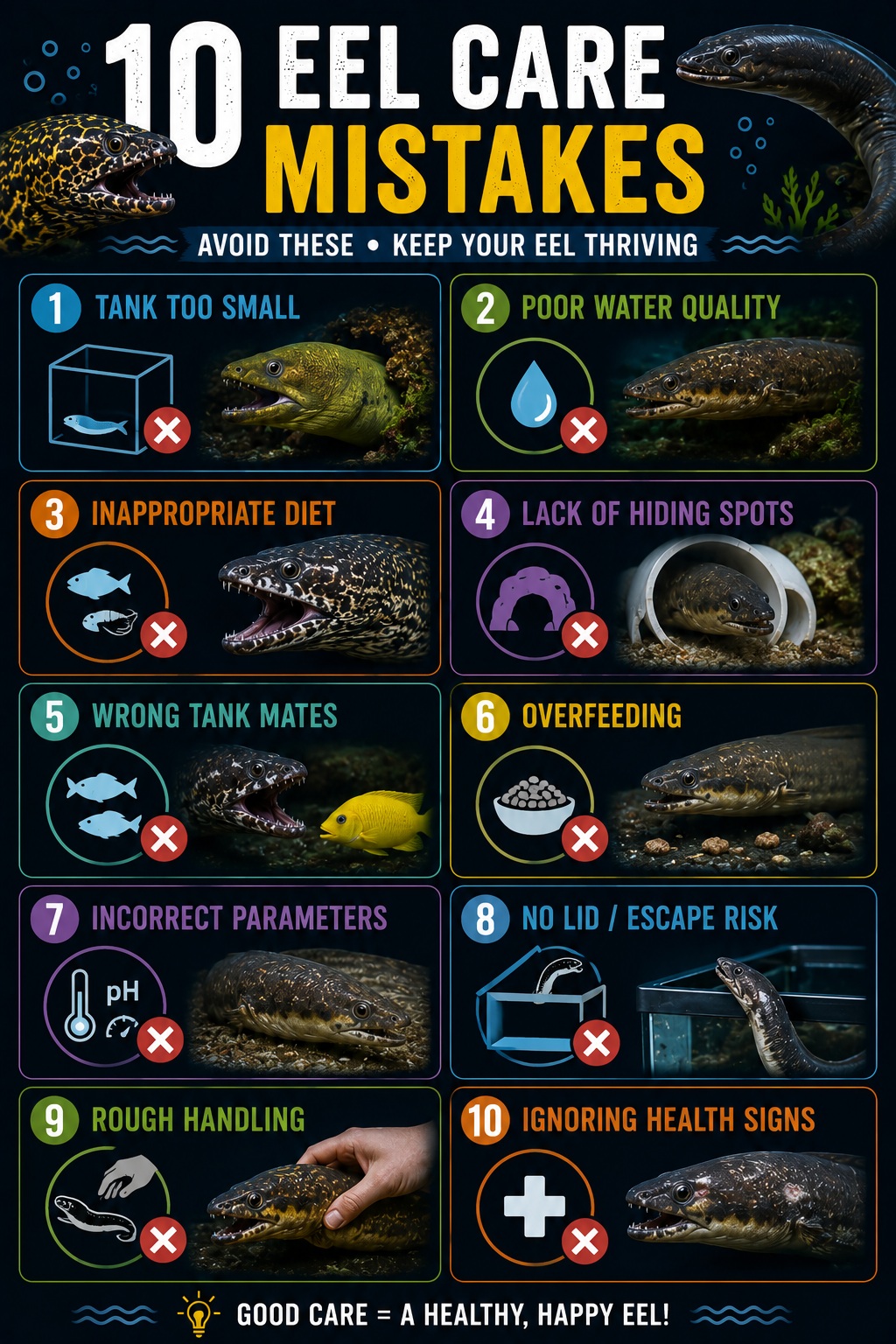
Summary Checklist for Success
| Mistake | Prevention |
| Escaping | Weighted lid + plugged cord gaps. |
| Skin Lesions | Use soft sand, never gravel. |
| Nutritional Deficit | Avoid goldfish; use varied frozen seafood/worms. |
| Starvation | Use feeding tongs for direct delivery. |
| Poisoning | Avoid copper-based medications. |
| Fatty Liver | Feed lean seafood; avoid beef/poultry fats. |
| Low Oxygen | Ensure high surface agitation and “flow-through” caves. |
| Heater Burns | Always use a plastic heater guard. |
| Chemical Sensitivity | Never add an eel to a brand-new, unseasoned aquarium. |
| Territoriality | Provide more caves than you have eels. |
A Pro-Tip on the “Floor Survival” (Point #1)
While it’s true they can survive for hours, the slime coat is often ruined by carpet fibers or dust. If you find an eel on the floor:
- Do not scrub it.
- Rinse it gently in a bucket of tank water first to remove debris.
- Add a “stress-coat” water conditioner to the tank to help them rebuild their protective mucus layer, as they will be highly prone to infection for the next 48 hours.
Common Eel Care Mistakes FAQ’s
1. What is the most common mistake in eel care?
Keeping eels in tanks that are too small. Many species grow larger than expected and require spacious aquariums.
2. Do eels need hiding places?
Yes. Eels are shy and nocturnal. Without caves, pipes, or sandy burrows, they become stressed and refuse to eat.
3. Can eels live in freshwater only?
Not always. Some species (like Gymnothorax tile) require brackish water. Misidentifying species leads to poor health.
4. Is overfeeding a problem?
Yes. Eels are slow digesters. Overfeeding causes obesity, water pollution, and disease. Feed sparingly, 2–3 times per week.
5. Do eels escape from tanks?
Absolutely. Eels are notorious escape artists. Tanks must have tight lids and secure openings.
6. Can eels be kept with other fish?
Compatibility is tricky. Small fish may be eaten, while aggressive tankmates can injure eels. Choose peaceful, larger companions.
7. Why is water quality so important?
Eels are sensitive to ammonia and nitrate buildup. Poor filtration and irregular water changes are major causes of illness.
8. Do eels eat prepared foods?
Some do, but many prefer live or frozen prey. A varied diet of worms, shrimp, and fish pieces is essential.
9. Is handling eels safe?
No. Their slippery bodies and sharp teeth make handling risky. Always use feeding tools instead of bare hands.
10. What’s the biggest beginner mistake?
Buying juvenile eels without realizing their adult size or care needs. Research species before purchase to avoid long‑term problems.