Eels have long occupied a space of mystery and intrigue in both natural history and the aquarium hobby. While the “Giant Moray” or the massive “Conger Eel” often dominate the headlines, there is an entire world of miniature “serpents” that navigate the crevices of coral reefs and the muddy bottoms of freshwater rivers. For the enthusiast, these smaller species offer the same serpentine grace and predatory intelligence as their larger cousins but in a package manageable for home observation or specialized study.
This guide explores the world’s most notable small eel species, categorized by their environment and biological traits, while clearing up common misconceptions about what constitutes a “true” eel.
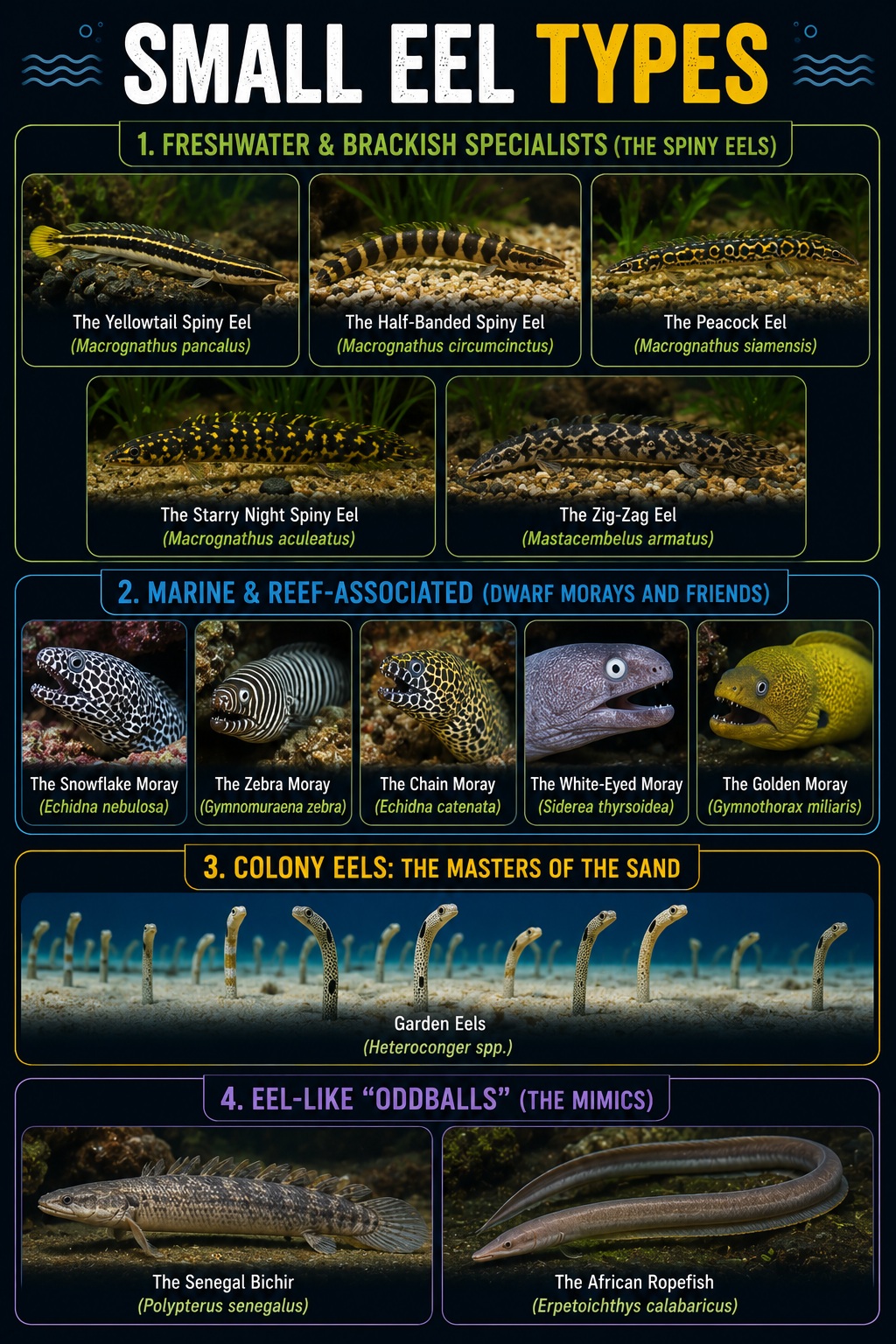
1. Freshwater & Brackish Specialists (The Spiny Eels)
It is important to note that many “freshwater eels” in the aquarium trade belong to the family Mastacembelidae. These are known as “Spiny Eels.” They are not closely related to the American or European eels but have evolved nearly identical bodies and behaviors.
The Yellowtail Spiny Eel (Macrognathus pancalus)
Coming in as one of the smallest and most manageable species, the Yellowtail typically reaches only 15 to 20 cm (6 to 8 inches). Native to the river systems of India and Pakistan, they are highly regarded for their hardiness.
- Behavior: They are notorious burrowers. In the wild, they use their pointed, sensitive snouts to sift through substrate for small invertebrates.
- Aquarium Note: Because of their size, they are one of the few species comfortable in a 30-gallon setup, provided the substrate is sand rather than sharp gravel.
The Half-Banded Spiny Eel (Macrognathus circumcinctus)
Often confused with its cousins, the Half-Banded is distinguished by dark vertical stripes that cover the top half of its body. It stays compact, usually maxing out at 20 cm.
- Habitat: Found in Southeast Asia, specifically in slow-moving or stagnant waters filled with leaf litter.
- Specialization: They are incredibly shy and nocturnal. Observing them requires dim lighting or “moonlight” LEDs to see them emerge from their hiding spots.
The Peacock Eel (Macrognathus siamensis)
Perhaps the most popular “starter” eel for freshwater hobbyists, the Peacock Eel reaches 30 cm (12 inches). It is named for the distinctive “eye-spots” (ocelli) on its dorsal fin, which mimic the pattern of a peacock’s tail to confuse predators.
- Survival Tactic: These spots serve as a form of mimicry, making a predator think the tail is actually the head of a much larger animal.
The Starry Night Spiny Eel (Macrognathus aculeatus)
A slightly more decorative relative, the Starry Night stays between 20 and 25 cm. Its body is covered in fine, white specks that resemble a night sky.
- Unique Trait: They are highly sensitive to water quality. Unlike the hardy Yellowtail, the Starry Night requires pristine, well-oxygenated water to thrive.
The Zig-Zag Eel (Mastacembelus armatus)
While the name “Zig-Zag” is often used for several species, the true M. armatus can actually grow quite large in the wild. However, in aquarium settings, they often remain in the 30 to 40 cm range.
- Identification: They possess a bold, erratic pattern of dark lines that crisscross their body, providing perfect camouflage against tangled roots and branches.
2. Marine & Reef-Associated (Dwarf Morays and Friends)
In the saltwater world, “small” is a relative term. While a 10-foot moray is a giant, a 2-foot moray is considered a “dwarf.” These species have adapted to life in the complex architecture of coral reefs.
The Snowflake Moray (Echidna nebulosa)
The Snowflake is arguably the most famous small marine eel, growing to about 60 cm (24 inches).
- Dentition: Unlike most morays that have needle-sharp teeth for catching fish, the Snowflake has blunt, molar-like teeth.
- Diet: They are “crustacean eaters,” specialized for crushing the shells of crabs and shrimp. This makes them significantly safer for a reef tank containing fish, though your ornamental shrimp will be at risk.
The Zebra Moray (Gymnomuraena zebra)
A striking species defined by bold black-and-white vertical bands, the Zebra Moray reaches about 50 to 60 cm.
- Temperament: They are widely considered the most “docile” of all morays. They are slow-moving and almost entirely uninterested in fish, preferring to hunt for mollusks and crabs at night.
The Chain Moray (Echidna catenata)
Native to the Atlantic, the Chain Moray stays around 40 to 60 cm. It features a beautiful “interlocked” pattern of yellow and brown.
- Habitat: They are often found in very shallow water, including tide pools. They have even been observed “leaping” briefly onto wet rocks to grab crabs—a rare example of land-based hunting in marine eels.
The White-Eyed Moray (Siderea thyrsoidea)
A true miniature, the White-Eyed Moray stays around 45 cm (1.5 feet). As the name suggests, their stark white irises give them a ghost-like appearance.
- Reef Safety: They are reliable feeders and tend to be less aggressive toward tank mates than other Gymnothorax species.
The Golden Moray (Gymnothorax miliaris)
One of the most prized species for its vibrant yellow color, the Golden Moray reaches roughly 60 to 65 cm.
- Variations: They can range from “fire” gold (solid yellow) to a speckled “banana” pattern. Despite their small size, they have a high metabolism and are much more active predators than the Zebra Moray.
3. Colony Eels: The Masters of the Sand
Not all eels live in holes or under rocks. Some have evolved to live in the open sand in massive, coordinated “forests.”
Garden Eels (Heteroconger spp.)
Most garden eels, such as the Brown Garden Eel, grow to roughly 30 to 40 cm (12 to 16 inches), but they are as thin as a pencil.
- Life in a Tube: They spend their entire lives inside a mucus-lined burrow in the sand. They sway in the current to catch plankton, looking like blades of grass.
- The “Vanishing” Act: Because they are so small and vulnerable, they are incredibly shy. At the first sign of a predator, an entire colony of hundreds of eels will vanish into the sand simultaneously.
4. Eel-Like “Oddballs” (The Mimics)
Some of the most popular “small eels” in the world are actually not eels at all, but ancient fish that have evolved eel-like bodies.
The Senegal Bichir (Polypterus senegalus)
Often called the “Dinosaur Eel,” the Senegal Bichir reaches about 30 cm.
- Evolutionary Link: They are “living fossils.” They possess lungs and can breathe atmospheric air, and their pectoral fins are “lobed,” allowing them to “walk” along the bottom of a river.
- Skin: Their bodies are covered in heavy, armor-like ganoid scales, making them nearly indestructible to smaller predators.
The African Ropefish (Erpetoichthys calabaricus)
The Ropefish is the most “eel-looking” fish that isn’t an eel. It is incredibly slender and can reach 40 cm in length.
- Anatomy: It lacks pelvic fins entirely, which enhances its snake-like appearance. Like the Bichir, it can breathe air and is a notorious “escape artist,” capable of slithering through the smallest gaps in an aquarium lid.
5. Biological Comparison & Requirements
| Species Group | Average Size | Diet | Best Substrate |
| Spiny Eels (Freshwater) | 15–30 cm | Bloodworms, small shrimp | Fine Sand |
| Dwarf Morays (Marine) | 40–60 cm | Crabs, mollusks, fish | Live Rock / Crevices |
| Garden Eels (Marine) | 30 cm | Plankton | Deep Sand (6″+) |
| Bichirs/Ropefish | 30–40 cm | Carnivorous pellets, fish | Sand or Smooth Gravel |
Frequently Asked Questions
Do small eels still have “toxic” blood?
Yes. Whether they are 6 inches or 6 feet, almost all true eels (Anguilliformes) possess ichthyotoxins in their blood. While this is only a danger if consumed raw, you should always wash your hands after handling them, especially if you have open cuts.
Why do my small eels keep disappearing?
Small eels are experts at two things: burrowing and escaping.
- Burrowing: Species like the Peacock or Yellowtail Spiny Eel can spend 90% of their day completely submerged in the sand with only their nose poking out.
- Escaping: Because their bodies are muscular and slimy, they can exert significant force. They can push open loose lids or slide through cord gaps. A “weighted” or “locking” lid is a requirement for any eel-like species.
Can I keep multiple small eels together?
It depends on the species. Garden Eels must be kept in groups to feel safe. Moray Eels, however, are generally solitary. While you can keep multiple morays in a very large tank with many hiding spots, they may fight over territory. Spiny Eels are generally peaceful with each other but can be competitive during feeding time.
Conclusion: The Appeal of the Miniature Eel
The fascination with small eel species lies in their complexity. To own or study a Dwarf Moray or a Yellowtail Spiny Eel is to witness a specialized predator that has traded sheer size for stealth and maneuverability. Whether it is the air-breathing capabilities of the Ropefish, the “Alien” jaws of the Moray, or the sand-forests of the Garden Eel, these small creatures prove that you don’t need to be a giant to be one of the most interesting inhabitants of the aquatic world.
By understanding their need for soft substrates, secure lids, and specific diets, anyone can appreciate the ancient, serpentine grace of these miniature marvels.