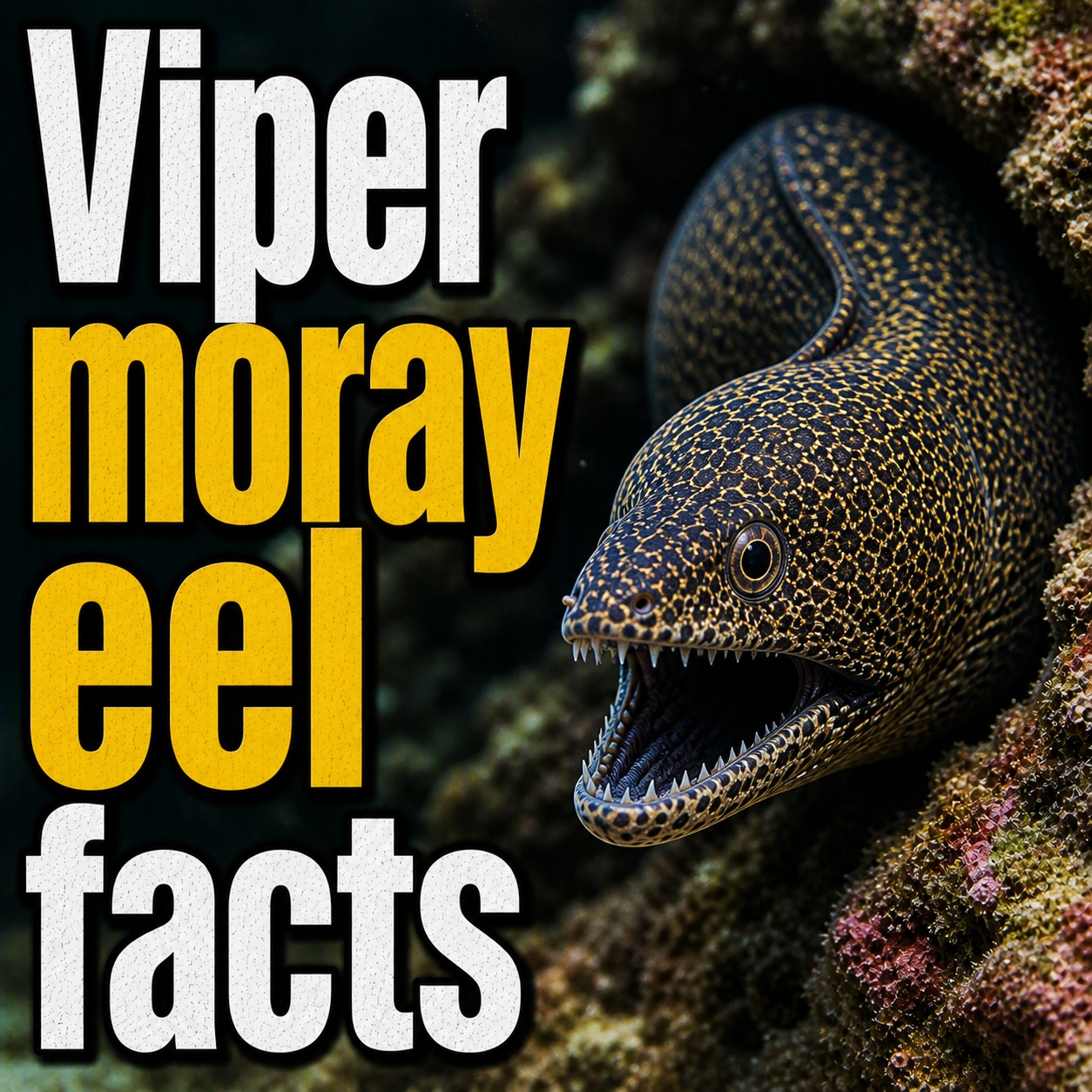
In the vast, shadowy catalog of marine life, few creatures command as much immediate, visceral dread as the Viper Moray Eel (Enchelycore anatona). Also known as the Fangtooth Moray, this species looks less like a modern fish and more like a relic from a prehistoric era or a creature birthed from the mind of a gothic horror novelist.
While most moray eels are known for their thick, muscular bodies and shy dispositions, the Viper Moray is defined by its architectural extremes: elongated, curved jaws that never close and a forest of translucent, needle-sharp teeth. In this comprehensive 2000-word guide, we will explore the biology, habitat, and specialized hunting mechanics of the Atlantic’s most terrifying-looking resident.
Taxonomic Identity and Evolutionary Niche
The Viper Moray belongs to the family Muraenidae and the genus Enchelycore. To understand its place in the ocean, one must look at the divergence between the “typical” moray and the “fangtooth” varieties.
- Genus Enchelycore: This genus is characterized by specialized jaw structures. Unlike the genus Gymnothorax (which includes the Green Moray), Enchelycore eels have evolved curved mandibles. This isn’t just an aesthetic choice; it is a functional adaptation for a specific type of predation that requires a “lock-on” grip rather than a crushing bite.
- The “Viper” Moniker: It earns its name from its facial resemblance to vipers and other venomous snakes. The combination of its narrow head, wide-set eyes, and protruding fangs creates a silhouette that triggers an instinctive “danger” response in almost all vertebrates.
Physical Anatomy: The Design of a Predator
The Viper Moray is a masterpiece of specialized anatomy. Every feature—from the pigments in its skin to the bones in its throat—is designed for high-efficiency hunting in low-light environments.
1. The “Eternal Snarl” Jaws
The most striking feature of the Viper Moray is its curved jaws. The upper and lower mandibles bow outward, meeting only at the base and the very tips.
- Why They Can’t Close: Because of this permanent curve, the Viper Moray cannot fully close its mouth.
- The Respiratory Trade-off: While this might seem like a disadvantage, it allows for a constant, high-volume flow of water over the gills. Morays must “pant” to breathe, and the Viper Moray’s structural gap ensures that even when it is stationary, oxygen-rich water is effortlessly flowing.
2. The Fangtooth Armament
Within that curved mouth lies a terrifying array of teeth.
- Translucent Fangs: The teeth are long, slender, and often nearly transparent, resembling shards of glass.
- The “Forest” Effect: The teeth are not just found on the jawline. The Viper Moray has rows of teeth on the roof of its mouth (the vomerine teeth) that point backward.
- The Trap: This design acts as a one-way street. Once a fish or squid is snagged by these needles, any struggle only drives the prey deeper onto the backward-facing spikes.
3. Size and Build
Compared to the “heavyweight” Giant Moray, the Viper Moray is a “middleweight” predator.
- Length: They typically reach between 80 and 120 centimeters (2.6 to 4 feet).
- Girth: They are more laterally compressed (flattened side-to-side) than other morays. This slender, blade-like body allows them to strike with incredible speed from within narrow rock fissures.
Coloration and Camouflage: The “Decaying” Aesthetic
The Viper Moray possesses a unique color palette that provides perfect camouflage in the “Twilight Zone” of the reef.
- The Base Coat: Their skin is typically a dark reddish-brown or deep chocolate color.
- The Mottled Pattern: Overlaid on this base are irregular, pale-yellow or white spots and splotches.
- The Mimicry: In the dim light of a rocky ledge, this pattern mimics the appearance of encrusting sponges, lichens, and decaying organic matter. To a passing fish, the eel looks like just another static part of the reef wall.
- The Eye: They often have pale, glassy eyes, which can make them look blind or “undead,” though their vision is actually quite acute for a moray.
Habitat: The Dark Ledges of the Atlantic
The Viper Moray is primarily an inhabitant of the Eastern and Central Atlantic Ocean.
1. Geographic Range
They are most commonly found around:
- The Canary Islands and Madeira: Where they are a staple sighting for deep-sea divers.
- The Azores and Cape Verde: Inhabiting the volcanic rock formations.
- The Mediterranean: Though rarer here, they are occasionally spotted in the warmer southern regions.
- The Western Atlantic: Rare sightings have been reported near Bermuda and the Caribbean, though they are much more established on the eastern side of the ocean.
2. Depth and Environment
Unlike the Chain Moray, which loves tide pools, the Viper Moray is a creature of the depths.
- Typical Depth: They are usually found between 30 and 100 meters (100–330 feet), though they have been recorded as deep as 800 meters.
- The Rocky Fortress: They strictly inhabit rocky bottoms and steep underwater cliffs. They are almost never found in sandy flats or seagrass meadows, as they require the physical protection of hard, deep crevices.
Diet and Hunting Behavior: The Silent Assassin
The Viper Moray is a specialized piscivore (fish-eater). Its dental structure makes it ill-equipped for crushing crabs (like the Chain Moray) but perfectly adapted for snagging fast, slippery fish.
1. The Ambush Strategy
The Viper Moray is the ultimate “sit-and-wait” predator. It wedges its long body into a crevice, leaving only its menacing head exposed.
- The Scent Trail: It uses its tube-like nostrils to detect the minute chemical signatures of prey.
- The Lightning Strike: When a fish swims within range, the eel launches its head forward. The curved jaws act like a spring-loaded trap, snapping shut and impaling the fish on dozens of needle-teeth.
2. The Pharyngeal Jaws (The “Alien” Mechanism)
Like all morays, the Viper Moray uses a second set of jaws located in its throat.
- Mechanical Transfer: Because the eel cannot use suction to swallow (as most fish do), once the primary jaws have a grip, the pharyngeal jaws shoot forward, grab the prey, and physically pull it back into the esophagus.
- Efficiency: In the Viper Moray, this process is incredibly fast, allowing it to reset for another strike almost immediately.
Behavior and Social Dynamics
The Viper Moray is notoriously solitary. While you might see multiple “Social” Green Morays sharing a large cave, the Viper Moray is almost always the lone occupant of its hole.
- Aggression: They are highly territorial. An “open-mouth” display from a Viper Moray is not just a breath—it is a clear warning. If a diver or another eel gets too close, they are prone to defensive strikes.
- Nocturnal Dominance: While they are occasionally seen during the day, they are truly in their element at night. Under the cover of darkness, they may leave their holes to prowl the reef wall, wiggling with a serpentine grace that is both beautiful and unsettling.
Comparison: Viper Moray vs. Dragon Moray
Divers often confuse the Viper Moray with its cousin, the Dragon Moray (Enchelycore pardalis). While they belong to the same genus, they are distinct:
| Feature | Viper Moray (E. anatona) | Dragon Moray (E. pardalis) |
| Primary Teeth | Long, translucent fangs. | Slightly shorter, thicker teeth. |
| Facial Horns | Lacks prominent “horns.” | Possesses large, flared nostril tubes (horns). |
| Coloration | Dark brown with yellow mottled spots. | Vibrant orange, white, and leopard spots. |
| Location | Mostly Eastern Atlantic. | Mostly Indo-Pacific. |
| Jaw Curve | Extreme, permanent “gap.” | Moderate curve. |
Human Interaction: Fear vs. Reality
The Viper Moray is often depicted as a “sea monster,” but the reality is more nuanced.
1. Are They Dangerous?
- The Bite: A bite from a Viper Moray is serious. Because of the backward-pointing teeth and the “lock-on” pharyngeal jaws, an eel may not be able to let go even if it wanted to. The wound is often a series of deep punctures that are highly prone to infection.
- Provocation: They do not hunt humans. Almost all recorded bites occur when a diver sticks their hand into a dark hole or attempts to hand-feed the eel.
2. The “Bacteria” Factor
The mouth of a Viper Moray is a repository for bacteria. They don’t have the “cleanest” dental hygiene, as they cannot brush away the rotting bits of fish caught in their fangs. A bite often requires immediate cleaning and a course of broad-spectrum antibiotics to prevent localized tissue necrosis.
The Mystery of Reproduction
Like most deep-sea morays, the reproductive life of the Viper Moray is largely a mystery.
- Spawning: They are assumed to be pelagic spawners, releasing eggs into the open water where they are fertilized.
- Leptocephalus Larvae: The young begin as transparent, leaf-like larvae that drift for months before settling onto a rocky reef and metamorphosing into their terrifying adult form.
- Lifespan: Based on the growth rates of similar species, it is estimated that a Viper Moray can live for 15 to 25 years in the wild.
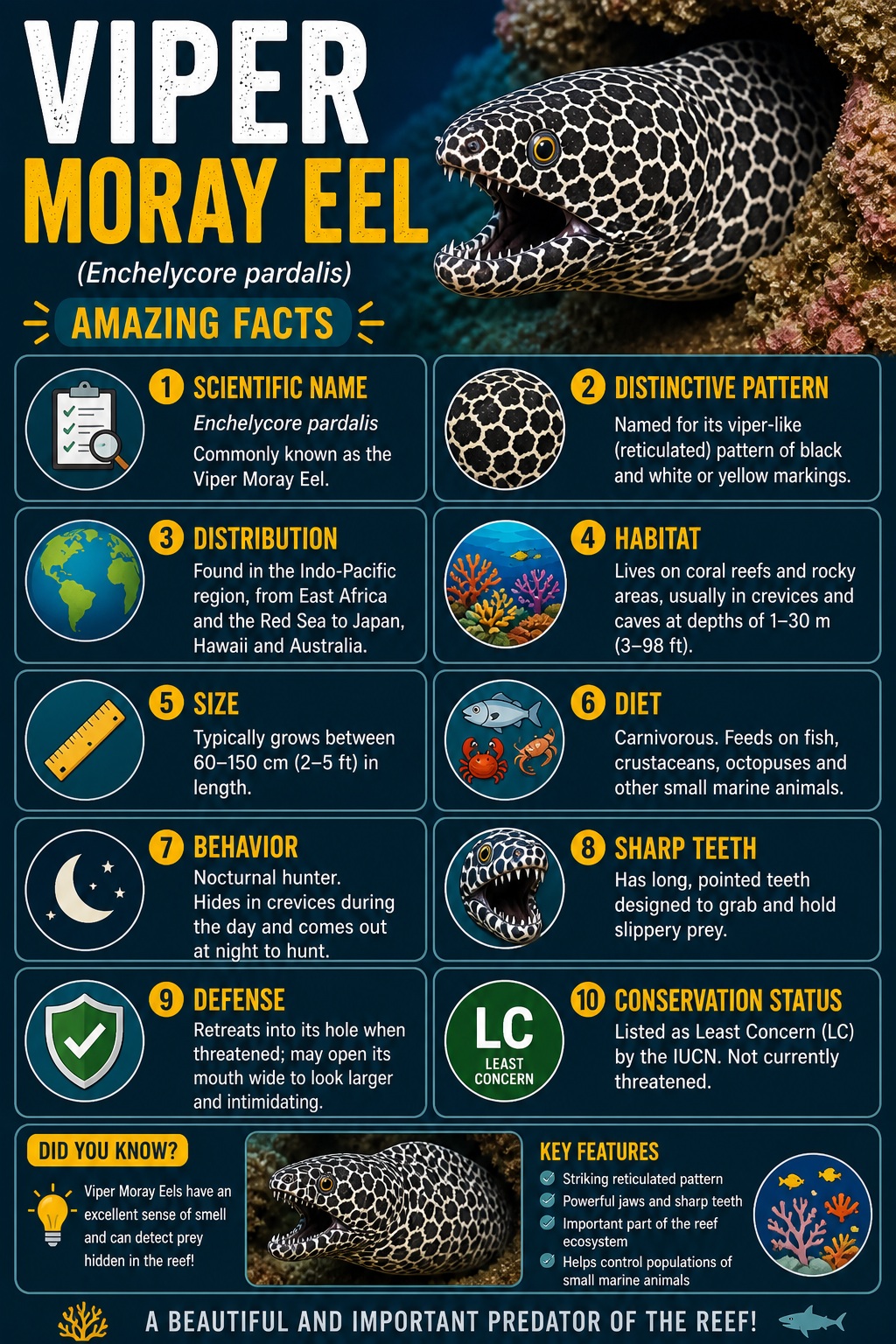
Summary of Key Viper Moray Facts
- Permanent Snarl: Their jaws are structurally curved and cannot close.
- Glass-Like Teeth: They possess some of the longest fangs of any eel species.
- Deep Dwellers: Often found at depths exceeding 100 meters.
- Nocturnal Foragers: They track prey at night using a highly developed sense of smell.
- Eastern Atlantic Kings: They are a signature species of the Canary Islands and Madeira.
- Second Jaws: They use pharyngeal jaws to pull prey into their throats.
- Scale-less: Their skin is protected by a toxic mucus rather than scales.
- Disruptive Camouflage: Their mottled pattern mimics reef lichens and sponges.
- Solitary: They rarely share their crevices with other eels.
- Ancient Lineage: Their body plan has remained largely unchanged for millions of years.
Conclusion: Respecting the Nightmare
The Viper Moray Eel is a vital component of the Atlantic’s deep-reef ecosystem. As a top predator, it keeps the populations of small reef fish in check, ensuring that the underwater “forests” of sponges and corals are not overgrazed.
While its appearance may be the stuff of nightmares, the Viper Moray is a masterpiece of biological engineering. It is an animal that has traded the conventional beauty of the reef for a functional, terrifying efficiency. To see a Viper Moray in the wild is to see one of the ocean’s most honest predators—a creature that makes no apologies for its fangs and offers a rare, spine-tingling glimpse into the raw, unpolished power of the deep sea.
Frequently Asked Questions (FAQ)
1. Can a Viper Moray Eel see in the dark?
While their eyes are functional, they primarily rely on chemoreception (smell) and their lateral line system (sensing vibrations) to hunt at night.
2. Why do they look like they are gasping?
They are pumping water over their gills. Because they don’t have gill covers like a goldfish, they must use their mouths to physically push water through their respiratory system.
3. Do they have venom?
No. They do not have venomous fangs. However, their skin mucus can be mildly toxic, and their blood is poisonous if eaten raw.
4. Can you keep one in an aquarium?
It is extremely difficult. They require very large tanks, specialized deep-water cooling systems, and they will eat almost any tank mate. They are only recommended for professional-grade public aquariums.
5. How fast can they strike?
A moray strike is one of the fastest movements in the ocean, occurring in a fraction of a second. This speed, combined with their needle-teeth, makes escape nearly impossible for small fish.