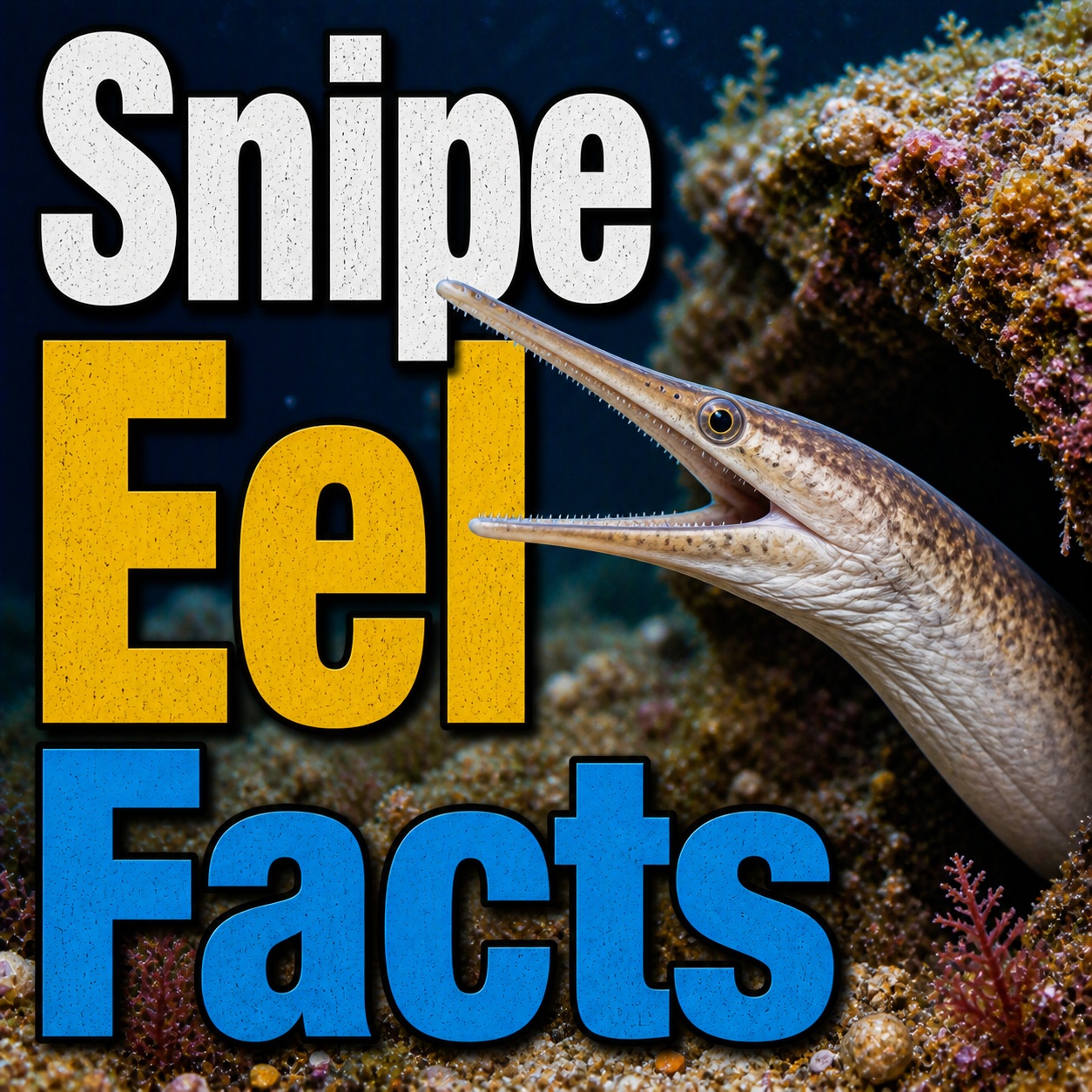
The deep ocean remains the final frontier of biological discovery on Earth, a realm where evolution takes “strange” to a whole new level. Among the most bizarre inhabitants of this midnight zone is the Snipe Eel (family Nemichthyidae). Looking more like a frayed piece of bird-ribbon than a traditional fish, the Snipe Eel challenges our understanding of aquatic anatomy.
In this comprehensive guide, we will explore the 2000-meter-deep world of the Snipe Eel, analyzing its bird-like beak, its shimmering “gossamer” body, and the specialized lifestyle that allows it to survive in the crushing pressures of the abyss.
Classification and Anatomy: The Bird of the Abyss
The Snipe Eel gets its name from the Common Snipe, a bird with a long, slender beak. However, unlike the bird, the Snipe Eel’s “beak” is a marvel of marine engineering that never actually closes.
1. The Non-Closing Beak
The most striking feature of the Snipe Eel is its jaws. Both the upper and lower jaws are extremely elongated and curve away from each other at the tips. Because of this permanent curve, the eel cannot close its mouth. Instead, the jaws act as a biological “velcro” trap. They are covered in thousands of tiny, hooked teeth called villiform teeth.
2. The Gossamer Body
Snipe Eels possess an incredibly slender, ribbon-like body. They can grow up to 1.5 meters (5 feet) in length, yet they rarely weigh more than a few ounces.
- The Thread-Tail: Their bodies taper down into a tail so thin it resembles a piece of sewing thread.
- Vertebrae Overload: To achieve this length and flexibility, Snipe Eels have more vertebrae than almost any other animal on Earth—sometimes exceeding 750 individual bones.
3. Large, Sensitive Eyes
Living in the “Twilight Zone” (Mesopelagic) and “Midnight Zone” (Bathypelagic), Snipe Eels have very large eyes relative to their head size. These eyes are designed to catch the faint traces of bioluminescence produced by other deep-sea creatures, helping the eel navigate a world without sunlight.
Snipe Eel Species List
There are nine recognized species of snipe eels in the family Nemichthyidae, grouped into three genera: Avocettina, Labichthys, and Nemichthys. They are deep‑sea, thread‑thin eels found worldwide between 300–600 m, sometimes deeper.
a. Genus Avocettina
- Avocettina acuticeps (Southern snipe eel) – Found in southern oceans, max length ~77 cm.
- Avocettina bowersii – Eastern Central Pacific, smaller species (~42 cm).
- Avocettina infans (Avocet snipe eel) – Circumglobal, up to 80 cm, found as deep as 4,580 m.
- Avocettina paucipora – Southwest Atlantic, smaller (~55 cm).
b. Genus Labichthys
- Labichthys carinatus – Eastern Atlantic, max length ~80 cm.
- Labichthys yanoi (Yano’s snipe eel) – Southwest Pacific, ~75 cm.
c. Genus Nemichthys
- Nemichthys curvirostris (Boxer snipe eel) – Worldwide tropical waters, up to 143 cm.
- Nemichthys larseni – Eastern Pacific, one of the largest (~161 cm).
- Nemichthys scolopaceus (Slender snipe eel) – Circumglobal, ~130 cm, with up to 750 vertebrae.
Key Characteristics
- Depth Range: 300–600 m typical, but some species recorded below 4,000 m.
- Body Shape: Extremely slender, thread‑like, with long beak‑like jaws.
- Weight: Despite lengths up to 1.6 m, they weigh only 80–400 g.
- Diet: Shrimp‑like crustaceans, caught with permanently open jaws.
- Reproduction: Oviparous; larvae (leptocephali) are transparent and leaf‑shaped.
Habitat and Distribution: Where the Sun Never Shines
Snipe Eels are not restricted to a single coastline; they are cosmopolitan, meaning they live in nearly every ocean across the globe.
4. Depth Ranges
You will typically find Snipe Eels at depths ranging from 300 to 2,000 meters (1,000 to 6,500 feet). At these depths:
- The water temperature is near freezing.
- The pressure is immense (up to 200 times the pressure at the surface).
- Food is incredibly scarce.
5. Diel Vertical Migration
Like many deep-sea dwellers, Snipe Eels engage in Diel Vertical Migration. They stay in the safety of the dark, deep water during the day to avoid visual predators and move closer to the surface at night to feed on the abundance of crustaceans in the slightly shallower waters.
Feeding Strategy: The Velcro Ambush
Because the Snipe Eel cannot close its mouth, it has developed one of the most specialized feeding techniques in the ocean.
6. Targeting the Antennae
Snipe Eels primarily eat small shrimp and crustaceans. When a shrimp swims past, it often has long, feathery antennae. The Snipe Eel doesn’t “bite” the shrimp in the traditional sense. Instead, it swims through the water with its beak open. When the shrimp’s antennae touch the eel’s jaws, the thousands of tiny, hooked teeth snag the antennae like velcro.
7. The Struggle
Once the shrimp is snagged, it struggles to get free, which only entangles it further in the eel’s hooked teeth. The eel then uses a combination of body movements and water pressure to pull the entangled prey into its throat. This strategy allows the eel to catch fast-moving prey without needing a powerful, muscular jaw.
The Life Cycle: A Transparent Beginning
The life of a Snipe Eel begins in a way that is common to all “true” eels, but with a deep-sea twist.
8. Leptocephalus Larvae
Snipe Eels start their lives as Leptocephali. These larvae are flat, leaf-shaped, and completely transparent. This transparency is a vital defense mechanism in the open ocean, as it makes the tiny larvae nearly invisible to predators looking up from below or down from above.
9. Metamorphosis and Sexual Dimorphism
As the Snipe Eel matures, it undergoes a dramatic transformation. Interestingly, Snipe Eels show sexual dimorphism (males and females look different) in a very tragic way.
- The Male’s Transformation: In some species, when the male reaches sexual maturity, it loses its teeth and its long beak shrinks. Its sensory organs for smell (olfactory organs) enlarge significantly to help it find a female in the vast darkness.
- The Final Act: It is believed that Snipe Eels, like many other eel species, are semelparous—they breed once and then die.
Unique Defense and Survival Traits
Surviving in the abyss requires more than just a weird beak; it requires specialized internal systems.
While the Snipe Eel itself is not known for having the large, glowing light organs found on anglerfish, some scientists believe they may have subtle photophores (light-producing cells) along their underside. This would help them with counter-illumination, a type of camouflage that hides their silhouette from predators lurking beneath them.
11. Lateral Line System
Because it is pitch black, the Snipe Eel relies on its lateral line system—a series of sensory pores along its body. This system allows the eel to detect tiny vibrations and pressure changes in the water, essentially allowing it to “feel” the movement of a shrimp from several feet away.
Research and Conservation Status
The Snipe Eel is rarely seen by humans except when caught in deep-sea research trawls or observed by Remotely Operated Vehicles (ROVs).
12. Data Deficient
The IUCN (International Union for Conservation of Nature) often lists deep-sea eels like the Snipe Eel as “Data Deficient.” Because they live so deep, it is difficult for scientists to estimate their total population. However, they are currently not considered to be at risk of extinction because their habitat is largely away from human interference.
13. The Threat of Deep-Sea Mining
The primary emerging threat to the Snipe Eel is deep-sea mining. As companies look to the ocean floor for minerals, the resulting sediment clouds could clog the delicate “velcro” jaws of the Snipe Eel or kill the shrimp they depend on for food.
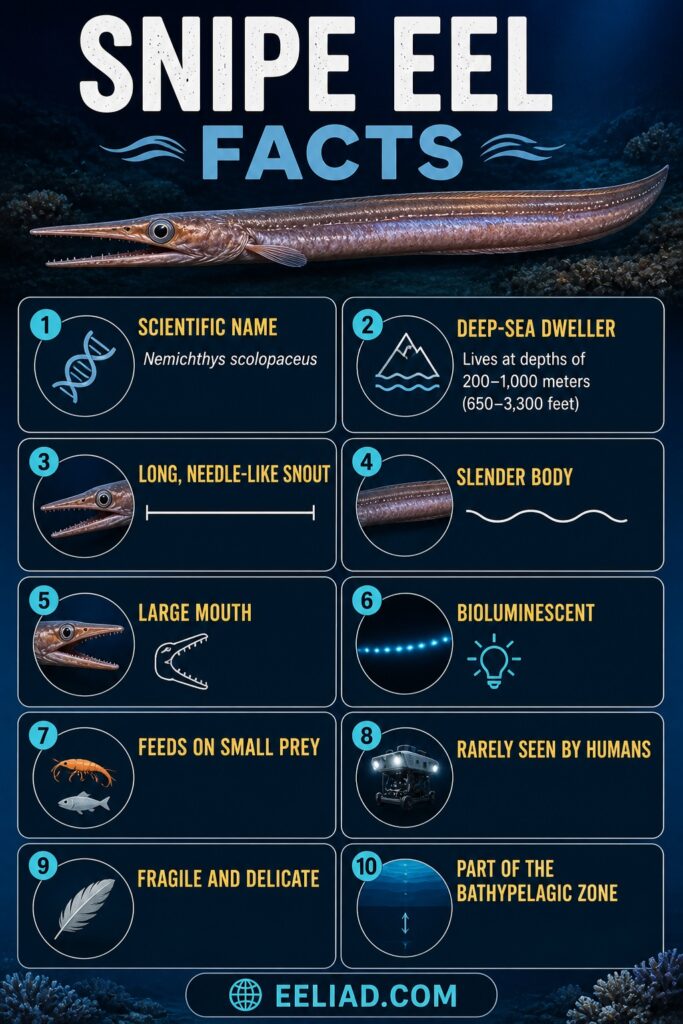
Summary of Snipe Eel Traits
| Feature | Description |
| Max Length | Up to 1.5 meters (5 feet). |
| Diet | Primarily shrimp and small crustaceans. |
| Jaws | Permanent open curve with villiform (hooked) teeth. |
| Habitat | Mesopelagic and Bathypelagic zones (up to 2,000m). |
| Reproduction | Produces transparent, leaf-shaped larvae (Leptocephali). |
Conclusion
The Snipe Eel is a testament to the creativity of evolution. In an environment where every calorie counts and every movement could reveal you to a predator, the Snipe Eel has traded armor and speed for a gossamer body and a “velcro” beak. It remains one of the most mysterious and elegant residents of the deep, a shimmering ribbon of life navigating the eternal night of the abyss.
Frequently Asked Questions (FAQ)
1. Can Snipe Eels bite humans?
No. They live thousands of feet below the surface and their mouths are designed to catch tiny shrimp, not large animals. Their jaws are far too delicate to harm a person.
2. Why do they look like birds?
The “beak” is a result of convergent evolution. Just as birds like the snipe evolved long beaks to probe the mud for food, the Snipe Eel evolved a long beak to snag the delicate antennae of deep-sea shrimp.
3. Do they have scales?
No. Like most eels, they lack scales and are covered in a thin, protective layer of mucus.
4. How do they swim?
They swim with an undulating, eel-like motion. However, they are often seen by ROVs hanging vertically in the water column, perfectly still, waiting for a shrimp to stumble into their jaws.
5. Are they related to Moray eels?
Yes, they are both part of the order Anguilliformes, which includes all true eels. However, they are in different families and have evolved very different hunting strategies.
6. What is the biggest threat to Snipe Eels?
Currently, climate change (which affects ocean temperatures and currents) and the potential for deep-sea mining are the greatest long-term threats to their habitat.
7. How long can they live?
We don’t know for sure. Deep-sea creatures often have slower metabolisms and can live quite long, but the Snipe Eel’s specific lifespan remains a mystery to science.