
The European eel (Anguilla anguilla)and the American eel (Anguilla rostrata) are two remarkable species that share the same mysterious spawning grounds in the Sargasso Sea, yet live on opposite sides of the Atlantic.
Both undertake epic migrations, shifting from transparent larvae to freshwater dwellers before returning to the ocean to reproduce. While they look similar, they differ in size, vertebrae count, migration distance, and conservation status — with the European eel critically endangered and the American eel vulnerable.
10 Key Differences European and American Eel
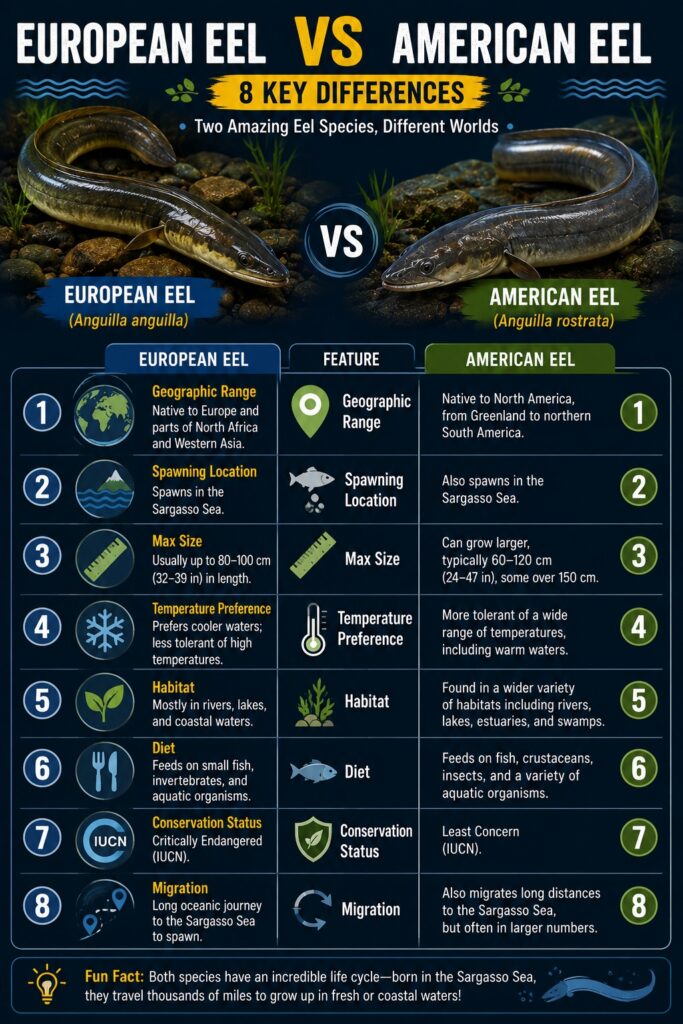
- Scientific Name: European Eel is Anguilla anguilla; American Eel is Anguilla rostrata.
- Vertebrae Count: The most accurate differentiator; American eels have fewer vertebrae (average ~107) compared to European eels (average ~115).
- Spawning Location: Both spawn in the Sargasso Sea, but American eels spawn further southwest, closer to Bermuda; European eels spawn further east/south.
- Larval Migration Time: European eel larvae (leptocephali) take 1–3 years to reach Europe, while American eel larvae take only 6–12 months to reach North America.
- Migration Distance: European eels travel over 6,000 km to reach Europe, while American eels travel a much shorter distance to the North American coast.
- Maximum Size: American eels can grow larger, with females reaching up to 5 feet (1.5 m) and over 16 lbs. European eels rarely exceed 1 meter, though they can reach 1.33 m.
- Coloration/Appearance: American eels often have a more brownish/greenish hue compared to the yellowish or olive-brown of European eels, although both change to silvery as adults.
- Population Status: The European eel is critically endangered (population reduced by 90–98%). The American eel is listed as endangered in some areas (e.g., Canada) but not as widely critical as the European species.
- Distribution: European eels are found in coastal and freshwater bodies across Europe and the Mediterranean. American eels occupy the eastern coast of North America, from Greenland to South America.
- Age at Migration (Silver Eel Stage): European eels generally mature and return to the sea at a later age (often 10–20+ years) compared to American eels, which can return earlier due to the shorter migration distance
Taxonomy & Evolution
- Both belong to the genus Anguilla, within the order Anguilliformes.
- Diverged ~3.5 million years ago when the Isthmus of Panama altered Atlantic currents.
- Despite divergence, they share the same spawning grounds in the Sargasso Sea.
- Hybrids occur naturally, showing genetic overlap.
Distribution & Habitat
- European Eel (A. anguilla): Found across Europe — from Iceland and Norway down to Morocco, including Mediterranean rivers and lakes.
- American Eel (A. rostrata): Found in eastern North America — from Greenland and Canada down to the Gulf of Mexico and the Caribbean.
- Both are catadromous: live in freshwater or estuaries, migrate to the ocean to spawn.
Size & Anatomy
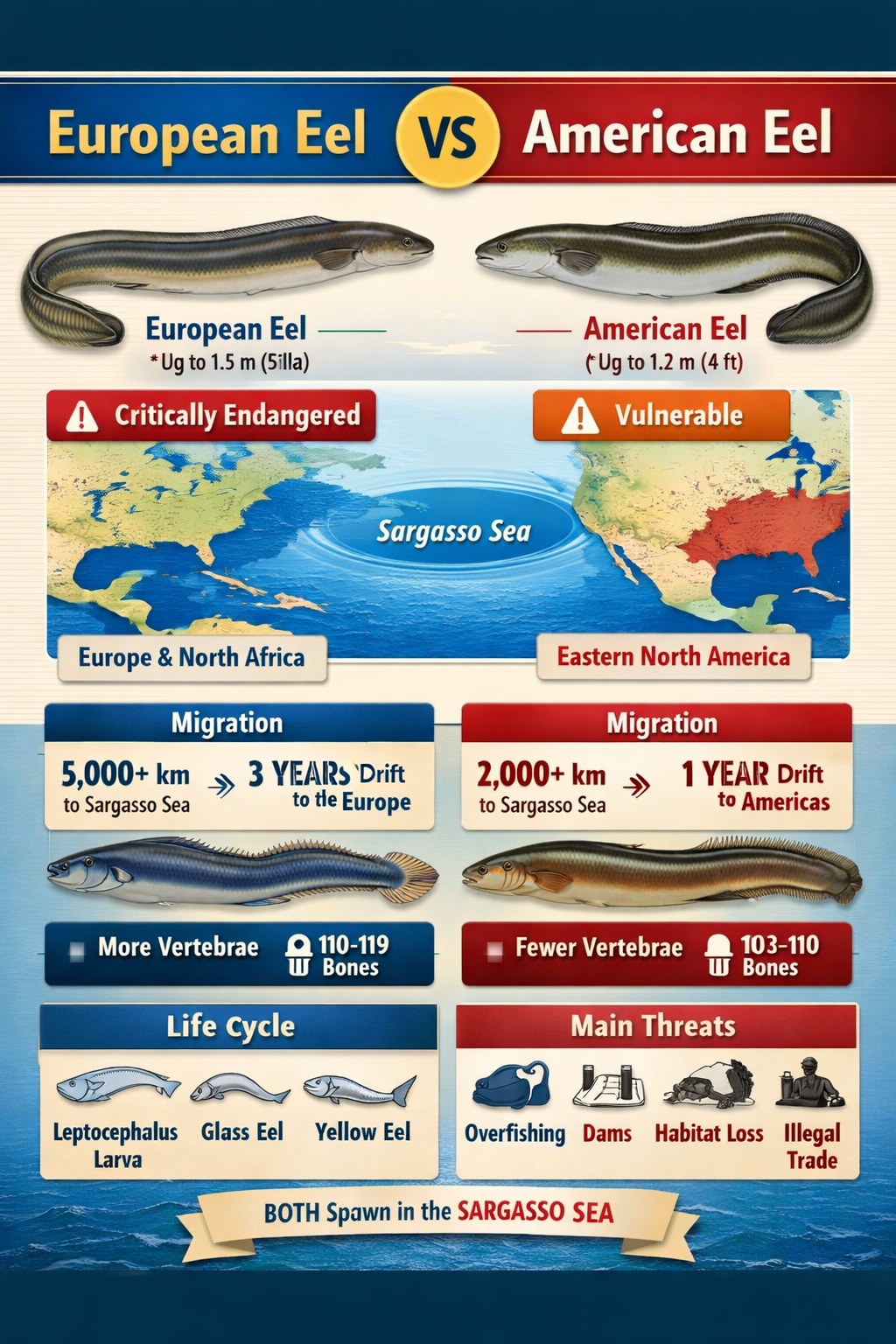
- European eel: Larger, up to 1.5 m long, heavier body.
- American eel: Smaller, up to 1.2 m long, slimmer build.
- Vertebrae count: European eel averages ~110–119; American eel ~103–110.
- Both lack pelvic fins, with continuous dorsal, anal, and caudal fins forming a ribbon.
- Skin covered in mucus, scaleless or with embedded scales, making them slippery.
Life Cycle Stages
Both eels go through the same “outfits” as they grow up. They change their appearance to match their environment.
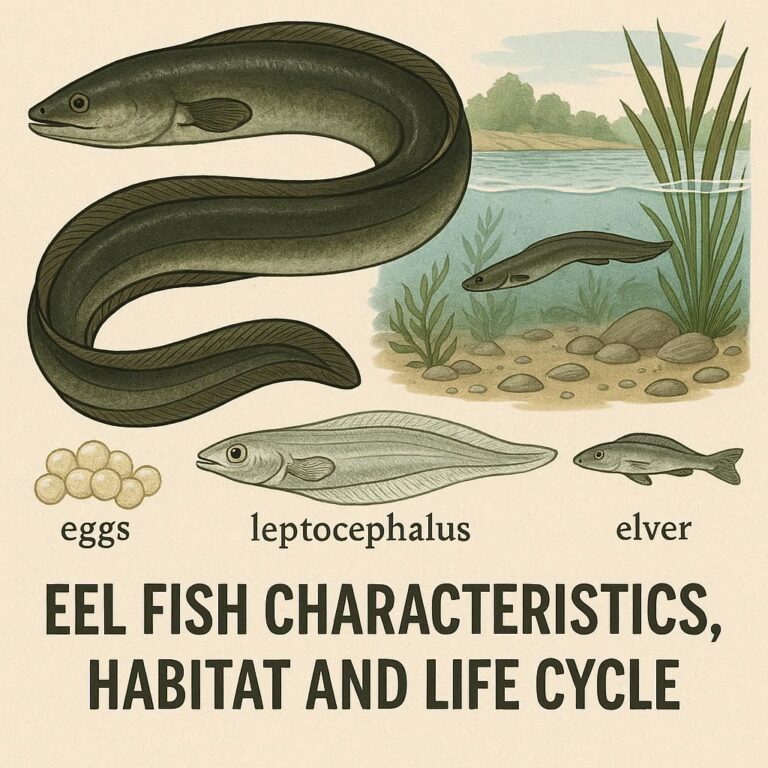
- Leptocephalus: Tiny, transparent, and shaped like a willow leaf. They drift in the ocean.
- Glass Eel: They arrive at the coast. They look like mini-eels but are still completely see-through.
- Elver: They enter rivers and develop pigment (color), usually turning brownish-green.
- Yellow Eel: This is their “teenage” and adult stage. They spend 5 to 20 years living in rivers, eating and growing.
- Silver Eel: The final stage. Their bellies turn silver, their eyes get bigger, and they stop eating. This is when they swim all the way back to the Sargasso Sea to lay eggs and die.
Differences:
- European eel larvae drift for ~3 years across 5,000 km.
- American eel larvae drift for ~1 year across ~2,000 km.
Migration
- Both species undertake one of the longest migrations in the animal kingdom.
- European eel: ~5,000–7,000 km journey from European rivers to the Sargasso Sea.
- American eel: ~2,000–3,000 km journey from North American rivers.
- Adults never return; spawning is their final act.
- No adult eels have ever been observed spawning — a biological mystery.
The “Commute”: How Long Does It Take?
Imagine two kids leaving the same playground. One lives across the street (American Eel), and the other lives five miles away (European Eel).
- The American Eel is a “short-haul” traveler. It takes about one year for the tiny, leaf-shaped eel larvae (called leptocephali) to drift on ocean currents and reach the American coast.
- The European Eel is a “long-haul” traveler. Because Europe is much farther away, it takes two to three years for them to complete the journey. They have to survive much longer in the open ocean before they find fresh water.
Diet & Behavior
- Carnivorous: Worms, crustaceans, mollusks, small fish, frogs.
- Nocturnal hunters: Hide in mud or rocks during the day, feed at night.
- Adaptability: Can survive in freshwater, brackish, and marine environments.
Cultural Significance
- Europe: Eel was a staple food in England (jellied eels), Italy (Capitone at Christmas), and the Netherlands (smoked eel).
- North America: American eel was important to Indigenous peoples for food and trade.
- Japan: Though not native, European and American eels were historically imported for unagi kabayaki before aquaculture expanded.
Conservation Status-Who is in Trouble?
While both eels face challenges like dams, pollution, and overfishing, the European Eel is in much more danger.
- European Eel: Listed as Critically Endangered. Their numbers have dropped by about 90% since the 1970s. Because their journey is longer, they are more vulnerable to changes in ocean currents and climate change.
- American Eel: Listed as Endangered. While they are doing slightly better than their European cousins, they are still a protected species in many areas, and fishing for them is strictly regulated.
Scientific Research
- Bone resorption: European eels lose skeletal mass during migration, using minerals for energy.
- Genetics: Studies show hybridization between species in the Sargasso Sea.
- Tracking: Satellite tagging confirms migration routes but spawning remains unseen.
Can You Tell Them Apart in a Tank?
If you put a young American eel and a European eel in the same aquarium, a normal person wouldn’t be able to tell the difference. Even experts often struggle!
The main visual clue is that European eels sometimes have a slightly shorter dorsal fin (the fin on their back) relative to their total length, but the vertebrae count remains the only 100% accurate way to identify them.
Comparative Summary
| Feature | European Eel (A. anguilla) | American Eel (A. rostrata) |
|---|---|---|
| Range | Europe, Mediterranean, North Africa | Eastern North America, Caribbean |
| Size | Up to 1.5 m | Up to 1.2 m |
| Vertebrae | ~110–119 | ~103–110 |
| Migration | 5,000–7,000 km, ~3 years drift | 2,000–3,000 km, ~1 year drift |
| Conservation | Critically Endangered | Vulnerable |
| Cultural Use | Jellied eels, smoked eel, Christmas dishes | Indigenous food, regional fisheries |
| Hybridization | Occurs in Sargasso Sea | Same |
Conclusion
The European eel and American eel are evolutionary cousins sharing the same spawning grounds but living on opposite sides of the Atlantic. Their differences in size, vertebrae count, and migration distance highlight adaptations to their respective environments. Both species face severe threats from overfishing, habitat loss, and climate change, making conservation urgent.
European Eel & American Eel FAQs
1. Are European and American eels the same species?
No. They are two distinct species — Anguilla anguilla (European eel) and Anguilla rostrata (American eel). They share the same spawning grounds in the Sargasso Sea but evolved separately about 3.5 million years ago.
2. Where do they live?
- European eel: Rivers, lakes, and coastal waters across Europe, North Africa, and the Mediterranean.
- American eel: Freshwater and estuarine habitats along eastern North America, from Greenland to the Gulf of Mexico.
3. Do both species spawn in the same place?
Yes. Both migrate thousands of kilometers to the Sargasso Sea in the Atlantic Ocean to spawn. No adult eels have ever been observed spawning — it remains one of nature’s great mysteries.
4. How far do they migrate?
- European eel: Travels up to 7,000 km; larvae drift for about 3 years.
- American eel: Travels up to 3,000 km; larvae drift for about 1 year.
5. What do they eat?
Both are carnivorous, feeding on worms, crustaceans, small fish, and amphibians. They hunt mostly at night.
6. Why are eels slippery?
Their skin secretes a thick mucus layer that reduces friction while swimming and protects against parasites and injury.
7. Are eels dangerous to humans?
No. They are not aggressive. However, raw eel blood is toxic and must always be cooked before eating.
8. Can European and American eels interbreed?
Yes. Genetic studies show hybridization occurs in the Sargasso Sea, producing viable offspring.
9. Why are eels endangered?
Overfishing, habitat loss, pollution, dams blocking migration routes, and illegal trade have caused severe population declines — especially for the European eel.
10. How long do eels live?
They can live 15–25 years in freshwater before migrating to spawn. Some European eels have been recorded living over 80 years in captivity.
11. Do eels have bones?
Yes — hundreds of small vertebrae form their flexible backbone. They also have a mineralized notochord that maintains strength during migration.
12. Are eels healthy to eat?
Yes, when cooked. Eel meat is rich in protein, omega‑3 fatty acids, and vitamins A, D, and B12.
13. What are the main differences between European and American eels?
- Size: European eel is larger.
- Vertebrae count: European eel has slightly more.
- Migration: European eel travels farther.
- Conservation: European eel is critically endangered; American eel is vulnerable.
14. What cultural dishes use these eels?
- Europe: Jellied eels (England), smoked eel (Netherlands), roasted Capitone (Italy).
- North America: Indigenous communities historically ate American eel.
- Japan: Imported eels used for Unagi Kabayaki before aquaculture expanded.