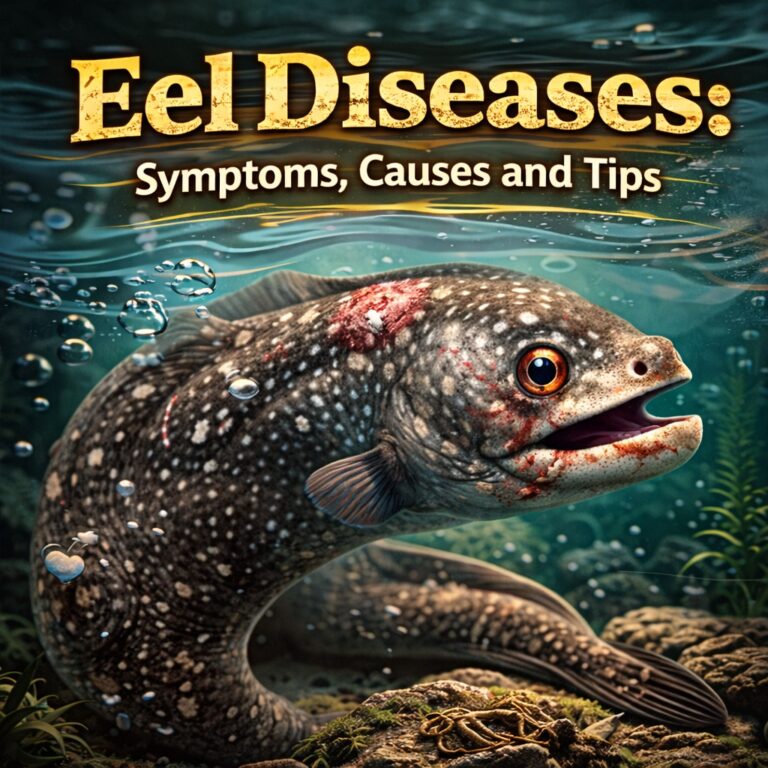

Eels are fascinating, snake‑like fish that have captivated aquarists for decades. Their elongated bodies, nocturnal habits, and mysterious personalities make them both challenging and rewarding pets. While not all eels are suitable for home aquariums, several freshwater and saltwater species have become popular among hobbyists. This guide explores the most common pet eels, their care needs, and what makes them unique.
12 Freshwater Pet Eels & Eel‑like Fish
1. Freshwater Moray Eel (Muraenidae)
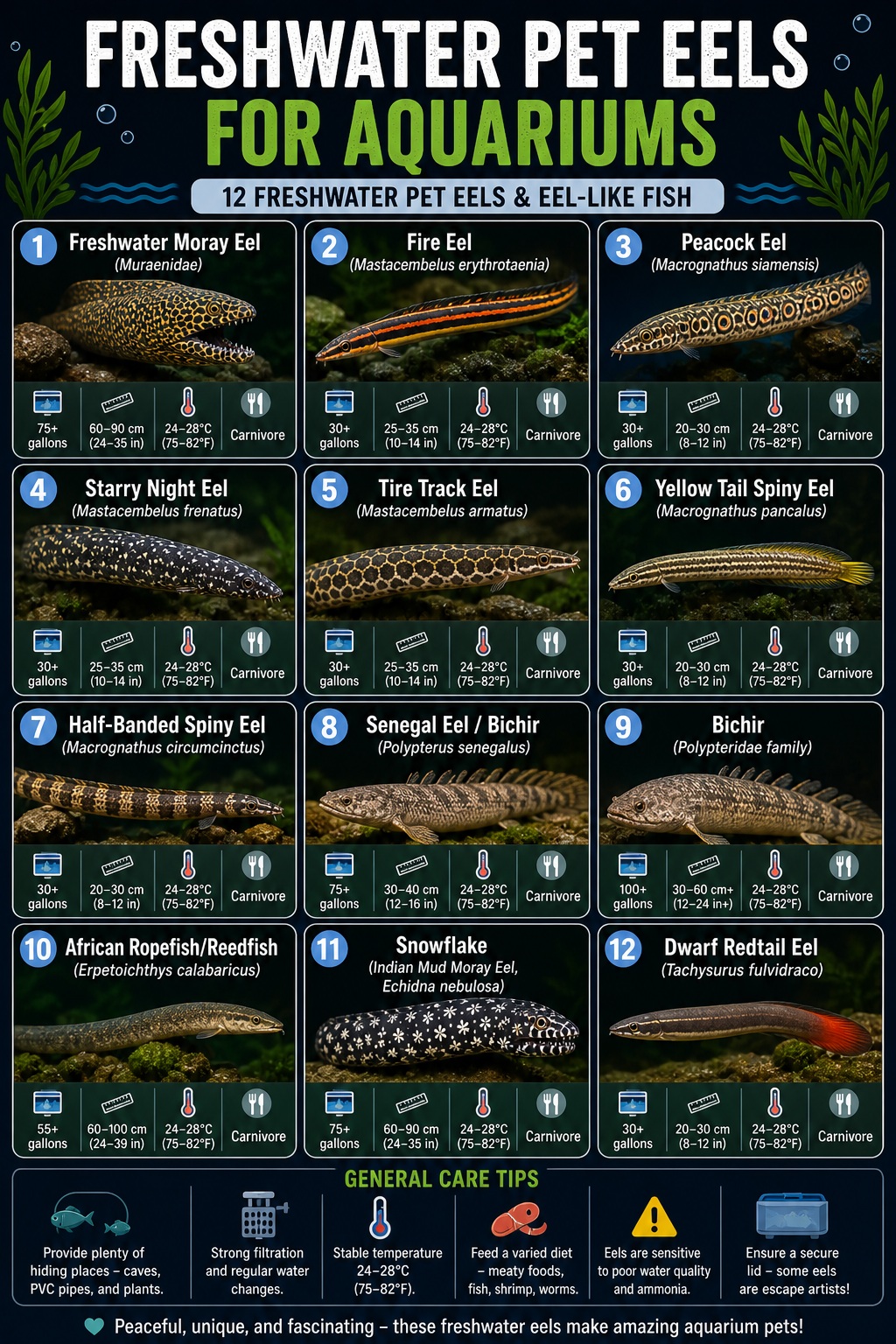
Although most morays are marine, a few species adapt to brackish or freshwater environments. The freshwater moray is rare in aquariums and requires careful acclimation. They grow up to 2–3 feet and need tanks of at least 75 gallons with secure lids. Morays are carnivorous, feeding on shrimp, fish, and squid. They are semi‑aggressive and best kept with larger tank mates. Their rarity and unique behavior make them fascinating but challenging pets, suitable only for advanced aquarists.
2. Fire Eel (Mastacembelus erythrotaenia)
One of the most popular spiny eels, the Fire Eel is known for its bold red and yellow stripes. It can grow up to 3 feet, requiring tanks of 100+ gallons. Fire Eels are semi‑aggressive but often become interactive with owners, recognizing feeding routines. They thrive in sandy substrates with hiding spots and feed on worms, shrimp, and small fish. Their striking appearance makes them a centerpiece species, though they demand advanced care.
3. Peacock Eel (Macrognathus siamensis)
A manageable species reaching about 11 inches, the Peacock Eel is peaceful and shy. It burrows in sand and prefers dimly lit tanks with hiding spaces. Its decorative “eye spots” along the dorsal fin make it visually appealing. Peacock Eels thrive in 30–40 gallon tanks and feed on worms, insect larvae, and small crustaceans. They are beginner‑friendly compared to larger spiny eels, making them popular among intermediate aquarists.
4. Starry Night Eel (Mastacembelus frenatus)
Native to Central Africa, the Starry Night Eel grows to about 15 inches. It has a dark body with star‑like speckles, giving it a celestial appearance. Hardy and semi‑aggressive, it requires tanks of 55+ gallons with sandy substrates and caves. Starry Night Eels are nocturnal hunters, feeding on worms and crustaceans. Their unique pattern and moderate size make them attractive for aquarists seeking something unusual.
5. Tire Track Eel (Mastacembelus armatus)
Named for its distinctive tire‑track markings, this eel grows up to 30 inches. It is shy, often hiding in substrate or caves, and requires tanks of 75+ gallons. Tire Track Eels are semi‑aggressive and nocturnal, feeding on worms, shrimp, and small fish. Their large size and unique markings make them impressive but challenging pets, best suited for experienced aquarists.
6. Yellow Tail Spiny Eel (Macrognathus pancalus)
A smaller spiny eel reaching about 7 inches, the Yellow Tail is semi‑aggressive but manageable. It thrives in 30–40 gallon tanks with sandy substrates and hiding spots. Its yellow tail adds a splash of color, making it visually distinctive. Yellow Tail Spiny Eels feed on worms and insect larvae. They are suitable for community tanks with larger fish, offering a balance of beauty and manageable care.
7. Half‑Banded Spiny Eel (Macrognathus circumcinctus)
Compact and attractive, this species grows to about 8 inches. Its striped body makes it visually appealing, and it thrives in 30‑gallon tanks. Half‑Banded Spiny Eels are peaceful and interactive, often becoming favorites due to their quirky personalities. They require sandy substrates and hiding spots, feeding on worms and crustaceans. Their manageable size and temperament make them beginner‑friendly.
8. Senegal Eel / Bichir (Polypterus senegalus)
Often called the Dinosaur Eel, the Senegal Bichir is a primitive fish with an eel‑like body. Growing to about 18 inches, it is hardy and adaptable. Bichirs breathe atmospheric air and require secure tanks with lids. They are peaceful but predatory, feeding on worms, shrimp, and small fish. Their prehistoric appearance and resilience make them popular among aquarists seeking oddball species.
Technically not a true eel but a primitive fish, the Senegal Bichir is often kept in aquariums due to its eel‑like body and prehistoric appearance. Growing to about 18 inches, it is hardy and adaptable. It breathes atmospheric air and thrives in tanks with secure lids. Its peaceful temperament makes it suitable for community setups with larger fish.
9. Bichir (Polypteridae family)
Beyond the Senegal, other bichirs are also kept in aquariums. They share the eel‑like body and hardy nature, growing to 10–20 inches depending on species. Bichirs are nocturnal, carnivorous, and require tanks of 55+ gallons. Their unique look and resilience make them suitable for intermediate aquarists.
10. African Ropefish/Reedfish (Erpetoichthys calabaricus)
Also called Reedfish, the Ropefish grows to about 2 feet. It has a snake‑like body and is peaceful, nocturnal, and social. Ropefish require secure tanks with tight lids, as they are escape artists. They feed on worms, crustaceans, and small fish. Their oddball appearance and gentle temperament make them popular among aquarists seeking unusual species.
11. Snowflake (Indian Mud Moray Eel, Echidna nebulosa)
Often mis‑sold as freshwater, the Snowflake Moray is actually a brackish/marine species but can survive in transitional freshwater tanks. It grows to about 2 feet and is hardy, feeding on crustaceans. Snowflake Morays require secure tanks of 75+ gallons. They are beginner‑friendly compared to other morays, making them popular despite their brackish nature.
12. Dwarf Redtail Eel (Tachysurus fulvidraco)
Noted for its smaller size and interactive nature, the Dwarf Redtail Eel is easier to care for than larger spiny eels. It suits modest aquariums and is known for being more manageable, making it appealing to hobbyists who want an eel without the challenges of giant species.
6 Saltwater Pet Eels
Snowflake Moray (Echidna nebulosa)
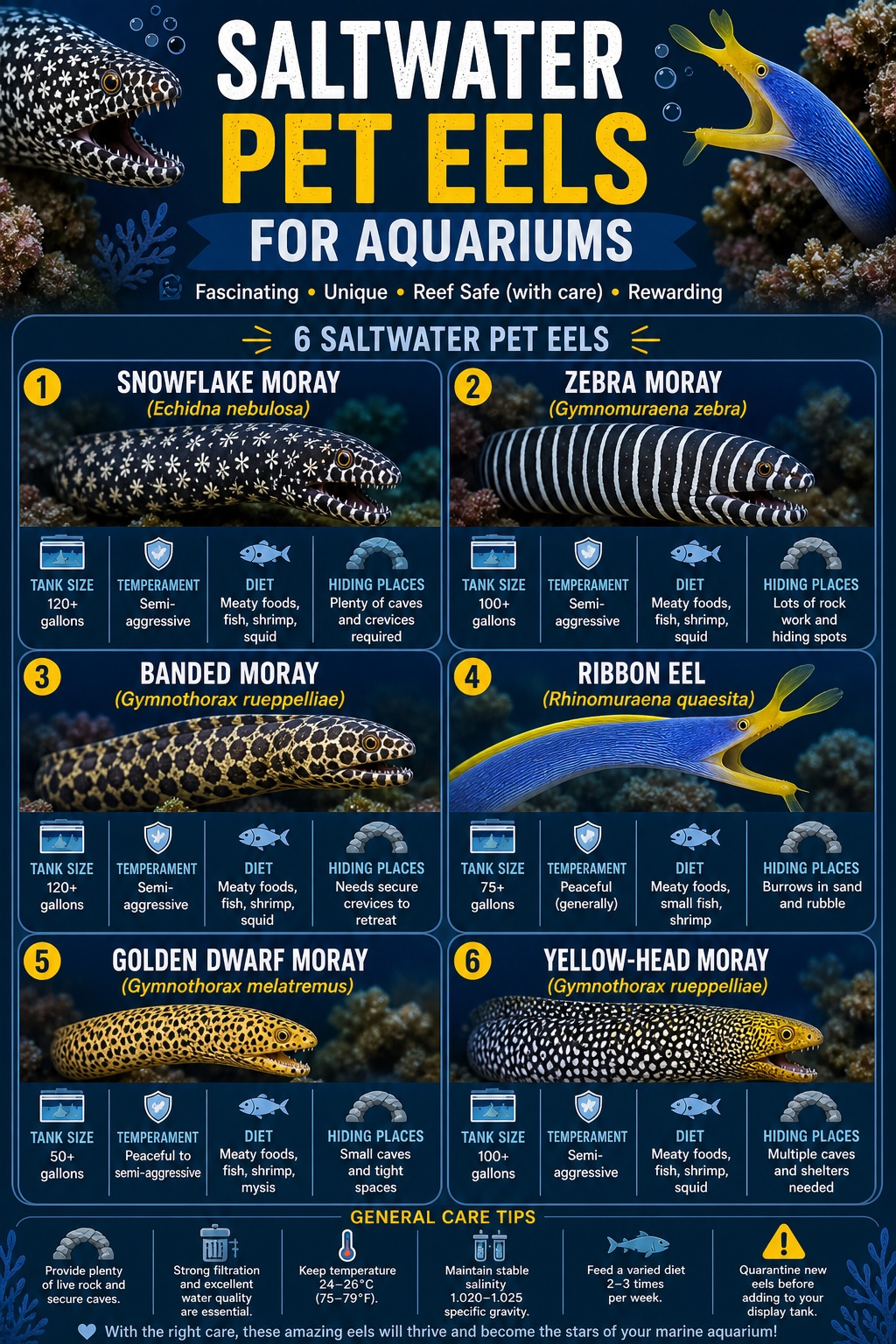
One of the most beginner‑friendly saltwater eels, the Snowflake Moray is hardy and adaptable. It grows to about 2 feet and feeds primarily on crustaceans. Snowflake Morays require secure tanks of at least 75 gallons. They are nocturnal but often become bold and interactive with owners. Their mottled white and black pattern makes them visually striking.
Zebra Moray (Gymnomuraena zebra)
Known for its bold zebra stripes, this eel is docile compared to other morays. It can grow up to 5 feet, requiring very large aquariums. Zebra Morays feed mainly on crustaceans and are less aggressive toward fish. Their peaceful nature and striking appearance make them highly desirable, though they are best suited for advanced aquarists with large tanks.
Banded Moray (Gymnothorax rueppelliae)
A shy but docile species, the Banded Moray has distinctive banded markings. It requires secure, large tanks to prevent escapes. Growing to about 3 feet, it is nocturnal and prefers hiding during the day. While not as bold as Snowflake or Zebra Morays, it is valued for its unique appearance.
Ribbon Eel (Rhinomuraena quaesita)
Highly sought after for its vibrant blue and yellow coloration, the Ribbon Eel is one of the most delicate and difficult species to keep. It requires pristine water conditions and specialized care, making it suitable only for advanced aquarists. Ribbon Eels are notorious for refusing food in captivity, which makes long‑term success challenging. Despite this, their beauty makes them a prized species among enthusiasts.
Golden Dwarf Moray (Gymnothorax melatremus):
Rare, expensive, but ideal for smaller high‑end aquariums. Reaches only ~12 inches, peaceful compared to larger morays, and can coexist with small reef fish. Requires pristine water and secure rockwork.
Yellow‑Head Moray (Gymnothorax rueppelliae):
Visually striking with a bright yellow head. Grows to ~2 feet, semi‑docile, and suitable for medium‑sized reef tanks. Needs secure hiding spaces and a carnivorous diet.
Care Considerations
Tank Size
- Small species like Peacock and Half‑Banded Eels thrive in 30–40 gallon tanks.
- Larger freshwater species like Fire and Tire Track Eels need 75–100+ gallons.
- Saltwater Zebra Morays may require tanks exceeding 150 gallons.
Escape Risk
All eels are escape artists. Secure lids and covered filtration systems are essential to prevent accidents.
Diet
Eels are carnivorous, feeding on worms, shrimp, crustaceans, and small fish. Frozen foods can be used, but live prey often stimulates natural hunting behavior.
Temperament
Most eels are nocturnal and semi‑aggressive. They should not be housed with small fish that can be mistaken for prey.
Experience Level
- Beginner‑friendly: Peacock Eel, Half‑Banded Spiny Eel, Snowflake Moray20 Types of Eels: Classification, Families and Diversity.
- Intermediate: Tire Track Eel, Ropefish, Banded Moray.
- Advanced: Fire Eel, Zebra Moray, Ribbon Eel.
Why Keep Pet Eels?
- Unique Appearance: Their snake‑like bodies and exotic markings make them stand out.
- Behavioral Fascination: Nocturnal habits, burrowing, and hunting behaviors are captivating.
- Challenge & Reward: Keeping eels requires skill, making them appealing to experienced aquarists.
- Conversation Starters: Eels are unusual pets that spark curiosity.
Saltwater Eel FAQs
Q1: What tank size do saltwater eels need?
- Snowflake Moray: 75 gallons.
- Zebra Moray: 125+ gallons.
- Ribbon Eel: 100+ gallons, pristine water required.
- Golden Dwarf Moray: 30–40 gallons, rare but ideal for smaller high‑end aquariums.
- Yellow‑Head Moray: 75–100 gallons, visually striking and semi‑docile.
Q2: What do saltwater eels eat? Carnivorous predators. Feed squid, shrimp, fish fillets, and crabs. Most eat 2–3 times per week.
Q3: Are saltwater eels reef‑safe? Generally safe with larger fish, but they will eat ornamental shrimp and crabs. Snowflake and Zebra Morays are considered more docile, while Ribbon Eels are delicate and difficult to keep.
Q4: How long do saltwater eels live? Many morays live 15–20 years in captivity with proper care.
Freshwater Eel FAQs
Q1: What tank size do freshwater eels need?
- Smaller species like Peacock or Half‑Banded Spiny Eels thrive in 30–40 gallon tanks.
- Larger species such as Fire or Tire Track Eels require 75–125+ gallons.
Q2: What do freshwater eels eat? They are carnivores. Offer worms, shrimp, krill, insect larvae, and small fish. Frozen foods are accepted, but live prey often stimulates natural hunting behavior.
Q3: Are freshwater eels aggressive? Most are semi‑aggressive. They may eat smaller tank mates, so pair them with larger, fast‑moving fish like barbs, cichlids, or gouramis.
Q4: How long do freshwater eels live? With proper care, many species live 10–15 years, some even longer.
Conclusion
Pet eels are fascinating, exotic additions to aquariums. From the manageable Peacock and Half‑Banded Spiny Eels to the majestic Fire and Zebra Morays, each species offers unique challenges and rewards.
Beginners may start with hardy species like the Snowflake Moray or Peacock Eel, while advanced aquarists can attempt the delicate Ribbon Eel. Regardless of choice, secure tanks, proper diets, and patience are essential for success.