Eels are fascinating creatures that inhabit oceans, rivers, and lakes worldwide. Their elongated bodies, slippery skin, and mysterious behaviors have inspired myths and scientific curiosity alike. One of the most intriguing aspects of eels is their defense traits—the adaptations that allow them to survive in environments filled with predators such as sharks, groupers, barracudas, and even humans.
This article explores the physical, behavioral, and ecological defense mechanisms of different eel species, from morays to snake eels, swamp eels, and electric eels.
🧬 Physical Defense Traits
Toxic Mucus (Crinotoxins)
Most eels produce a thick, slippery coating of mucus that serves as a chemical shield.
- The “Burn” Factor: In many species, this slime contains crinotoxins. If a predator tries to bite the eel, the toxins cause an immediate bitter taste and can even cause the predator’s throat to swell or sting.
- Friction Reduction: This mucus makes the eel nearly impossible to grip. If a predator like a shark or a larger fish tries to grab them, the eel simply slides out of their jaws.
- Healing Properties: The slime also contains antibacterial agents that allow eels to live in bacteria-rich crevices or mud without getting skin infections.
- Hagfish (eel‑like relatives) take this to the extreme, producing slime that can clog predator gills.
2. Backward-Burrowing Tails
- Snake eels and sharptail eels have a defense trait found in almost no other fish: a calcitied, finless tail tip.
- This burrowing trait also allows them to ambush prey while remaining hidden.
- The Retreat: Instead of swimming away and exposing their heads, these eels can burrow backward into the sand.
- Armor-Plated Tail: The tip of the tail is hard and pointed like a spike. They use it to “drill” into the substrate, disappearing tail-first in a matter of seconds while keeping their eyes and teeth facing the threat.
3. Camouflage and Coloration
- Color patterns allow eels to melt into their surroundings, making them difficult to distinguish from the environment.
- Nature Mimicry: Garden eels resemble blades of sea grass when protruding from their sandy burrows.
- Reef Integration: Moray eels display mottled or speckled patterns that blend perfectly with the textures of coral reefs. This camouflage reduces detection and increases survival in predator-rich environments.
🦷 Active Defense Traits
4. Powerful Bite
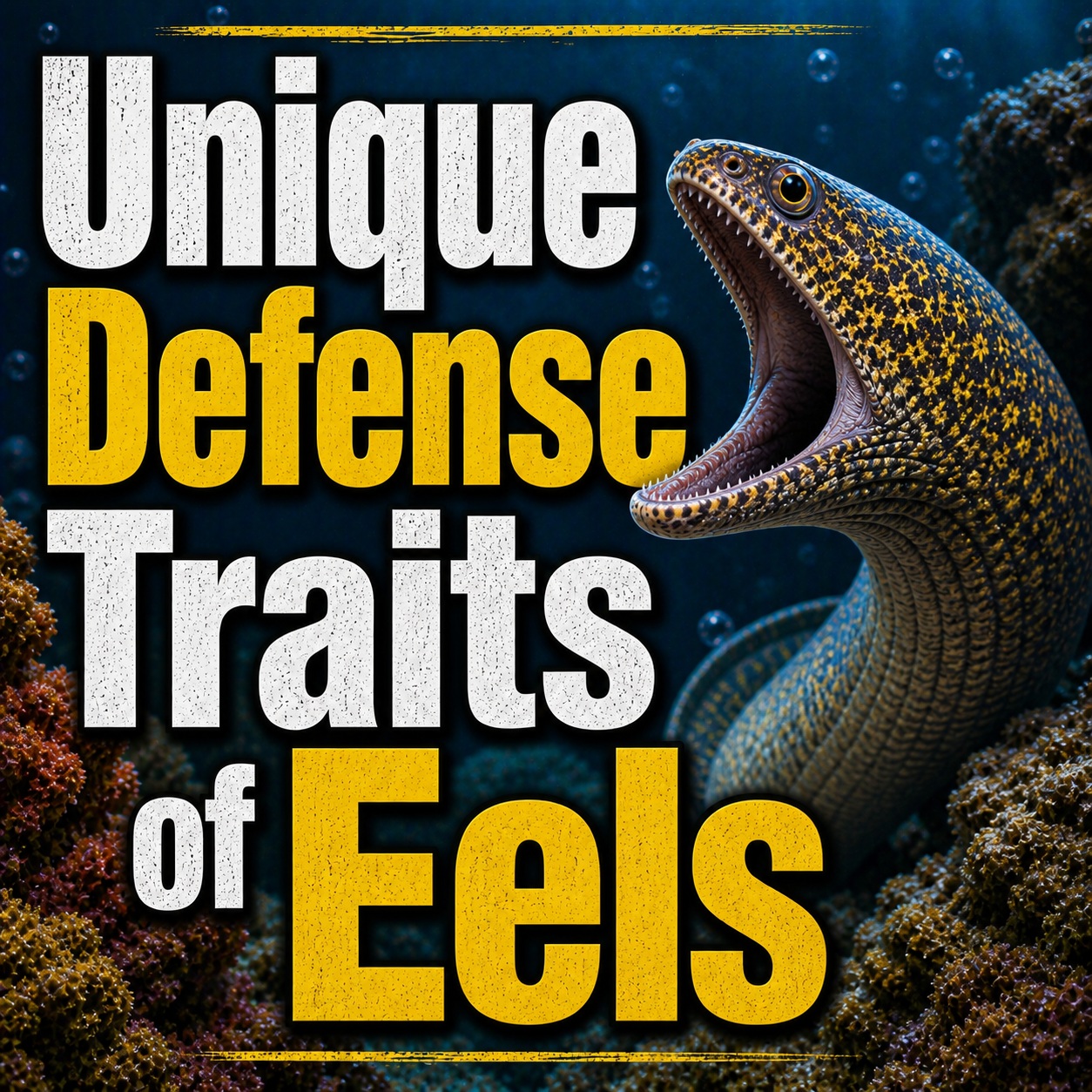
Moray eels possess a fearsome mouth designed for a “no-escape” grip.
- Pharyngeal Jaws: They utilize a second set of jaws hidden in the throat that launches forward to secure food or a threat. This “alien-like” anatomy provides a mechanical advantage that few other vertebrates possess.
- Grip and Lock: They have sharp, backward-pointing teeth designed to grip slippery prey. When threatened, morays deliver painful defensive bites that deter even the most persistent predators.
5. Electric Shock (Electric Eel)
- The electric eel (Electrophorus electricus), found in South America, is not a true eel but a knifefish.
- It generates shocks up to 860 volts, enough to stun predators or incapacitate prey.
- This is one of the most dramatic defense traits in the animal kingdom.
🌙 Behavioral Defense Traits
6. Nocturnal Activity
- Many eels are nocturnal, hunting at night and hiding during the day.
- This reduces encounters with daytime predators such as reef fish and seabirds.
7. Escape Reflex
- Juvenile eels have been observed escaping through the gill openings of predators that swallow them.
- This rare vertebrate defense mechanism allows survival even after capture.
8. Territorial Retreat
- Moray eels retreat deep into reef crevices when threatened.
- Their narrow, flexible bodies allow them to vanish into spaces inaccessible to larger predators.
9. Knotting Behavior
When a moray eel is grabbed by a large predator, it uses a unique physical maneuver known as “knotting.”
- Leverage: The eel ties its body into a tight “overhand knot.” It then slides the knot down its body toward its head.
- The Breakout: This creates massive leverage, allowing the eel to literally “push” itself out of the predator’s mouth or a tight crevice that it has become stuck in.
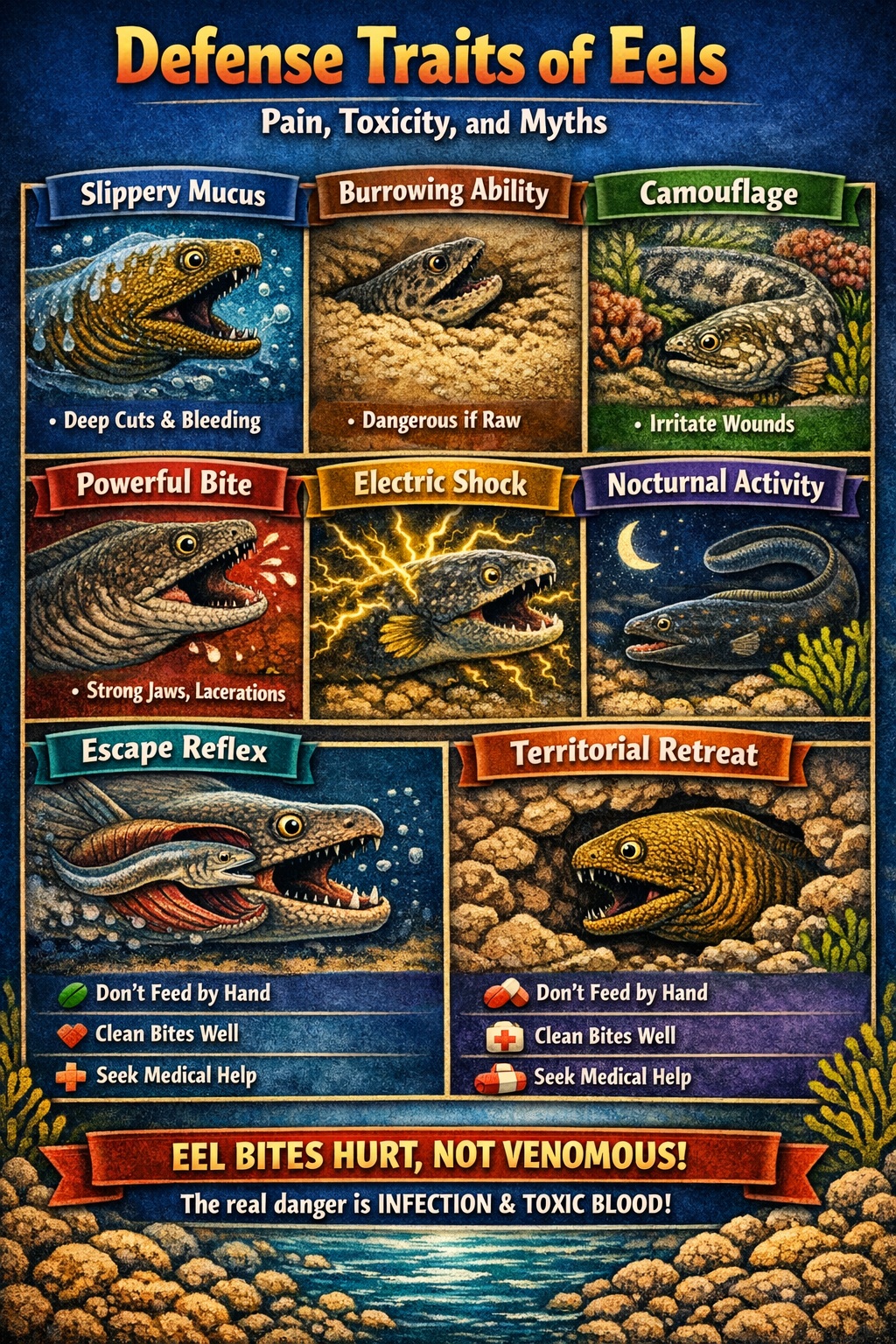
Summary of Defensive Specializations
| Defense Trait | Category | Primary Function |
| Toxic Mucus | Passive | Deterrence via taste and slipperiness. |
| Pharyngeal Jaws | Active | Securing a defensive bite that won’t let go. |
| Burrowing | Physical | Rapidly disappearing into the sea floor. |
| Electric Shock | Active | Paralyzing or stunning threats (Knifefish only). |
| Gill Escape | Behavioral | Surviving after being swallowed by a predator. |
🐍 Species‑Specific Defense Traits
Moray Eels (Muraenidae)
- Open‑mouth breathing often mistaken for aggression.
- Sharp teeth and pharyngeal jaws for defense.
- Camouflage patterns blend with coral reefs.
Snake Eels (Ophichthidae)
- Burrow rapidly into sand.
- Camouflage with sandy coloration.
- Use sharp tails to dig and escape predators.
Conger Eels (Congridae)
- Large size deters predators.
- Powerful bite when cornered.
- Hide in deep rocky crevices.
Garden Eels (Heterocongrinae)
- Colony behavior mimics sea grass fields.
- Retreat into burrows instantly when threatened.
Electric Eels (Electrophorus electricus)
- Generate electricity for defense and hunting.
- Shocks can deter predators and even humans.
🌍 Ecological Importance of Defense Traits
Eel defense mechanisms are not just survival strategies—they shape ecosystems:
- Predator Balance: By surviving predation, eels regulate prey populations.
- Symbiosis: Cleaner shrimp and wrasses rely on eels for food (parasites).
- Habitat Health: Burrowing aerates sediment, improving reef ecosystems.
📜 Myths and Misconceptions
- Myth: Eels are venomous.
- Reality: No true eel injects venom; their blood contains toxins only harmful if ingested raw.
- Myth: Moray eels attack divers.
- Reality: They bite only when provoked or fed by hand.
- Myth: Electric eels are true eels.
- Reality: They are knifefish, not members of Anguilliformes.
❓ FAQs
Q1: Do all eels bite as defense? No, only species like morays and congers rely on biting; others prefer hiding.
Q2: Are eels venomous? No, but their blood contains toxic proteins that are neutralized by cooking.
Q3: How do snake eels defend themselves? They burrow into sand rapidly, becoming invisible to predators.
Q4: Can electric eels kill humans? Their shocks can cause drowning accidents, but they are not venomous.
Q5: Why do moray eels look aggressive? Their open mouths are for breathing, not hostility.
Q6: Do garden eels have defense traits? Yes, they mimic sea grass and retreat instantly into burrows.
Q7: What is the rarest eel defense? Juveniles escaping through predator gills—a unique survival tactic.
Q8: Are eel defenses harmful to humans? Only bites and electric shocks pose risks; most eels avoid humans.
Q9: Do eels use camouflage? Yes, many species blend with sand, reefs, or vegetation.
Q10: Why are eel defenses important? They ensure survival, maintain predator‑prey balance, and support reef health.
Conclusion
Eels are masters of defense, combining physical traits like mucus and camouflage with active strategies such as biting, burrowing, and electric shocks. Their nocturnal habits and escape reflexes further enhance survival. These adaptations not only protect eels but also sustain the ecosystems they inhabit.
Understanding eel defense traits dispels myths and highlights their role as resilient, ingenious survivors of aquatic environments.