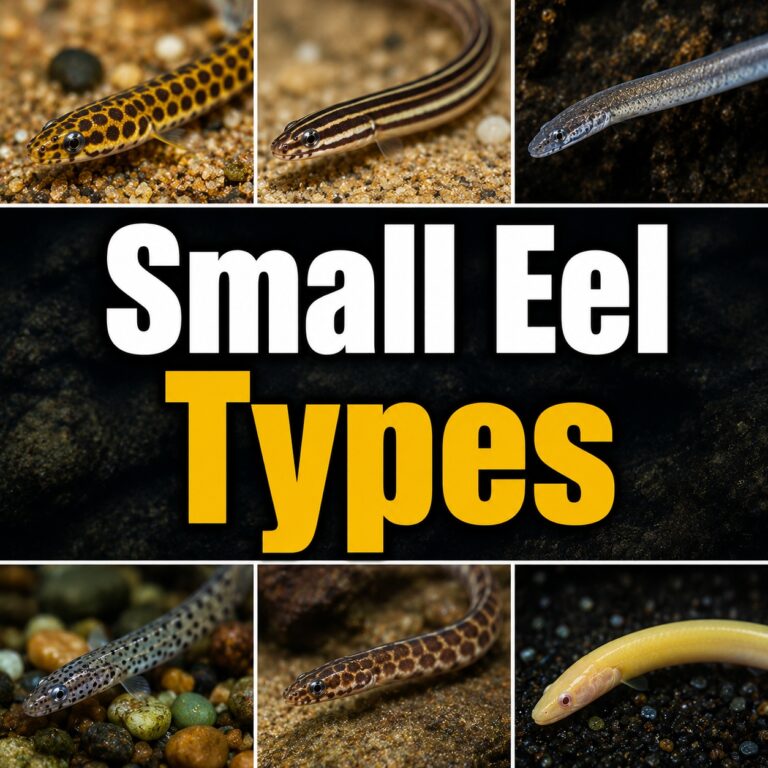
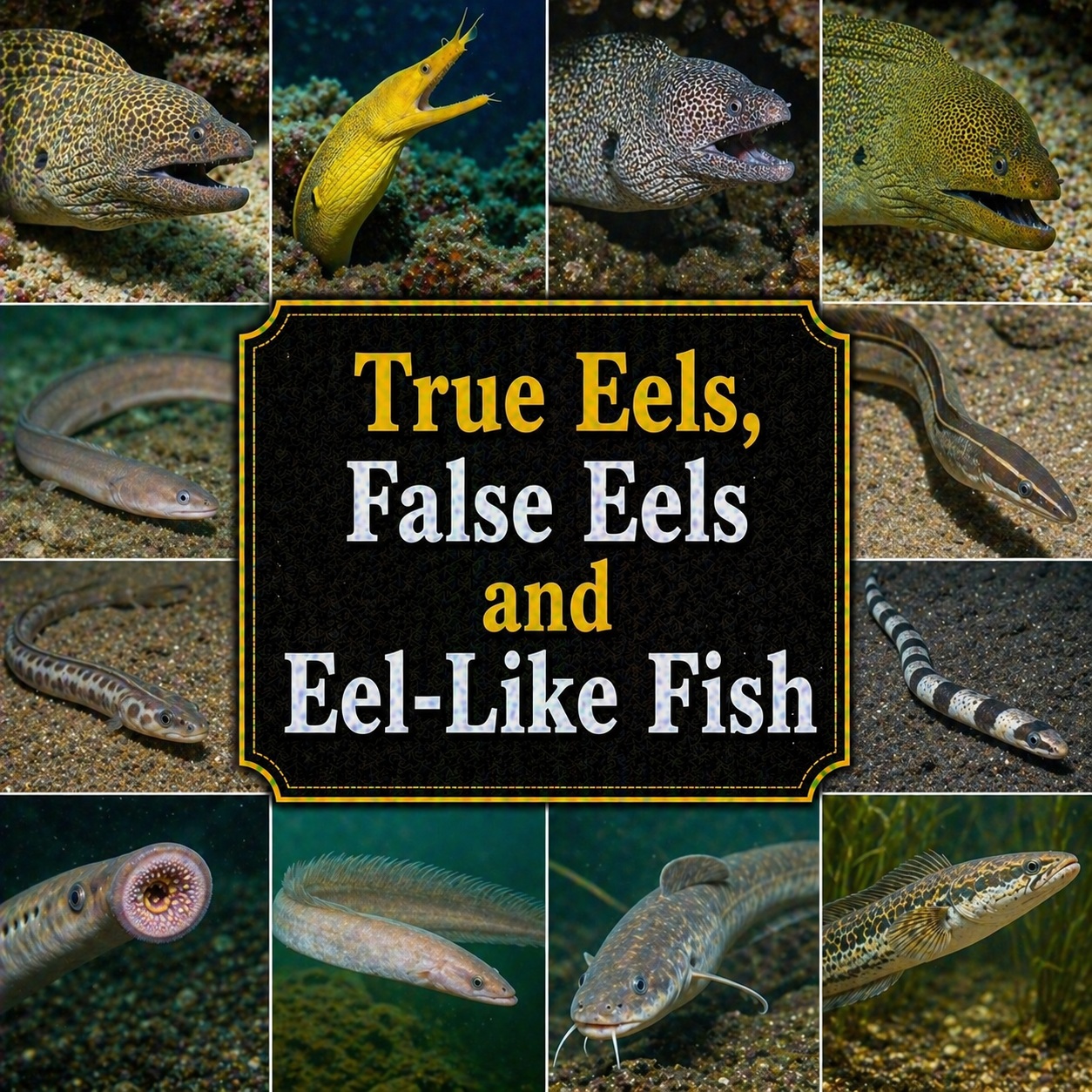
The underwater world is a masterclass in efficient engineering. One of its most successful “mechanical” designs is the long, slender, serpentine body. While most people see a snake-like creature in the water and immediately label it an “eel,” the biological truth is far more complex.
True eels belong to the order Anguilliformes, while “false eels” and “eel‑like fish” only resemble them in body shape but come from entirely different families. Understanding the differences helps avoid confusion, especially since many unrelated species are popularly called “eels.”
By the end, you will understand how to distinguish these aquatic architects by their fins, their skeletons, and their incredible survival strategies.
Defining the “True Eel”: The Order Anguilliformes
To qualify as a “true” eel, a fish must belong to the order Anguilliformes. This group contains over 1,000 species across 20 different families. While they vary in size and color, they all follow a specific anatomical blueprint that separates them from the rest of the fish world.
The Anatomical Blueprint
True eels have abandoned many traditional fish features to master the art of sliding through tight spaces.
- The Continuous Fin: In a true eel, the dorsal (top), caudal (tail), and anal (bottom) fins are fused into a single, unbroken ribbon. This creates a massive surface area for “undulatory” swimming, allowing them to move forward and backward with equal ease.
- The “Missing” Hardware: True eels lack pelvic fins entirely. Most species have also lost their pectoral fins (the “arms” behind the head), though some families like the Freshwater Eels (Anguillidae) still retain them.
- The Gill Slits: Instead of the large, flapping gill covers (operculum) seen on a bass or goldfish, true eels have small, narrow gill slits. This prevents sand and debris from entering their respiratory system when they burrow.
- Scalelessness: While some true eels have tiny, microscopic scales embedded in their skin, they appear completely smooth and “slimy” to the touch. This mucus layer is a vital mechanical defense, reducing friction and protecting against parasites.
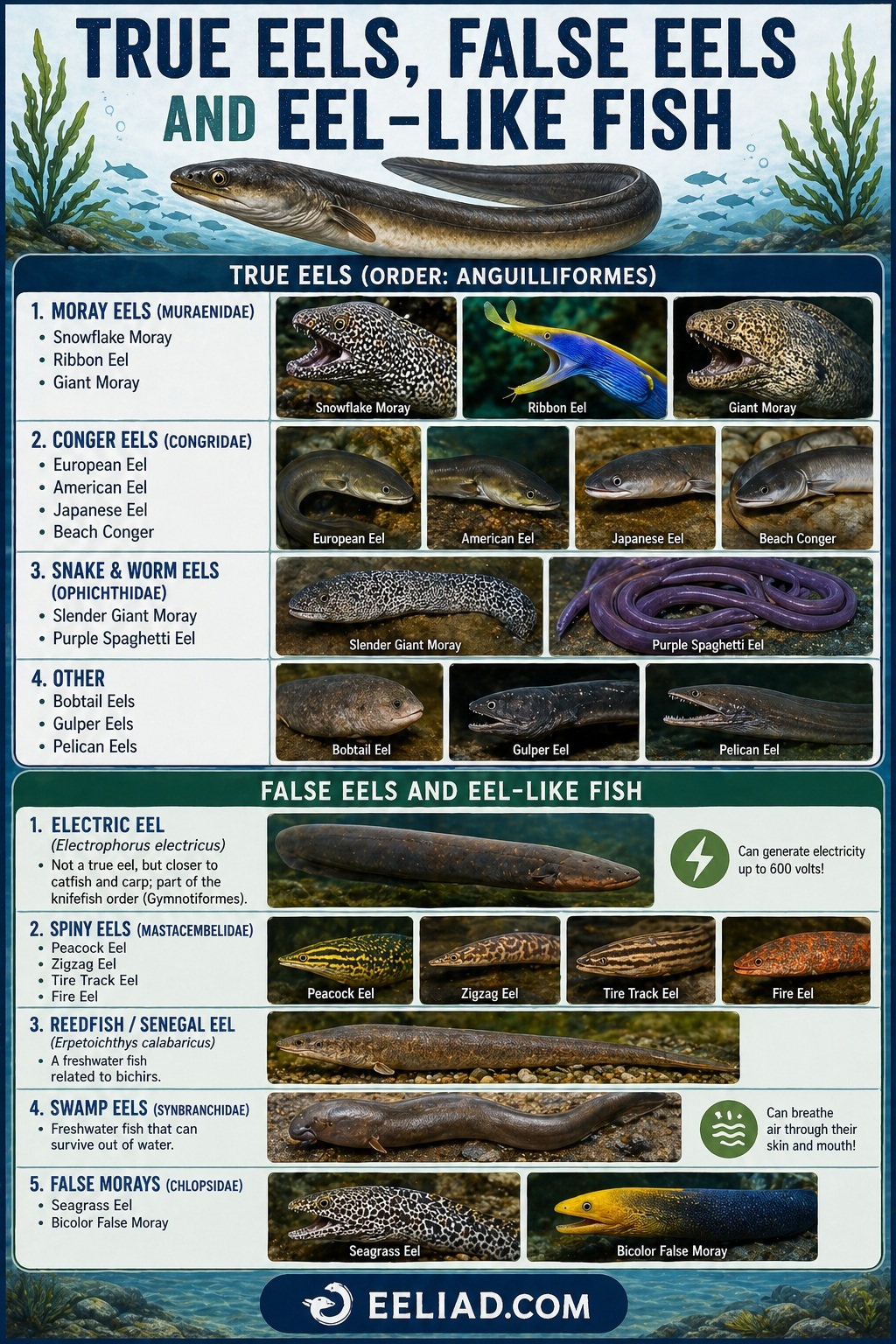
Famous Families of True Eels
- Moray Eels (Muraenidae): These are the most iconic marine eels. They lack pectoral fins and possess a secondary set of jaws in their throat—pharyngeal jaws—which they use to pull prey from their mouth down into their stomach.
- Conger Eels (Congridae): Often found in shipwrecks, these are large, powerful predators that can grow over 6 feet long. Unlike Morays, they usually possess pectoral fins.
- Garden Eels (Heterocongrinae): These shy eels live in colonies on the sandy sea floor. They spend their lives partially buried in holes, swaying in the current like blades of grass to catch passing plankton.
- Snake & Worm Eels (Ophichthidae): Slender Giant Moray, Purple Spaghetti Eel.
- Other: Bobtail Eels, Gulper Eels, Pelican Eels.
The Great Imposters: Defining “False Eels”
Many of the most famous creatures with “eel” in their name are not eels at all. These species have evolved a serpentine shape because it is an effective tool for their specific environment, but their internal “machinery” tells a different story.
- Electric Eel (Electrophorus electricus): Not a true eel, but closer to catfish and carp; part of the knifefish order (Gymnotiformes).
- Spiny Eels (Mastacembelidae): Peacock Eel, Zigzag Eel, Tire Track Eel, Fire Eel.
- Reedfish/Senegal Eel (Erpetoichthys calabaricus): A freshwater fish related to bichirs.
- Swamp Eels (Synbranchidae): Freshwater fish that can survive out of water.
- False Morays (Chlopsidae): Seagrass Eel, Bicolor False Moray
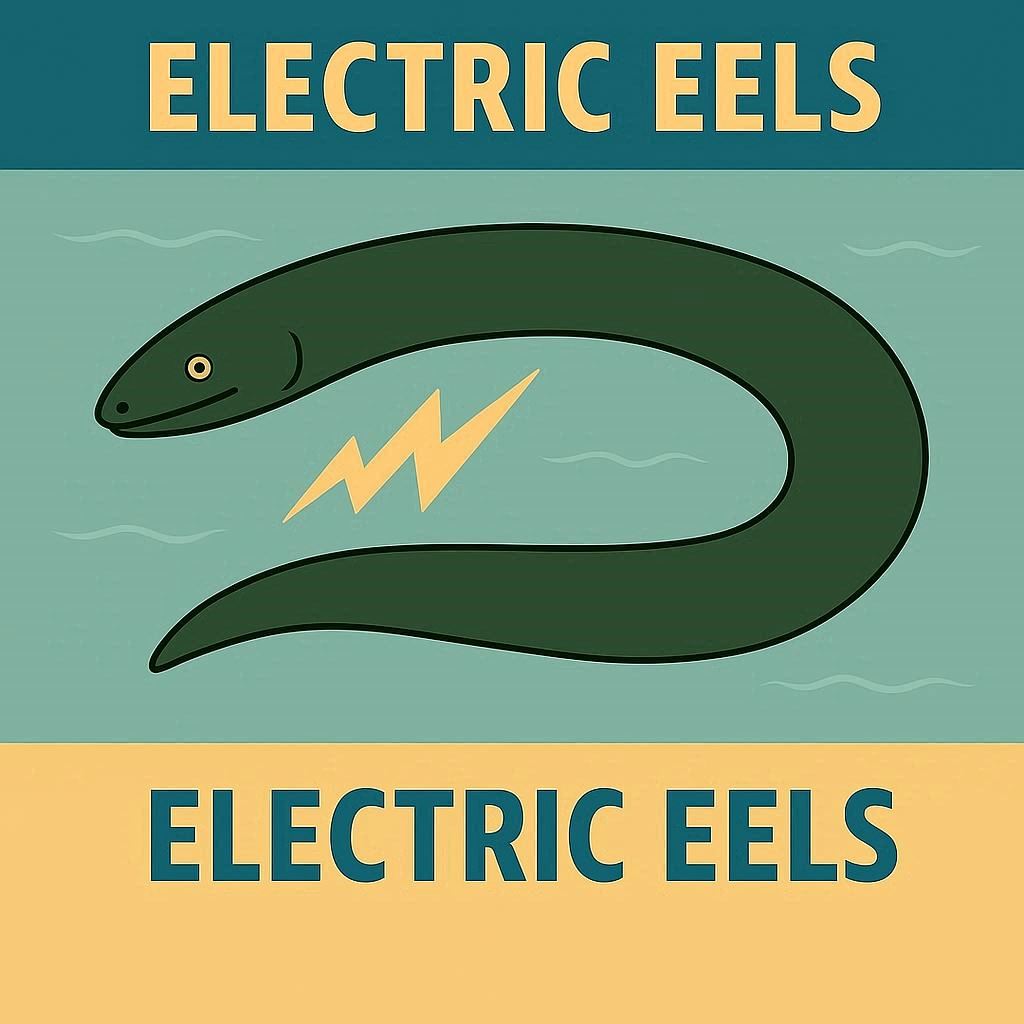
The Electric Eel (Electrophorus)
The Electric Eel is perhaps the most famous “fake” eel in history. Taxonomically, it is actually a type of knifefish, more closely related to catfish and carp than to a Moray.
- The Electric Hardware: About 80% of an Electric Eel’s body is dedicated to specialized cells called electroocytes. These act like tiny batteries, allowing the fish to discharge up to 860 volts.
- Respiratory Adaptation: Unlike true eels, the Electric Eel is an obligate air-breather. It lives in oxygen-poor Amazonian waters and must surface every few minutes to gulp air.
The Slime Eel (Hagfish)
Hagfish are often called “Slime Eels,” but they are actually jawless fish. They represent one of the most ancient lineages of vertebrates.
- The Slime Mechanism: When threatened, a Hagfish can produce liters of thick, fibrous mucus in seconds. This slime expands in the water, clogging the gills of any predator that tries to bite them.
Convergent Evolution: The “Eel-Like” Specialists
Nature frequently repeats successful designs. When unrelated species evolve similar traits, we call it convergent evolution. Several fish families have adopted the eel’s “hardware” to thrive in rocky “condos” or muddy riverbeds.

The Wolf Eel (Anarrhichthys ocellatus)
As we have explored, the Wolf Eel is actually a member of the wolffish family.
- Why it’s not an eel: It possesses large, functional pectoral fins and a massive, specialized skull with crushing molars.
- The Benthic Sinker: Because it lacks a swim bladder, the Wolf Eel is much heavier than a true eel and spends its life resting on the seafloor rather than swimming through the water column.
Spiny Eels (Mastacembelidae)
Common in the freshwater rivers of Africa and Asia, Spiny Eels look exactly like true eels until you look at their backs. They possess a row of small, sharp spines in front of their dorsal fin—a mechanical defense that true eels never evolved.
Habitat and Lifestyle: The Global Reach
True eels and their look-alikes are found in nearly every aquatic environment on Earth, from the crushing depths of the abyss to the smallest backyard ponds.
Marine Masters
Most true eels are marine. Morays and Congers act as the “policing force” of the coral reefs, keeping populations of crustaceans and smaller fish in balance. They are “crevice specialists,” using their thin bodies to hunt in holes where other predators cannot reach.
Catadromous Wonders: The Freshwater Eel
One of the most incredible migrations in the animal kingdom belongs to the American and European Eels.
- The Cycle: These eels live most of their lives in freshwater rivers and lakes.
- The Journey: Once they reach maturity, they undergo a physical transformation, turning “silver.” They then migrate thousands of miles to the Sargasso Sea in the Atlantic Ocean to spawn and die.
- The Larvae: Their babies, called Leptocephali, are transparent and leaf-shaped, drifting on ocean currents back to the rivers their parents once called home.
Comparative Analysis: How to Tell Them Apart
If you encounter a long, skinny fish, use this “Mechanical Checklist” to identify it:
| Feature | True Eel (Anguilliformes) | Electric Eel (Knifefish) | Wolf Eel (Wolffish) |
| Dorsal/Anal Fins | Fused with tail (continuous) | Long anal fin; small dorsal | Separate, distinct fins |
| Pelvic Fins | Completely Absent | Absent | Absent |
| Pectoral Fins | Often Absent | Present (small) | Present (large) |
| Gills | Small slits or holes | Traditional gill covers | Wide, open gill slits |
| Mouth | Wide; sometimes pharyngeal jaws | Small; electric sensors | Massive; crushing molars |
| Environment | Mostly Marine / Catadromous | Freshwater (Amazon) | North Pacific Benthos |
The Ecological “Architects”
Whether true or false, these creatures serve as vital “architects” of their ecosystems.
- Nutrient Cycling: By hunting in deep crevices, they move nutrients from hidden areas into the open water.
- Population Control: As apex predators of the reef and river, they prevent smaller species from overpopulating.
- Habitat Creators: Species like the Garden Eel create vast “forests” of burrows that aerate the sea floor and provide homes for smaller invertebrates.
Frequently Asked Questions (FAQ)
Are Moray Eels dangerous?
Moray Eels are generally not aggressive unless they feel threatened or mistake a human hand for food. However, because they have poor eyesight and rely on smell, they may bite if a diver places their hand too close to their den. Their “secondary jaws” make their bite particularly difficult to release.
Why is the Electric Eel not a true eel?
It lacks the fused fins and skeletal structure of the Anguilliformes. Genetically and anatomically, it is much closer to a catfish. It developed the “eel shape” independently because it is efficient for navigating the murky, root-filled waters of the Amazon.
Can eels live on land?
Some species, like the American Eel, can travel across damp grass or mud for short distances. They use their skin to “breathe” (cutaneous respiration), allowing them to move between ponds or bypass obstacles in a river.
What is the rarest eel?
The Chinese Long-Snout Eel and certain species of deep-sea Snipe Eels are rarely seen by humans due to their extreme habitats.
Why do eels have so much slime?
The mucus layer serves three mechanical purposes: it reduces drag while swimming, it makes them difficult for predators to grip, and it contains chemical defenses that protect against bacteria and salt stress.