Imagine you are traveling thousands of feet below the ocean surface. The sunlight fades to a dim blue, then to a haunting gray, and finally, everything turns pitch black. In this “Midnight Zone,” the pressure is high enough to crush a human, and food is almost impossible to find. Suddenly, out of the darkness, a bizarre creature appears. It looks like a long, thin piece of black ribbon with a head that is almost entirely made of mouth.
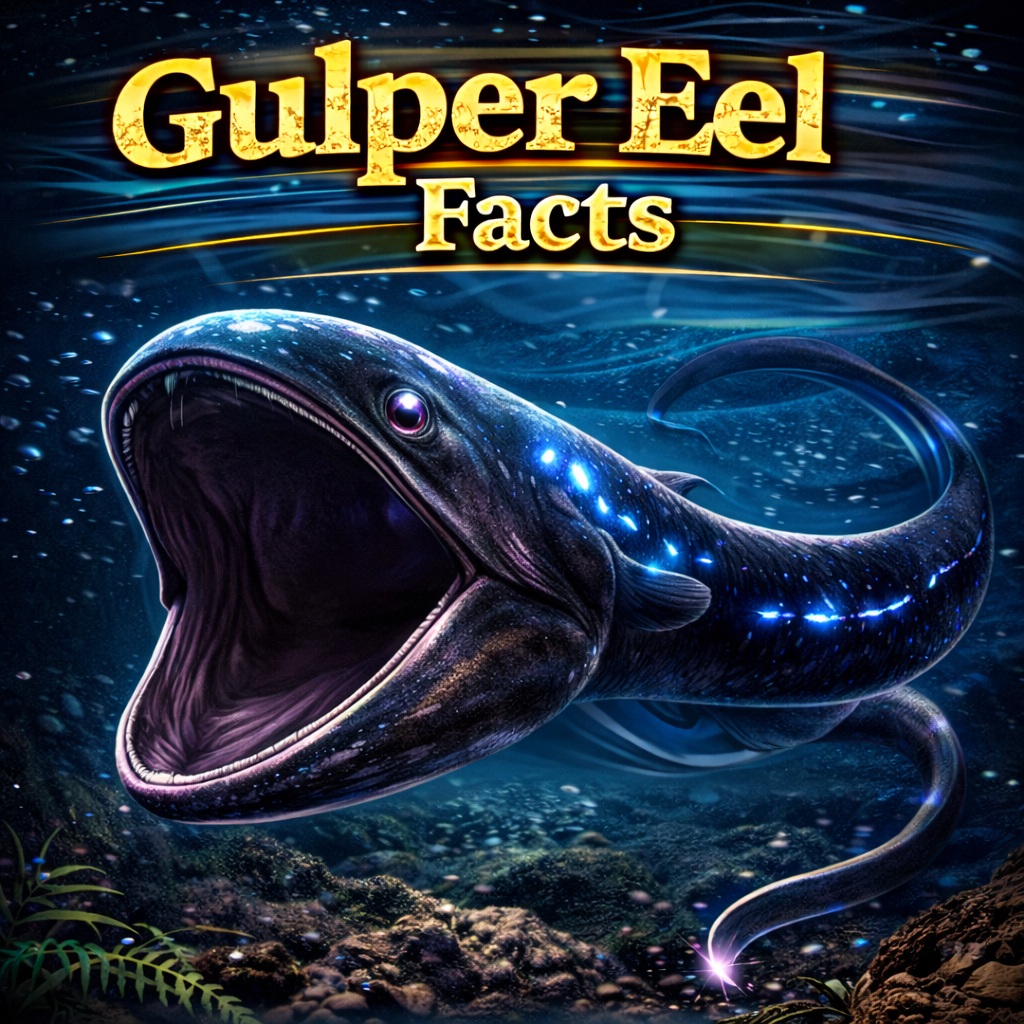
This is the Gulper Eel (Eurypharynx pelecanoides). Scientists often call it the “Pelican Eel” because of its massive, pouch-like jaw. It is one of the strangest animals on Earth. In this guide, we will explore the life, body, and secrets of this deep-sea marvel.
1. What Exactly is a Gulper Eel?
The Gulper Eel is a deep-sea fish. Even though we call it an “eel,” it is quite different from the eels you might see in a coral reef or a river. It belongs to the order Saccopharyngiforms. These are a group of fish specifically adapted for life in the deep trenches of the ocean.
You can find Gulper Eels in every ocean in the world, as long as the water is deep enough. They prefer tropical and temperate climates. Most of the time, they hang out at depths between 1,500 and 3,000 meters (roughly 5,000 to 10,000 feet).
The Ultimate “Mouth on a Stick”
If you looked at a Gulper Eel, you would notice one thing immediately: its jaw. The jaw is much longer than its actual skull. In fact, its mouth is so large that it can swallow animals much bigger than itself. However, just because it can eat big things doesn’t mean it always does.
2. Anatomy: Designed for the Abyss
Nature did not design the Gulper Eel for speed or beauty. It designed this fish for survival. Let’s break down the different parts of its body and see how they help it live in the dark.
The Massive Jaw
The jaw is the Gulper Eel’s most famous feature. It is loosely hinged, meaning the eel can “unhinge” its mouth to open it incredibly wide. This mouth works like a giant net. When the eel sees a group of small shrimp or fish, it opens its mouth and swims through them, scooping them up like a pelican.
The Expandable Stomach
Because the Gulper Eel lives in a place where food is scarce, it cannot afford to be picky. When it finds a meal, it needs to eat as much as possible. Its stomach is highly elastic. It can stretch out to hold a massive amount of food, allowing the eel to go weeks or even months between meals.
A Tiny Body
The rest of the eel is surprisingly small. While the mouth is huge, the body is thin and whip-like. Most Gulper Eels grow to about 0.6 to 1 meter (2 to 3 feet) in length. They do not have scales. Instead, they have a thin, black skin that helps them blend into the darkness of the deep sea.
The Glowing Tail (Bioluminescence)
At the very tip of its long, thin tail, the Gulper Eel has a special organ called a photophore. This organ produces a bright pink light. In the total darkness of the abyss, this light acts like a fishing lure. Small fish and crustaceans see the glowing light and swim toward it, thinking it is a small piece of food. Instead, they find themselves face-to-face with the eel’s giant mouth.
3. How the Gulper Eel Moves
In the deep sea, you don’t want to waste energy. The Gulper Eel is not a powerful swimmer. It doesn’t have the big, muscular fins that tuna or sharks have. Instead, it moves with a slow, wavy motion called anguilliform locomotion.
It spends much of its time drifting or hanging vertically in the water. It waits for prey to come to it. This “sit-and-wait” strategy saves precious calories. When the eel does decide to move quickly, it uses its long tail to push through the water, but it can only sustain this for a short time.
4. Sensory Mastery: Seeing Without Light
Since there is no sunlight where the Gulper Eel lives, eyes aren’t very useful. The Gulper Eel does have eyes, but they are very small. Scientists believe these eyes can only detect the faintest flashes of bioluminescence from other creatures.
So, how does it navigate? It uses a lateral line system.
- What it is: A series of tiny pores or sensors along the side of its body.
- How it works: These sensors detect changes in water pressure and vibrations.
If a shrimp swims nearby, the Gulper Eel “feels” the movement in the water long before it sees it. This allows the eel to strike accurately even in pitch-black conditions.
5. Diet: What Does a “Gulper” Actually Gulp?
For a long time, people thought the Gulper Eel used its giant mouth to eat massive fish. It makes sense, right? Big mouth, big meal. But when scientists actually looked at the stomachs of these eels, they found something surprising.
The Gulper Eel mostly eats small crustaceans, such as shrimp and copepods.
The “Net” Strategy
Instead of chasing down one big fish, the Gulper Eel uses its mouth like a trawl net. It opens wide and scoops up hundreds of tiny organisms at once. Think of it like a whale eating krill. This is much more efficient than trying to fight a large, struggling fish that might damage the eel’s delicate jaw.
Opportunistic Feeding
While it prefers small snacks, the Gulper Eel is an “opportunistic” feeder. This means if a larger fish happens to swim into its mouth, the eel will absolutely eat it. In the deep sea, you never turn down a meal.
6. The Mysterious Life Cycle
We know very little about how Gulper Eels grow up. Because they live so deep, it is hard for humans to watch them in the wild. However, we have found out a few interesting things about their “childhood.”
The Leptocephalus Stage
Like many other eels, the Gulper Eel starts its life as a tiny, transparent larva called a leptocephalus. At this stage, they look like thin, clear leaves drifting in the ocean currents. They live closer to the surface where there is more food. As they grow and change (metamorphose), they develop their giant mouths and start sinking down into the deep, dark layers of the ocean.
Growing Into the Jaw
Interestingly, the giant jaw doesn’t appear immediately. As the eel matures, its head structure changes dramatically. The bones in the face stretch out, and the stomach becomes more elastic.
Breeding and Death
Some scientists believe that Gulper Eels are semelparous. This means they live their whole lives, breed once, and then die. We have found adult Gulper Eels with highly developed reproductive organs but very small stomachs. This suggests that as they get ready to mate, they stop eating entirely and put all their energy into producing eggs or sperm.
7. Why Does the Gulper Eel Look So Weird?
Evolution usually follows the rule of “form follows function.” The Gulper Eel looks like a nightmare because its environment is a nightmare.
- Energy Conservation: Every part of the eel is designed to save energy. It doesn’t have heavy bones or thick muscles because those require too many calories to maintain.
- Maximum Opportunity: The giant mouth ensures that if anything passes by, the eel can catch it. In a place where you might go days without seeing another living thing, you can’t afford to miss a single chance to eat.
- Low Visibility: Its black color makes it invisible to predators from below, while the lack of a shiny silver belly (which many surface fish have) prevents it from being seen by predators from above.
8. Research: How Do We Study Them?
For hundreds of years, the only way we saw Gulper Eels was when they accidentally got caught in deep-sea fishing nets. Unfortunately, when you pull a deep-sea fish to the surface, the change in pressure usually kills it, and its delicate body often falls apart.
Today, we use ROVs (Remotely Operated Vehicles). These are underwater robots with high-definition cameras.
- In 2018, researchers with the E/V Nautilus captured famous footage of a juvenile Gulper Eel.
- The eel puffed up its head like a giant balloon to scare away the robot.
- This footage proved that the eel uses its mouth not just for eating, but as a defense mechanism to make itself look much bigger than it actually is.
9. Comparison: Gulper Eel vs. Common Eel
| Feature | Gulper Eel | Common Moray Eel |
| Habitat | Deep Sea (1,000m+) | Shallow Reefs |
| Mouth Size | Massive (1/4 of body) | Proportionate to head |
| Scales | None | None (thick mucus) |
| Speed | Slow / Drifting | Fast / Powerful |
| Lure | Bioluminescent tail tip | None |
14 Fun Facts About the Gulper Eel
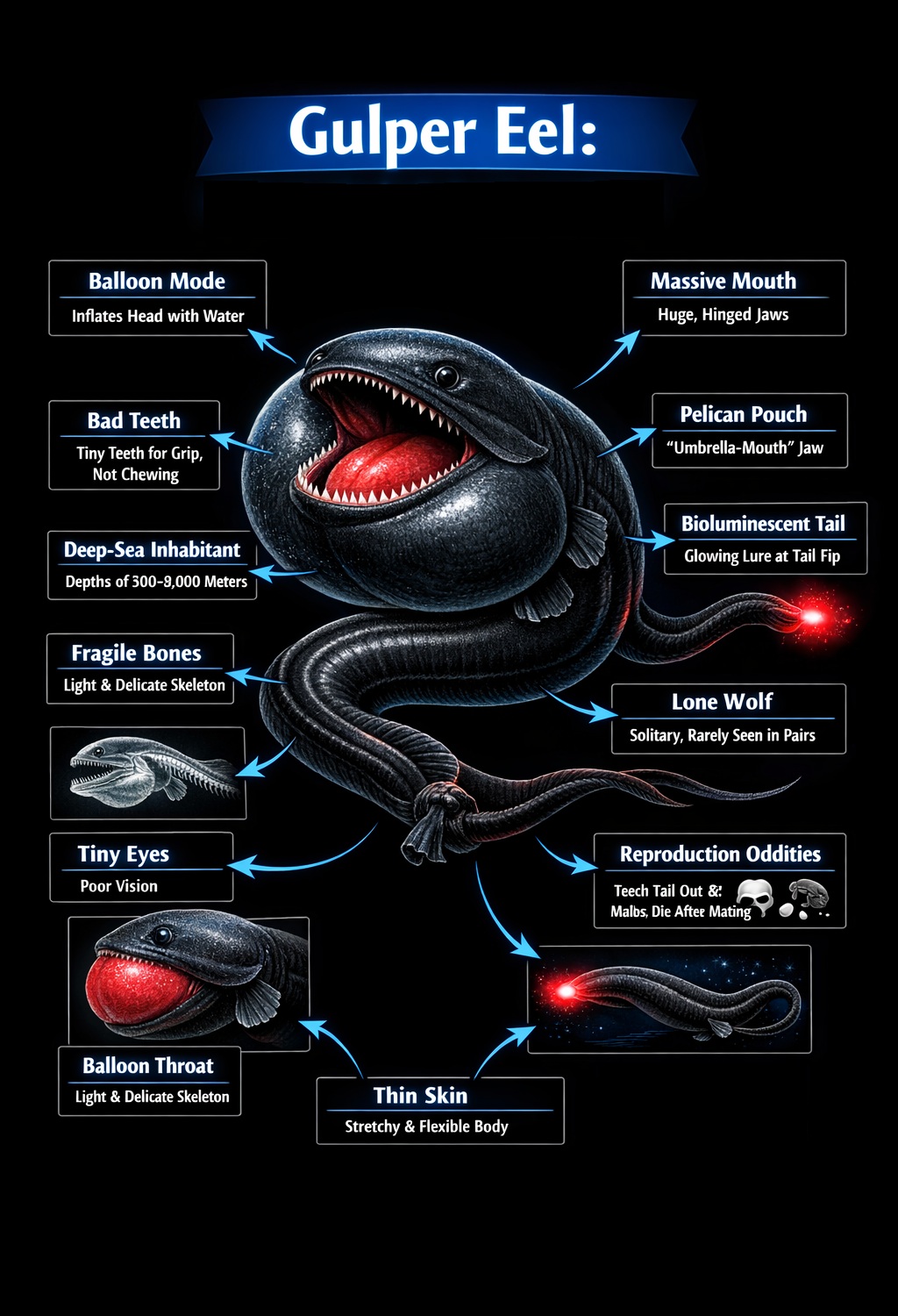
- Balloon Mode: When threatened, the Gulper Eel can swallow a large amount of water to inflate its head. This makes it look like a giant, intimidating sphere.
- Bad Teeth: Despite the huge mouth, the Gulper Eel has very tiny teeth. It doesn’t use them to chew; it uses them to grip prey so it doesn’t slide out of the mouth.
- Fragile Bones: Its bones are very light and contain very little calcium. This makes the eel flexible but also very delicate.
- Lone Wolf: Gulper Eels are solitary. You will almost never find two of them together unless they are mating.
- Massive Mouth: They have enormous, hinged jaws, allowing them to swallow prey much larger than themselves.
- Pelican Nickname: Their lower jaw is loosely hinged, forming a pouch similar to a pelican, often termed “umbrella-mouth”.
- Bioluminescent Tail: They possess a glowing organ at their tail tip (often pink or red) used as a lure to attract prey in the darkness.
- Deep-Sea Inhabitant: They live in tropical and temperate oceans at depths between 500 and 3,000 meters.
- Diet: Primarily, they eat small crustaceans, fish, and cephalopods, but can take larger prey if necessary.
- Unique Anatomy: Their skin is very thin and, along with the head, can inflate to store water and prey.
- Small Eyes: Like many deep-sea creatures, they have tiny eyes, as they rely on lures rather than sight.
- Size: They can grow up to 3 feet (meter) long, with the tail being thin and ribbon-like.
- Rare Sightings: Despite their wide range, they are rarely seen, with researchers having observed them only a few times in decades.
- Reproduction & Life Cycle: They use scent to find mates and likely die shortly after breeding, during which their teeth often fall out.
Frequently Asked Questions (FAQ)
Q: Is the Gulper Eel dangerous to humans?
A: No. Gulper Eels live miles below where humans swim. Even if you met one, they are small and fragile. Their teeth are not designed to bite large animals, and they would likely be more afraid of you than you are of them.
Q: Can a Gulper Eel live in an aquarium?
A: No. They require the extreme pressure and freezing temperatures of the deep ocean. If you brought one to the surface, the lack of pressure would cause its cells to fail, and it would die almost instantly.
Q: Why is the light on its tail pink?
A: Most bioluminescence in the ocean is blue or green because those colors travel furthest through water. However, some predators have evolved to see blue light easily. By having a reddish or pinkish light, the Gulper Eel might be using a color that some prey can see, but some of its own predators might overlook.
Q: How big can they get?
A: Most grow to around 3 feet. While there are stories of “giant” deep-sea eels, the Eurypharynx pelecanoides stays relatively small.
Q: Does it have a “stomach-mouth” connection?
A: Yes! Because the mouth is so big, the “throat” is essentially just a short tube leading to a massive, stretchy stomach.
Summary
The Gulper Eel is a reminder of how diverse life can be. It lives in a world that feels like another planet, using a glowing tail and a mouth the size of a bucket to survive. It isn’t a monster; it is a perfectly tuned survivor in one of the toughest neighborhoods on Earth.
The next time you look at the ocean, remember that far beneath the waves, a little black fish with a giant mouth is patiently waiting in the dark, glowing its pink tail, and hoping for a snack.
Would you like to learn more about other “monsters” of the deep, like the Anglerfish or the Giant Isopod?